
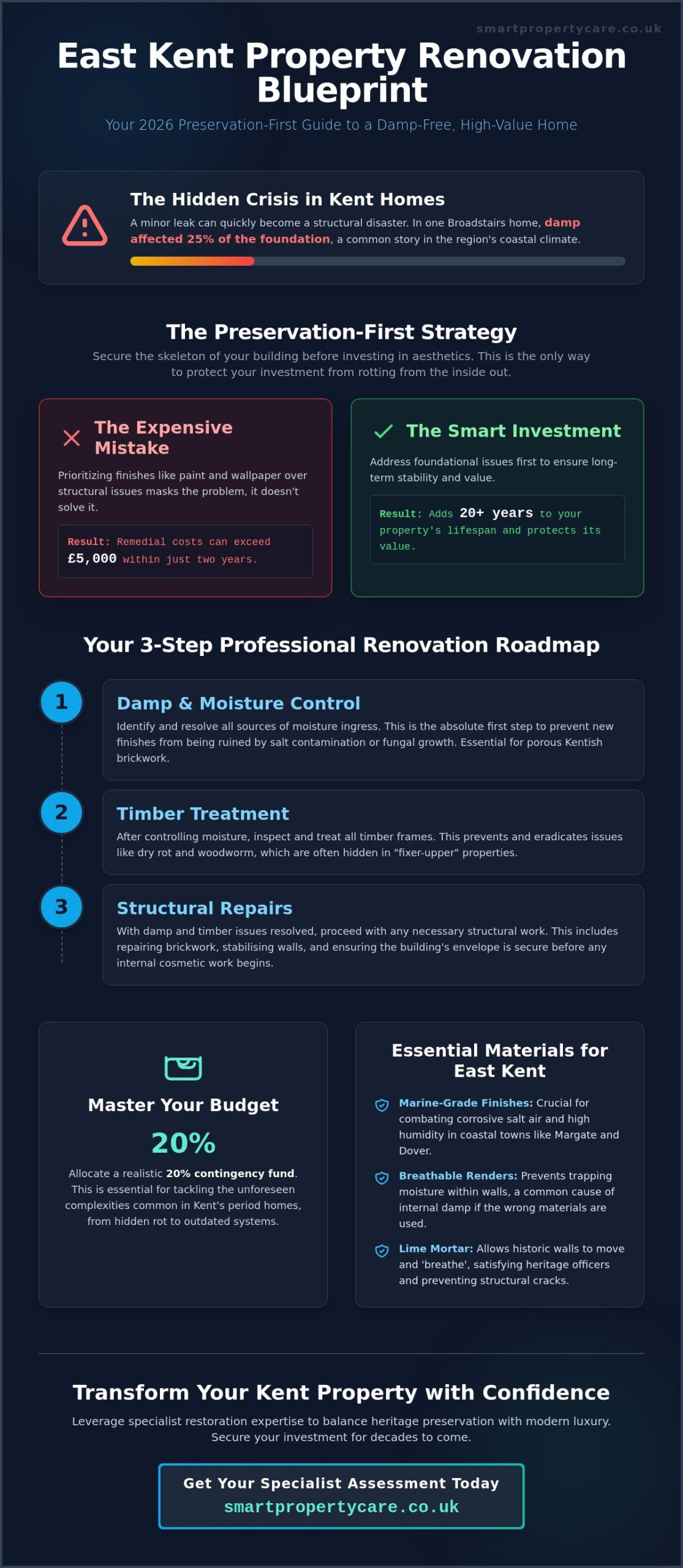
Last November, a homeowner in Broadstairs discovered that a minor leak had evolved into a structural crisis, with damp affecting 25% of the property’s foundation. It’s a common story in East Kent, where the coastal climate relentlessly tests the integrity of our historic architecture. Successfully managing a property renovation in this region requires more than just an eye for design; it demands a meticulous, preservation-first approach to protect your investment from the ground up.
You likely understand the stress of balancing modern comforts with the strict requirements of a Grade II listed building. We’ve designed this 2026 guide to give you total peace of mind, offering a clear roadmap to a damp-free, high-value home. We’ll cover everything from navigating local planning nuances to securing the bespoke craftsmanship your Kentish property deserves. By the end of this article, you’ll have the confidence to transform your space while ensuring its structural integrity remains uncompromised for decades to come.
Key Takeaways
- Understand why East Kent’s unique coastal environment demands specific material choices to combat salt air and high humidity.
- Adopt a preservation-first strategy to resolve structural moisture and timber issues before investing in any aesthetic finishes.
- Master your budget by allocating a realistic 20% contingency fund specifically tailored for the complexities of Kentish period homes.
- Follow a meticulous step-by-step roadmap for your property renovation that prioritizes securing the building envelope and external rendering.
- Learn how to leverage specialist restoration expertise to achieve a seamless balance between heritage preservation and modern luxury.
Planning a Property Renovation in East Kent: Unique Challenges and Opportunities
Successful property renovation in East Kent requires more than an eye for design. It demands a deep understanding of the county’s varied architectural heritage. You might be restoring a Victorian terrace in Herne Bay or stabilizing medieval timbers in Sandwich. Each project presents distinct structural requirements. In 2026, the priority for any savvy homeowner is the “bones” of the building. We focus on structural preservation before addressing cosmetic finishes. This strategy ensures your investment stands firm against the elements and maintains its value for decades.
The coastal factor is a primary concern for homeowners in Margate and Dover. Salt air and high humidity levels are relentless. These conditions accelerate the degradation of standard building materials, often leading to blown brickwork or corroded fixtures. We specify moisture-resistant solutions and marine-grade finishes to combat these local environmental pressures. Choosing the wrong external render can trap moisture, causing significant internal damp issues within just 18 to 24 months. Our meticulous selection of materials prevents these avoidable failures.
The East Kent Property Market in 2026
The 2026 market shows a 12% increase in “preservation-led” refurbishments across Faversham and Ramsgate. Buyers now prioritize original features over modern, characterless replacements. Common pitfalls in Kentish “fixer-uppers” include hidden rot in timber frames and outdated electrical systems that fail to meet current safety standards. We identify these risks early. A sympathetic approach to period properties preserves the building’s soul while integrating modern efficiency. This balance is the hallmark of a high-end property renovation.
Navigating Local Regulations and Consents
Working with Canterbury City Council or Thanet District Council requires precision and patience. Historic areas often mandate the use of traditional materials to protect the local character. We specialize in applying lime mortar and breathable renders that satisfy heritage officers. These materials allow old walls to move and breathe, preventing the structural cracks common in poorly executed modern repairs. Don’t commit to a purchase without involving a specialist surveyor. They provide the technical clarity needed to navigate conservation area constraints. We transform these complex regulatory hurdles into a seamless part of your project, delivering a result that is both compliant and beautiful.
- Expert assessment of medieval and Victorian structural frames.
- Marine-grade material specifications for coastal durability.
- Full management of heritage and conservation area applications.
- Detailed structural surveys to identify hidden “fixer-upper” costs.
Our goal is your absolute peace of mind. We deliver a polished, professional service that removes the stress from complex builds. By focusing on quality craftsmanship and local expertise, we ensure your Kent property remains a valuable asset for years to come.
The Preservation-First Strategy: Securing Your Property Foundation
A successful property renovation fails when the owner prioritizes aesthetics over structural integrity. The preservation-first strategy is a meticulous methodology that identifies and resolves moisture and timber issues before a single roll of wallpaper is bought. It’s about securing the skeleton of the building to ensure your investment doesn’t literally rot from the inside out. Painting over damp is the most expensive mistake a Kent renovator can make. It masks a symptom while the underlying cause erodes the brickwork, often leading to remedial costs exceeding £5,000 within just two years of completion.
Effective renovation follows a strict hierarchy. You must address damp proofing first, followed by timber treatment, and finally structural repairs. This logical flow prevents new finishes from being ruined by salt contamination or fungal growth. By committing to this professional order of operations, you add 20 years or more to a property’s lifespan. When structural repairs involve load-bearing walls or significant damp-proofing alterations, securing Building Regulations approval is a legal necessity that ensures your investment remains compliant and safe.
Tackling Damp and Moisture Ingress
Older Kentish brickwork is notoriously porous, especially in coastal areas like Herne Bay. You must distinguish between rising damp, which draws groundwater up through capillary action, and penetrating damp caused by blocked gutters or cracked pointing. Identifying the source requires technical precision. Booking a professional damp survey is the only way to get a data-driven map of your home’s moisture profile. Modern solutions now include breathable membranes and salt-neutralizing renders that respect traditional building techniques while providing a seamless, dry finish for your property renovation project.
Timber Preservation: Woodworm and Rot
Historic timbers in Sandwich and Canterbury are particularly susceptible to dry rot, a fungal infection that can travel through masonry to destroy entire floor spans. Any property over 50 years old should undergo a woodworm survey to check for active infestations of the Common Furniture Beetle. It’s vital to differentiate between wet rot, which stays confined to damp areas, and dry rot, which requires aggressive treatment. Our team provides a bespoke assessment to help you map out these critical first steps.
- Dry Rot: Spreads through walls; requires specialist chemical treatment.
- Wet Rot: Localized decay; usually solved by removing the moisture source.
- Woodworm: Identified by 1-2mm exit holes; requires deep-penetrating insecticidal spray.
Budgeting for Your Renovation: Calculating Costs and Specialist Services
Successful property renovation in Kent requires more than just an eye for design; it demands a rigorous financial strategy. For owners of period properties in East Kent, a 20% contingency fund isn’t a luxury, it’s a necessity. Older structures often hide decades of patchwork repairs that only reveal themselves once the first floorboard is lifted. By securing this buffer, you protect your project from stalling when unexpected structural issues arise.
Early investment in professional surveys yields the highest return on investment. Identifying dry rot or woodworm before the main works begin can save upwards of £5,000 in emergency remedial costs. For those working with listed buildings or coastal cottages, following expert guidance on historic homes ensures that your budget respects both your wallet and the building’s heritage. We often find that hidden costs in Kent renovations stem from structural chemical treatments and specialist rendering, which are frequently omitted from initial general builder quotes.
Specialist vs. General Contractors
While a general builder handles standard extensions, a damp specialist is essential for the remedial phase of any Kent property renovation. Standard gypsum plaster often fails in older properties due to hygroscopic salts. We use specialist salt-retardant plastering to ensure longevity. It’s a meticulous process that prevents decorative failure and keeps your walls breathable. Choosing a one-stop-shop for preservation and renovation provides a seamless transition from structural repair to aesthetic finish. It eliminates the blame game between different trades.
Understanding Specialist Reports
A comprehensive damp and timber report serves as a vital diagnostic tool. In Kent’s 2026 market, these technical documents are frequently used to negotiate property purchase prices down by significant amounts if defects are uncovered. Most mortgage lenders now insist on reports from certified dampness surveyors before releasing funds. This isn’t just red tape. It’s a safeguard for your investment. These reports provide the transparent pricing and technical certainty required to transform a high-risk site into a bespoke living space.
- 20% Contingency: Essential for East Kent’s flint and lime-mortar buildings.
- Pre-purchase Leverage: Use specialist reports to adjust your buying price.
- Certified Expertise: Only use surveyors recognized by major UK lenders.
- Long-term Value: Specialist plastering outlasts standard finishes by decades in damp-prone environments.
Your 2026 Property Renovation Roadmap: Step-by-Step
Executing a successful property renovation in Kent requires a disciplined, sequential approach. You cannot rush the aesthetic stage if the structural foundation remains compromised. By 2026, the standard for domestic refurbishment has evolved to prioritise thermal efficiency and long-term moisture management. Following a logical roadmap ensures your investment is protected from the ground up.
- Step 1: Comprehensive Survey. We begin with a structural and preservation audit to identify hidden defects like lateral damp or subsidence.
- Step 2: Securing the Envelope. We repair the roof, clear gutters, and fix external rendering to stop water ingress immediately.
- Step 3: Damp and Timber. This involves installing damp proof courses and treating floor joists against fungal decay or infestation.
- Step 4: First-Fix Services. Once the shell is dry, we execute structural alterations and install plumbing and electrical systems.
- Step 5: Finishing. We apply specialist plaster and breathable paints to create a flawless, durable interior.
Phase 1: The “Dirty” Work
The initial phase focuses on remediation. We strip back salt-contaminated plaster to the original masonry, removing years of accumulated hygroscopic salts that attract moisture. Our team installs modern chemical damp proof courses and treats infested floor joists using high-performance, low-odour preservatives. To combat the 11% of UK homes currently suffering from condensation issues, we integrate mechanical ventilation solutions like PIV systems. This ensures the building breathes while remaining energy efficient.
Phase 2: Restoration and Finishing
Coastal property renovation in areas like Margate or Ramsgate presents unique challenges. High salt-loading and wind-driven rain require specific external renders, such as silicone-based systems or traditional lime. We prioritise breathable finishes in period homes to prevent moisture entrapment, which often leads to structural decay. Before the first coat of paint is applied, we conduct final moisture inspections. This ensures the substrate is truly dry, preventing future blistering or peeling. We don’t consider a project finished until the environment is stable and the finish is meticulous.
Ready to restore your home with professional precision? Contact Smart Property Care today for a free, no-obligation survey and quote.
Bespoke Restoration: How Smart Property Care Transforms Kent Homes
Smart Property Care brings over 20 years of specialized experience to the Kent property market. We’ve spent two decades refining our approach to property preservation across Herne Bay and Canterbury, ensuring local heritage buildings remain structuraly sound. Our team operates as a family-run business, which means we prioritize reliability and personal accountability on every site. We combine this traditional ethos with modern technological damp-proofing solutions to provide a service that is both rooted in experience and driven by innovation. This dual approach ensures every property renovation we undertake meets 2026 building standards while respecting the original architectural integrity of the home.
We manage the entire lifecycle of a project. Our process begins with a comprehensive initial survey and extends through to final structural repairs. We don’t just fix surface issues; we address the root causes of decay. By integrating advanced moisture-tracking sensors with time-tested repair techniques, we offer a level of precision that general contractors often overlook. This meticulous methodology has made us a trusted partner for homeowners who require more than just a cosmetic refresh.
Our Specialist Plastering and Rendering Services
High-quality finishes are essential for long-term durability, especially in the challenging UK climate. Our internal plastering is engineered specifically for post-damp treatment scenarios. We use salt-retardant additives and breathable aggregates that prevent future salt migration, ensuring your interior walls remain pristine for years. For the exterior, we apply specialist rendering solutions designed to withstand the 50mph winds and salt-heavy air common along the Kent coast. Our craftsmen also focus on the finer details, including:
- Structural Carpentry: Expert repair and replacement of floor joists and roof timbers affected by rot.
- Weather-Resistant Finishes: External coatings that provide a thermal barrier while allowing the building to breathe.
- Meticulous Detailing: Precise restoration of period features, from decorative cornices to original timber frames.
Book Your Specialist Kent Renovation Survey
A successful project relies on a clear, data-driven roadmap. We provide a detailed, costed specification for every property renovation, ensuring you have a full understanding of the required investment before work begins. Our commitment to transparent pricing means there are no hidden costs or unexpected surprises during the build phase. We deliver high-end craftsmanship that adds tangible market value to your home while providing the emotional peace of mind that comes from a job well done. You can secure your property’s future today by requesting a professional assessment from our expert team. Contact Smart Property Care for your property renovation in Kent to discuss your specific requirements and book your specialist survey.
Secure Your Kent Property Investment for 2026 and Beyond
Transforming a Kent home requires more than a fresh coat of paint. It demands a meticulous preservation-first strategy that addresses structural integrity from the ground up. By following our 2026 roadmap, you’ve learned how to navigate East Kent’s unique architectural challenges while integrating bespoke restoration techniques. Successful property renovation hinges on balancing your aesthetic vision with technical precision. This ensures your home remains damp-free and structurally sound for decades. Professional planning and a clear understanding of specialist costs are the foundations of a seamless project.
Smart Property Care brings over 20 years of experience to every East Kent site. As a family-run business and certified damp and timber specialists, we provide the authoritative expertise required to protect your investment. We focus on delivering high-end craftsmanship that turns complex refurbishments into stress-free transformations. Our team is ready to help you achieve the perfect balance of heritage preservation and modern comfort.
Book Your Specialist Damp and Renovation Survey in Kent Today
Your property deserves the highest standard of care, and we’re here to help you start that journey with confidence.
Frequently Asked Questions
How much does a typical property renovation cost in Kent for 2026?
A typical full-scale property renovation in Kent for 2026 ranges between £1,500 and £3,000 per square metre depending on the finish quality. This estimate follows a 4% annual increase in material costs reported by the RICS Building Cost Information Service (BCIS). For a standard three-bedroom semi-detached home, expect total investment figures to start from £75,000 for structural and aesthetic updates.
Do I need a damp survey before starting a renovation in Canterbury?
Yes, securing a specialist damp survey is essential before starting any property renovation in Canterbury due to the high density of historic timber-framed and solid-brick buildings. Properties in the CT1 postcode often suffer from hygroscopic salt contamination. Our surveyors identify specific moisture ingress points, preventing expensive remedial work later. We provide a detailed report within 48 hours of inspection to keep your project timeline on track.
Can I renovate a Grade II listed building in Sandwich myself?
You can perform basic cosmetic updates, but structural or material changes to a Grade II listed building in Sandwich require Listed Building Consent from Dover District Council. Unauthorized work on protected structures is a criminal offense under the Planning (Listed Buildings and Conservation Areas) Act 1990. Professional contractors must use traditional materials like lime mortar or hair-chalk plaster to maintain the building’s historical integrity and breathability.
What is the best way to treat woodworm in an old Kentish home?
The most effective treatment for woodworm involves deep-penetrating insecticidal sprays or targeted timber injections using Permethrin-based solutions. In Kentish homes with heavy oak beams, we apply a dual-purpose preservative that eliminates Common Furniture Beetle larvae and prevents future infestations. We provide a 20-year guarantee on all timber treatments, ensuring your structural woodwork remains sound and protected against biological decay.
How long does a professional damp-proofing treatment take during a renovation?
A professional damp-proofing installation typically takes between 2 and 5 days for a standard ground-floor area. This timeframe includes the removal of contaminated plaster, the injection of a high-performance chemical damp proof course (DPC), and the application of specialist salt-neutralizing renders. Larger projects or those requiring tanking membranes may extend to 10 days to ensure every surface is meticulously prepared and sealed against moisture.
Why is specialist plastering necessary after treating rising damp?
Specialist plastering is vital because standard gypsum plaster absorbs hygroscopic salts that remain in the masonry even after a new damp course is installed. These salts attract moisture from the air, causing persistent damp patches and peeling paint. We use a bespoke salt-retardant render or a ventilated membrane system to create a dry, breathable surface. This meticulous approach ensures your final decorative finish stays flawless for years.
How do coastal conditions in Herne Bay affect external rendering?
Coastal conditions in Herne Bay subject external rendering to high salt spray and wind-driven rain, which causes standard sand and cement mixes to crack within 5 to 7 years. We recommend silicone-based monocouche renders or through-colour renders for seaside properties. These advanced materials offer superior flexibility and water repellency, protecting your home’s exterior from the aggressive maritime climate while reducing the need for frequent repainting.
Is a damp and timber report different from a standard homebuyer survey?
Yes, a specialist damp and timber report provides a more granular diagnostic analysis than a standard RICS Level 2 or Level 3 survey. While a homebuyer survey identifies visible issues, our report uses calibrated moisture meters and invasive testing where necessary to pinpoint the root cause of decay. We provide a fully costed remedial plan that serves as a reliable document for mortgage lenders and price negotiations.