
A single misdiagnosed patch of salt on your masonry can cost you £5,000 in unnecessary remedial work or see your 2026 mortgage application rejected instantly. You’ve likely felt the anxiety of spotting a dark stain in your Herne Bay or Canterbury home and wondered if you’re about to be misled by a contractor looking for a quick win. Securing a professional damp survey is the only way to bypass this confusion and obtain a definitive, honest diagnosis that protects your property’s long term value.
It’s a common frustration for Kent homeowners who value quality but fear the high price of guesswork. We’re here to offer a meticulous, evidence-based approach that separates expensive myths from practical, bespoke solutions. This guide ensures you understand the technical process of an inspection and how a certified report safeguards your home from rising damp, condensation, and timber decay. We’ll walk through the essential tools used by our expert craftsmen and provide a clear, costed roadmap to restore your peace of mind and your home’s structural integrity.
Key Takeaways
- Understand why East Kent’s coastal exposure requires a specialised approach to combat unique challenges like ‘salt damp’ and preserve your property’s structural integrity.
- Learn how a professional damp survey uses advanced thermal imaging and hygrometers to provide a meticulous, evidence-based diagnosis of hidden moisture issues.
- Discover the vital differences between rising damp and condensation to avoid the common pitfalls of misdiagnosis and ensure you only invest in the repairs you actually need.
- Follow our expert checklist to prepare your home for inspection, ensuring seamless access to critical areas like lofts and cellars for the most accurate results.
- Realise why specialist salt-retardant plastering is the definitive solution for preventing damp recurrence and restoring your interior to a high-end, durable finish.
What is a Damp Survey and Why is it Essential in East Kent?
A professional damp survey is a technical, forensic inspection designed to pinpoint the exact source of moisture ingress and assess the integrity of a building’s timber. In East Kent, where coastal exposure meets historic architecture, this process is vital. What is Structural Damp? is a complex question involving rising damp, penetrating damp, and condensation, all of which require a meticulous eye to diagnose correctly. A damp survey provides the clarity needed to protect your property from long term decay.
Properties in Herne Bay, Margate, and Ramsgate face unique environmental stressors. High salt content in the sea air can lead to ‘salt damp,’ where hygroscopic salts attract moisture directly from the atmosphere into the masonry. Our team brings 20 years of local experience to every inspection, ensuring we distinguish between minor condensation and the deep-seated structural issues common in Canterbury’s medieval and Georgian builds. We understand the specific construction methods used in Kent, allowing us to provide a bespoke assessment that a general surveyor might miss.
It’s a mistake to confuse a basic mortgage valuation with a specialist damp and timber report. A valuation is a brief overview for a lender’s security, often completed in under 20 minutes. A specialist survey is a deep dive into the property’s health. We use calibrated moisture meters and thermal imaging to create a transparent, evidence-based report. This document serves as a reliable roadmap for any necessary refurbishment, ensuring you don’t pay for repairs you don’t need. For a full breakdown of what these specialist assessments cover, our damp and timber report Kent guide explains exactly what our experts look for and how to interpret the findings.
When Should You Book a Specialist Survey?
You should act the moment you spot tide marks on ground floor walls, peeling wallpaper, or detect a persistent musty odour. These are often the first signs of a failing damp proof course. In the Kent property market, lenders frequently insist on PCA-standard reports before approving a mortgage, particularly for older stock. A damp survey is a forensic investigation of property health that identifies hidden moisture and structural decay before they become catastrophic.
The Risks of Ignoring Damp in Coastal Properties
Untreated rising damp in Victorian and Edwardian terraces can lead to devastating structural implications. When moisture levels in timber exceed 20%, the risk of dry rot increases significantly. In coastal towns like Faversham and Herne Bay, high relative humidity levels often hover above 75% during winter months, which accelerates mould growth and timber rot. This isn’t just an aesthetic issue; it’s a threat to the building’s skeleton.
Ignoring these issues doesn’t just damage the brickwork, it guts the property’s resale value. A house with unresolved damp issues can see a valuation drop of up to 10% in the current East Kent market. Professional intervention ensures the structural integrity of your home remains intact. Resolving these problems early ensures a seamless sale and total peace of mind for the homeowner.
The Process: What Happens During a Professional Damp Inspection?
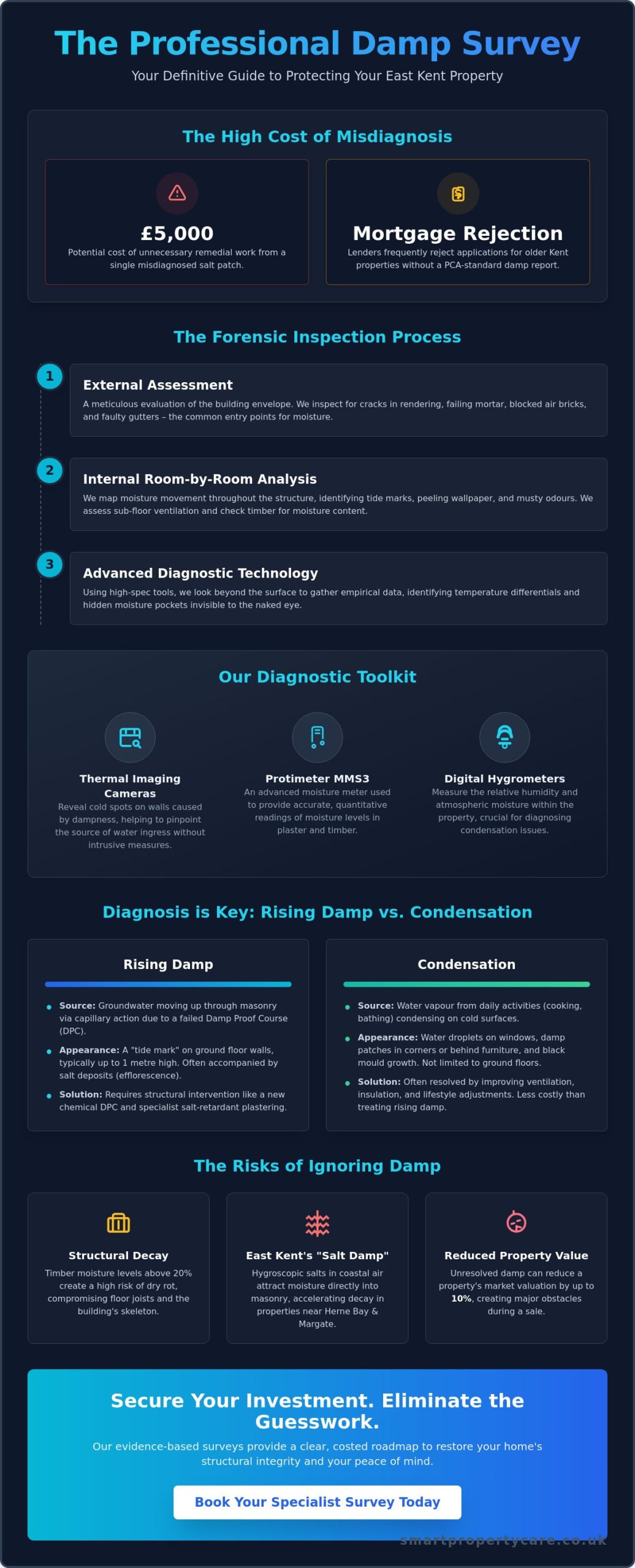
A Smart Property Care damp survey is a forensic investigation into your building’s health. We don’t just look for dark patches on walls; we follow a rigorous protocol to map moisture movement throughout the structure. Our surveyors arrive equipped with high-specification diagnostic technology, including the Protimeter MMS3, digital hygrometers, and thermal imaging cameras. These tools allow us to see beyond the surface, identifying temperature differentials and hidden moisture pockets that the naked eye cannot detect.
The inspection begins with an external sweep of the property. We evaluate the building envelope, looking for cracks in rendering or failing mortar joints. We then transition inside to perform a room-by-room analysis. By the time we finish, we have a comprehensive data set that distinguishes between rising damp, penetrating damp, and condensation. This meticulous approach ensures that we provide a definitive diagnosis rather than a guess.
Internal vs. External Assessment
Our team pays close attention to the relationship between your home’s exterior and its internal condition. In older Canterbury properties, we frequently discover that original sub-floor ventilation has been compromised. Air bricks, designed to keep timber floor joists dry, are often blocked by debris or modern landscaping. We examine gutters and downpipes for signs of leakage, as even a small overflow can saturate masonry during a heavy East Kent downpour.
Inside, we test the plaster for hygroscopic salt contamination. These salts are often left behind when moisture evaporates, and they continue to pull water from the air even after a leak is fixed. Understanding this chemical balance is vital for a successful repair. If you suspect your home is suffering from these complex issues, you can request a professional assessment to get a clear picture of your property’s status.
Non-Invasive vs. Invasive Testing
We prioritise non-invasive methods to protect your decor. Surface meters provide instant moisture readings across walls and floors without leaving a mark. However, when readings are inconclusive, we may suggest invasive testing. This involves using deep-wall probes to measure the moisture content within the core of the masonry. This is particularly useful for identifying ‘bridged’ damp proof courses (DPC). This occurs when external ground levels, such as a new patio or raised garden bed, are built higher than the original DPC, allowing water to bypass the barrier.
A true specialist looks for the why, not just the where. We don’t stop at finding a wet patch; we trace the moisture back to its origin. Whether it’s a 150mm breach in the ground level or a microscopic crack in a chimney stack, we identify the root cause to prevent the problem from returning. This level of detail is what separates a professional damp survey from a quick visual check.
Rising Damp vs. Condensation: Understanding Your Survey Results
Your technical report provides a meticulous breakdown of moisture levels, but interpreting these findings requires an expert eye. A professional damp survey distinguishes between three primary culprits: rising damp, penetrating damp, and condensation. Misdiagnosis is a frequent issue in the industry. Data from independent property inspections suggests that approximately 75% of dampness reported in older East Kent homes is actually caused by condensation or simple maintenance failures rather than structural rising damp. Identifying the root cause ensures you don’t spend thousands on unnecessary treatments.
Red flags in your report often involve moisture meter readings. High readings concentrated at the base of a wall, typically tapering off at a height of 1 metre, often point to ground moisture. If readings are high across the entire wall surface, atmospheric moisture is the likely culprit. Ignoring these signals leads to secondary damage. Excess moisture provides the perfect environment for timber infestations. Wood-rotting fungi like dry rot or wood-boring beetles, such as Anobium punctatum (woodworm), thrive when timber moisture content exceeds 20%. Our surveyors look for these biological markers to provide a comprehensive health check for your property. If an active infestation is identified, a prompt woodworm treatment programme is essential to prevent further structural deterioration.
Rising Damp and the DPC Trap
Rising damp occurs when ground water climbs through porous masonry via capillary action. This is particularly common in traditional Kentish brickwork found in Herne Bay and Canterbury. Many ‘cowboy’ firms quickly recommend expensive chemical injections, but a failing Damp Proof Course (DPC) isn’t always the reason. Blocked sub-floor vents or high external ground levels often bridge the existing DPC. We focus on these practical fixes first. If a structural failure is confirmed, we provide a bespoke damp proofing Kent solution that restores your home’s integrity without unnecessary disruption.
Condensation and Mould: The Modern Kent Problem
Modern home improvements often create unintended consequences in Dover and Sandwich properties. Installing high-spec uPVC windows without adequate trickle vents traps moist air inside. This leads to black mould growth on cold spots like external corners or behind wardrobes. It’s a lifestyle and ventilation issue rather than a structural defect. We assess your home’s thermal performance and airflow to provide a permanent fix. If your damp survey identifies significant fungal growth, our expert mould remediation services will safely remove spores and improve your indoor air quality for long-term peace of mind.
Preparing for Your Survey in Herne Bay, Canterbury, or Dover
A meticulous damp survey requires more than just a surveyor showing up with a meter. You play a vital role in ensuring we get the most accurate data possible. Start by gathering your property’s history. Locate any guarantees for a previously installed Damp Proof Course (DPC) or invoices for roof repairs from the last 15 years. In historic hubs like Canterbury or Faversham, check if your property is Grade II listed or sits within a conservation area. These designations influence the remedial methods we can recommend. We always ensure our solutions respect the heritage requirements of East Kent’s unique architecture while providing a permanent fix. For homeowners planning broader works alongside their survey, our guide to property renovation in Kent provides a comprehensive roadmap to balancing structural preservation with aesthetic restoration in 2026.
Access and Visual Obstructions
We need a clear line of sight to provide a definitive diagnosis. Clear away heavy furniture from external walls where you’ve spotted salt staining or peeling paint. Access to the cellar and loft space is non-negotiable. We often find that hidden moisture in these voids leads to structural decay long before it’s visible in the living areas. For properties with suspended timber floors, we must inspect the sub-floor area. This is essential for identifying early signs of woodworm or rot that could compromise your home’s integrity. Ensure the external perimeter is free of debris or stored firewood so we can check the ground levels against your DPC. If we can’t see the wall, we can’t guarantee the result.
Questions to Ask Your Surveyor
Don’t hesitate to vet your specialist before the inspection begins. A professional surveyor welcomes your questions because they demonstrate you value quality. Use this checklist to ensure you’re hiring the right expert for your 2026 property maintenance:
- Is the surveyor PCA (Property Care Association) trained? This ensures they follow the UK’s highest industry standards and stay updated on the latest building science.
- Will the report include a costed specification? You need a clear financial roadmap for any remedial works, not just a vague list of problems.
- Does the survey cover both dampness and timber decay? These issues often go hand-in-hand in East Kent’s older building stock, and missing one could lead to expensive repairs later.
Preparation transforms a standard inspection into a comprehensive health check for your home. By clearing the way and providing property records, you help us deliver the precision your investment deserves. If you’re ready to protect your property with a professional damp survey, contact our expert team today for a no-obligation quote.
From Survey to Solution: Specialist Plastering and Remediation
Identifying the root cause through a professional damp survey represents only the first phase of property recovery. True remediation demands a seamless transition from diagnostic data to technical execution. Many homeowners make the mistake of hiring general builders to patch up damp damage, yet 2025 industry data suggests that 35% of damp repairs fail within two years when standard materials are used. Smart Property Care eliminates this risk by providing a comprehensive one-stop service, taking your project from the initial diagnosis through to the final bespoke decoration.
Our approach ensures that every structural intervention aligns with the surveyor’s findings. Whether we’re addressing rising damp in a Canterbury terrace or penetrating damp in a coastal Margate villa, the remediation must be meticulous. We don’t just hide the stains; we transform the environment. This integrated process provides the peace of mind that comes from knowing a single, expert entity is responsible for the health of your home. If your survey results indicate that wider works are needed, our expertise extends to full property renovation in Kent, ensuring structural preservation and aesthetic restoration are handled together under one trusted team.
Specialist Plastering: The Invisible Barrier
Standard gypsum plaster acts like a sponge. When applied over walls previously affected by moisture, it quickly absorbs hygroscopic salts left behind in the brickwork. These salts attract atmospheric moisture, leading to “salt damp” even after a new damp proof course is installed. Our specialist dampness surveyors specify salt-retardant rendering systems as a mandatory second line of defense. This technical plastering manages salt migration and creates a breathable yet resilient finish. It’s a bespoke solution that ensures your interior walls remain dry, crisp, and ready for high-end decoration.
For exposed coastal properties in Ramsgate and Margate, external protection is equally vital. The 2026 weather patterns have shown an increase in driving rain intensity along the Kent coast. We apply high-performance, breathable external renders and water-repellent treatments that allow moisture to escape while preventing sea spray from entering the substrate. This dual-action protection is essential for maintaining the structural integrity of period seaside homes.
Long-Term Protection and Guarantees
Quality remediation is an investment in your property’s future value. Every structural repair we undertake is backed by robust, insurance-backed guarantees. This certification is a vital trust signal for future buyers and provides immediate reassurance for current residents. Beyond the work itself, we provide homeowners with a clear maintenance roadmap. Simple actions can preserve your results for decades:
- Annual Gutter Audits: Ensure rainwater is directed away from the masonry.
- Ventilation Management: Use humidistat-controlled fans to maintain 40 to 60 percent relative humidity.
- External Ground Levels: Keep soil and patios at least 150mm below the damp proof course.
Don’t leave your home’s health to chance. A meticulous damp survey is the only way to secure a dry, healthy living space. Contact Smart Property Care today to book your expert assessment and take the first step toward a permanent solution.
Secure Your Kent Property for 2026 and Beyond
Protecting your home from moisture requires more than a temporary fix; it demands a precise diagnosis. Whether you’re navigating a property purchase in Canterbury or managing a period home in Herne Bay, identifying the specific cause of moisture is vital. Our team brings over 20 years of local Kent expertise to every inspection, ensuring you receive a comprehensive damp survey that satisfies mortgage lenders and provides total peace of mind. As a family-run business, we pride ourselves on meticulous attention to detail, moving beyond the surface to deliver lasting remediation. We handle everything from initial detection to specialist plastering, transforming damp, cold spaces into healthy, resilient environments. Don’t let untreated issues devalue your investment or compromise your comfort. You deserve a dry, healthy home that stands the test of time. Take the first step toward a safer property with a partner who understands the unique coastal and rural challenges across East Kent.
Book Your Specialist Damp Survey in Kent Today
We’re ready to restore your property’s integrity and give you the confidence you need for the years ahead.
Frequently Asked Questions
How much does a damp survey cost in Kent in 2026?
A professional damp survey in Kent typically costs between £250 and £500 for a standard three-bedroom semi-detached property in 2026. Prices fluctuate based on the building’s total square footage and the complexity of the inspection required. Larger period properties in historic Canterbury often command fees closer to £650 because of their intricate construction. You’ll receive a detailed report and a bespoke remediation plan tailored to your specific property needs.
Is a damp survey different from a standard homebuyer’s report?
Yes, a damp survey is a specialist inspection that goes far beyond the visual checks included in a standard Level 2 or Level 3 Homebuyer’s Report. While a general surveyor might identify a risk of damp using a basic moisture meter, our specialist technicians use thermal imaging and hygrometers to pinpoint the exact source. This meticulous approach ensures you don’t face unexpected repair costs after completing your purchase.
How long does a professional damp inspection take?
A comprehensive professional damp inspection usually takes between 1.5 and 3 hours to complete. For a standard terraced home in Herne Bay, our experts typically spend 90 minutes on-site conducting thorough moisture mapping. Larger commercial units or older Kentish farmhouses require up to 4 hours of detailed analysis. We ensure every wall and sub-floor void is checked to provide a seamless diagnostic experience for every client.
Do I need a damp survey if I’m buying a house in Canterbury?
You should definitely commission a damp survey when purchasing in Canterbury, particularly as 35% of the city’s housing stock consists of older, solid-wall constructions. These historic buildings are prone to moisture ingress and timber decay if not managed correctly. Securing an expert assessment protects your investment and provides the necessary evidence to negotiate property prices if significant issues are uncovered during the pre-purchase phase. A comprehensive damp and timber report is particularly valuable at this stage, providing the technical clarity needed to satisfy mortgage lenders and obtain accurate costings for any remedial works.
Can a damp survey detect hidden woodworm or dry rot?
Yes, our specialist surveys are designed to identify active woodworm infestations and the early stages of dry rot. These issues often coexist with high moisture levels, so we inspect floor joists and roof timbers as a priority. Identifying these problems early prevents structural failure. We provide a certified report that details the extent of any timber damage alongside our recommended woodworm treatment protocols to restore your property’s health.
What happens if my damp survey reveals serious rising damp?
If serious rising damp is identified, we provide a transparent, fixed-price quotation for a bespoke chemical DPC injection or membrane system. Our team handles the entire refurbishment process, from removing contaminated plaster to the final specialist re-rendering. You’ll receive a long-term guarantee, ensuring your home remains dry and healthy. This structured approach removes the stress of dealing with multiple contractors for a single repair.
Will a damp survey help me get a mortgage on a Kent property?
A professional damp survey is often a mandatory requirement from UK mortgage lenders if their initial valuation flags high moisture readings. Providing a certified report from a qualified specialist demonstrates that the property is a sound investment. It gives lenders the confidence to proceed with your application. Our reports are recognized by major banks and building societies across the South East, facilitating a smoother transaction.
Are ‘free’ damp surveys actually reliable?
Free damp surveys are often provided by sales-driven companies and may lack the impartiality of a paid, independent assessment. These visits frequently result in recommendations for unnecessary and expensive treatments to cover the company’s lead-generation costs. Investing in a professional, fee-based survey ensures you receive unbiased advice focused solely on the structural integrity of your home. It’s the most reliable way to achieve genuine peace of mind.