
Last Tuesday, a homeowner in Herne Bay discovered a fine dusting of powder beneath their Victorian floorboards, triggering an immediate fear of structural collapse and a potential mortgage rejection. It’s a common story across Kent, where the sight of tiny exit holes can stall a property sale or lead to weeks of unnecessary stress. You likely already know that ignoring these signs isn’t an option, but you’re also rightly concerned about the difference between a dormant, historic issue and an active infestation. A professional woodworm survey is the only way to gain absolute clarity and protect your investment from the inside out.
We agree that your home should be a place of security, not a source of structural anxiety. In this guide, you’ll discover exactly what happens when a specialist inspects your timber, ensuring you receive a definitive answer on infestation activity rather than expensive guesswork. We’ll outline how a certified report satisfies lenders and provides a transparent roadmap for any required repairs. From identifying the specific beetle species to providing a clear, honest cost for treatment, you’re about to learn how to safeguard your property with the precision it deserves.
Key Takeaways
- Understand why a specialist woodworm survey is a vital, non-destructive inspection that identifies structural risks hidden deep beneath the surface of your timber.
- Learn how to distinguish between active and historic infestations using the “Frass Test” to ensure you only invest in necessary remedial treatments.
- Discover our meticulous step-by-step inspection process for Kent homes, which connects external damp entry points to internal timber health.
- Gain clarity on reading professional timber reports, including bespoke repair maps and transparent cost calculations tailored to your property.
- Leverage 20 years of PCA-trained expertise in Herne Bay and Canterbury for the authoritative peace of mind that comes with high-end craftsmanship.
Understanding the Woodworm Survey: More Than Just Holes in Timber
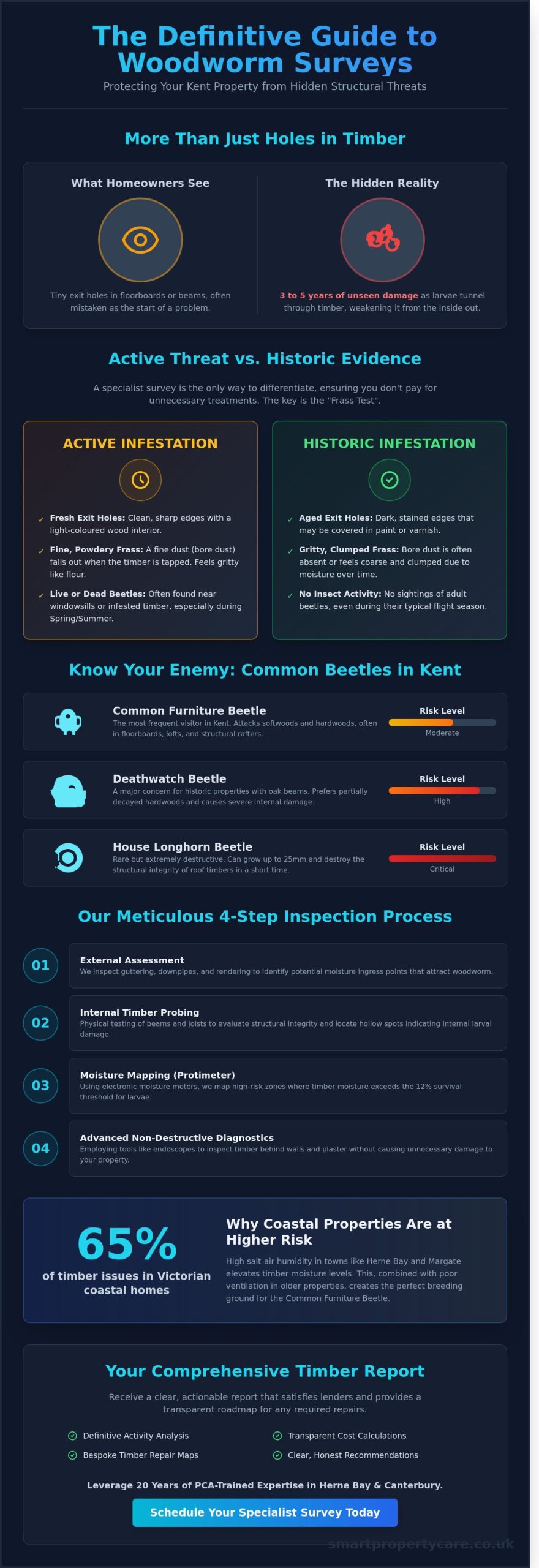
A woodworm survey is a forensic analysis of timber health and moisture levels. While many homeowners assume that small holes in a floorboard or joist are the start of a problem, these marks are actually the exit points where adult beetles have already departed. The real damage occurs out of sight, often over a period of three to five years, as larvae tunnel through the wood. A professional woodworm survey is a non-destructive structural timber inspection that identifies whether an infestation is historic or currently active and threatening the integrity of your home.
For homeowners, Understanding Woodworm and its lifecycle is vital for effective property maintenance. Standard RICS homebuyer surveys often highlight the presence of flight holes but lack the technical depth of a specialist timber report. Our specialists use precision moisture meters because beetle larvae require specific conditions to thrive. If timber moisture content remains below 12%, most species cannot survive. However, in the humid environments of East Kent, these levels often climb much higher, creating a perfect habitat for wood-boring insects.
The Different Types of Wood-Boring Beetles in Kent
- Common Furniture Beetle: This is the most frequent visitor we encounter in Herne Bay lofts. It attacks softwoods and European hardwoods, often found in floorboards and structural rafters.
- Deathwatch Beetle: This species is a specific concern for historic Canterbury properties featuring heavy oak beams. It prefers partially decayed hardwoods and can cause significant internal structural damage while leaving few external clues.
- House Longhorn Beetle: Although rare, this is a high-risk threat. It can grow up to 25mm long and is capable of destroying the structural capacity of a roof timber in a very short timeframe.
Why Coastal Properties in Herne Bay and Margate are at Risk
Coastal properties face unique environmental pressures that increase the necessity of a woodworm survey. High salt-air humidity in towns like Herne Bay and Margate naturally elevates the moisture content of internal timbers. Sea-spray penetration through porous brickwork or ageing roof tiles provides the damp conditions that wood-boring beetles crave.
In our recent inspections of Victorian seaside terraces built between 1880 and 1900, we frequently find that 65% of timber issues stem from poor ventilation combined with coastal damp. These properties often feature original Baltic pine joists which, when exposed to the humid Kent climate, become highly susceptible to the Common Furniture Beetle. Identifying these patterns early ensures that we can implement targeted, breathable treatments that preserve the character and safety of your coastal home. For those planning a wider property renovation in Kent, addressing timber health at the outset is a critical first step in any preservation-first approach.
The Step-by-Step Woodworm Inspection Process for Kent Properties
A professional woodworm survey begins before we even step inside your property. Our surveyors first conduct a thorough external assessment to identify potential moisture ingress points. We examine the condition of your guttering, downpipes, and rendering, as faulty drainage often leads to the damp conditions that attract wood-boring insects. Once inside, we move to internal timber probing and sounding. This physical testing allows us to evaluate the structural integrity of your beams and joists. We don’t just look at the surface; we use the weight and resonance of the timber to find hollow spots that indicate internal damage.
Our team uses “Protimeter” technology to ensure total accuracy during every inspection. These electronic moisture meters help us map high-risk zones where larvae are most likely to thrive. We pay particular attention to sub-floor voids and roof timbers, as these dark, undisturbed areas are the primary hiding spots for infestations in Herne Bay and Canterbury homes. By identifying these moisture “hotspots,” we can predict where activity is likely to be most concentrated.
Tools of the Trade: Beyond the Naked Eye
We employ advanced diagnostic equipment to ensure a non-destructive yet thorough inspection. Endoscopes allow us to view the condition of timbers behind lath and plaster walls without causing unnecessary damage to your home’s fabric. Our surveyors also use “shaving” techniques on suspected timber. By removing a tiny sliver of wood, we can see if the tunnels contain fresh “frass,” which is the powdery waste left by larvae. This is a critical step in identifying wood-boring beetles and determining if an infestation is active or historic. Because woodworm requires moisture to survive, we always check for damp alongside timber issues. This integrated approach draws on our expertise as a damp specialist in Kent to ensure we solve the root cause, not just the symptoms.
Access Requirements: What the Homeowner Needs to Prepare
A successful woodworm survey requires access to the skeleton of your home. We ask that homeowners ensure lofts are clear of storage and that floorboards can be safely lifted where necessary. It’s vital that we inspect “hidden” timbers in cellars and basements, as these are often the most vulnerable areas due to poor ventilation. You should also be prepared for our specialist dampness surveyors in Herne Bay & Canterbury to move furniture if it blocks access to perimeter walls or floor hatches. We work with total respect for your space, ensuring the process is seamless and tidy. If you’re concerned about the state of your floorboards, book a professional consultation with our team today for a definitive answer and total peace of mind.
Active vs. Historic Infestations: Identifying the Real Risk
Distinguishing between an active colony and a dormant one is the most critical part of any woodworm survey. Homeowners in Canterbury often discover exit holes during a renovation and assume the worst. However, those holes might represent an infestation that died out decades ago. Conversely, ignoring “old” holes can lead to structural failure if the beetles are still feeding beneath the surface. You can’t afford to guess when the integrity of your floor joists is at stake.
The “Frass” test remains the most reliable field indicator for activity. Frass is the fine, powdery waste left behind by larvae as they tunnel. If you find light, cream-colored dust that feels like fine flour, the infestation is likely active. If the dust is dark, gritty, or clumped together, it’s probably historic. Timing is also a factor. Adult beetles typically emerge between May and September. If you spot new holes or live beetles during these five months, your property requires immediate professional intervention to stop the lifecycle.
Even if an infestation appears dormant, it isn’t necessarily gone forever. Wood-boring beetles thrive in timber with a moisture content above 12%. If a pipe leaks or rising damp increases the humidity in your crawlspace, a “historic” issue can quickly become a live one. This is why a professional woodworm survey focuses as much on environmental conditions as it does on the timber itself. We identify the root cause of the dampness to ensure the beetles don’t return. A professional damp survey in Herne Bay and East Kent can provide the definitive moisture diagnosis needed to confirm whether environmental conditions are putting your timbers at ongoing risk.
Signs of Active Woodworm You Can Spot Today
You don’t always need to wait for a specialist to find red flags. Check your loft or floorboards for these three indicators:
- Fresh Bore Dust: Look for small piles of frass directly beneath exit holes or on the surfaces of joists.
- Hole Appearance: Active exit holes have sharp, “clean” edges and the wood inside looks bright and new. Old holes look rounded, dark, and filled with household dust.
- Audible Cues: In large oak timbers, you may hear a distinct “ticking” sound. This is the mating call of the Deathwatch Beetle, often audible during quiet nights in older Herne Bay properties.
Why Historic Damage Still Matters for Structural Integrity
Homeowners often ask why they should pay for a survey if the holes are fifty years old. The answer lies in the cumulative nature of timber damage. Every exit hole represents a tunnel that has weakened the wood’s internal matrix. Over several decades, “Swiss cheese” timber can lose up to 25% of its load-bearing capacity, leading to sagging floors or roof spread. It’s a physical deficit that doesn’t fix itself just because the beetles died out.
There’s also the risk of secondary decay. Old beetle tunnels act as conduits for moisture, which often leads to outbreaks of wet or dry rot. Because of these hidden risks, most UK mortgage lenders require a formal sign-off from a member of the Property Care Association before approving a loan. They need a guarantee that the timber is both chemically treated and structurally sound, regardless of whether the beetles are currently present. We provide the meticulous documentation needed to satisfy these lenders and give you total peace of mind.
Reading Your Timber Report: Costs, Recommendations, and Next Steps
A professional woodworm survey report from Smart Property Care is designed to be a definitive roadmap for your property’s health. We don’t believe in vague observations or “ballpark” figures. Instead, your report arrives as a comprehensive document featuring detailed floor maps that pinpoint exactly where active infestations are located. High-resolution photographs provide visual evidence of exit holes or bore dust, ensuring you see exactly what our surveyors saw during the inspection.
The “remedial works” section is the core of the document. We provide a fully costed specification rather than a loose estimate. This precision is vital for homeowners in Herne Bay and Canterbury, especially those currently navigating property sales or purchases. Having a fixed price for repairs allows you to negotiate with total confidence. It transforms a potential deal-breaker into a manageable, transparent repair cost that solicitors and lenders can easily process. For buyers and homeowners who need a combined assessment of moisture and structural timber health, a specialist damp and timber report for Kent properties provides the comprehensive technical evidence that lenders increasingly require before approving a mortgage.
The Link Between Woodworm and Damp Treatment
Woodworm beetles thrive in high-moisture environments. If your timbers are damp, they become the perfect soft target for Common Furniture Beetle larvae. This is why we often recommend damp proofing Kent properties as a primary preventative measure. By addressing the source of moisture, we aim to reduce the relative humidity within the timber to below 12%. This creates an environment where beetles simply cannot survive. If timber treatments require us to remove wall finishes, we specify specialist salt-retardant plastering to ensure your interior remains pristine and protected against future damp migration. Where the source of moisture remains unclear, commissioning a professional damp survey for your Canterbury or East Kent property is the most reliable way to obtain an evidence-based diagnosis before any remedial work begins.
Treatment Options: From Chemical Sprays to Timber Replacement
Our treatment protocols prioritize both efficacy and safety. We typically use low-odour, water-based insecticides that allow you to re-occupy your home within hours of application. For structural timbers that have suffered significant damage, our expert carpenters perform “sistering,” which involves bolting new, treated timber alongside the original beam to restore its strength. If a joist is too far gone, we execute a full, seamless replacement. Homeowners undertaking a broader property renovation in Kent will find that integrating timber treatment into the wider restoration plan delivers the most durable and cost-effective results.
- Environmental Checks: We conduct thorough checks for protected species like bats before any loft treatments begin.
- Pet Safety: All chemical specifications include clear instructions on when it’s safe for pets to return to the treated area.
- Structural Integrity: We verify the load-bearing capacity of every beam we treat or replace.
We take pride in being a one-stop shop for property preservation. From the initial woodworm survey to the final lick of specialist plaster, our team handles every detail with meticulous care. You won’t have to manage multiple contractors; we provide the expertise, the tools, and the insurance-backed guarantees in one professional package.
Ready to move forward with clarity? Book your comprehensive timber inspection today to receive a fixed-price specification for your property.
Expert Woodworm Surveys in East Kent: The Smart Property Care Advantage
Smart Property Care has spent two decades protecting homes across Herne Bay and Canterbury. Our family-run business brings 20 years of hands-on experience to every property we visit. We understand that discovering timber damage is stressful for any homeowner. That’s why we’ve built our reputation on providing a service that is as reassuring as it is technically proficient. A woodworm survey is only as reliable as the person conducting it. Every one of our surveyors is PCA-trained, ensuring they meet the rigorous standards set by the Property Care Association.
We adopt a “no-stone-unturned” philosophy for property preservation. Our team doesn’t just glance at floorboards; we investigate sub-floor voids, roof timbers, and structural joists to identify the exact species of infestation. We know your time is valuable. Kent residents can typically expect lead times of 48 to 72 hours for a site visit. This rapid response prevents further structural degradation and provides the answers you need without delay.
Local Knowledge for Local Homes
We understand the unique architectural challenges of East Kent. Our surveyors are intimately familiar with the medieval timber frames found in Sandwich and the traditional Georgian brickwork of Faversham. These different building styles require specific diagnostic approaches. Local estate agents trust our reports for quick property completions because we provide clear, definitive evidence that mortgage lenders require. Our commitment to transparent pricing means the quote you receive is the price you pay. We don’t hide remedial extras or inflate costs with unnecessary treatments.
- Detailed analysis of timber moisture content to identify active infestations.
- Comprehensive reports suitable for mortgage lenders and insurance providers.
- Specialist advice on historical property preservation for Kent’s heritage buildings.
Book Your Professional Survey Today
Securing your home’s structural integrity starts with a simple phone call. Contact our team today to arrange a fixed-fee specialist woodworm survey. We provide total reassurance through our full professional indemnity insurance and long-term guarantees on all remedial works. Our goal is to resolve your property issues with the precision of an expert craftsman and the personal touch of a local partner. Don’t leave your timber health to chance; choose the specialists who have served the Kent community since 2004.
Secure Your Kent Property’s Structural Integrity Today
Protecting your home in Herne Bay or Canterbury requires more than a quick glance at timber holes. You must distinguish between active threats and historic damage to avoid unnecessary repair costs. A professional woodworm survey provides the definitive evidence required to secure your investment and satisfy strict mortgage requirements. Smart Property Care brings over 20 years of dedicated property preservation experience to East Kent. Our PCA-trained surveyors specialize in the unique structural challenges of coastal and historic homes. We deliver comprehensive, meticulous reports that are accepted by all major UK mortgage lenders; this ensures your property transaction or renovation stays on track. Don’t leave your timber to chance when expert help is readily available. We’re ready to provide the technical clarity and peace of mind your property deserves. Take the first step toward a protected home by contacting our specialist team for a detailed inspection.
Request Your Specialist Woodworm Survey in Kent
Frequently Asked Questions
How much does a woodworm survey cost in Kent?
A professional woodworm survey in Kent typically costs between £150 and £350 for a standard three-bedroom semi-detached property. Prices fluctuate based on the building’s size and the depth of the inspection required for a mortgage-approved report. We provide a meticulous assessment that gives you a clear understanding of your property’s structural health. This investment helps you avoid unexpected repair costs after you’ve already completed your purchase.
How long does a professional woodworm survey take to complete?
A professional inspection usually takes between 1 and 2 hours to complete for a standard residential home. Our surveyors conduct a thorough examination of all accessible timbers, including floorboards, joists, and roof spaces. We focus on identifying exit holes, bore dust, and structural weakening. Larger period properties in Canterbury often require up to 3 hours to ensure every timber is inspected with our signature attention to detail.
Is woodworm a deal-breaker when buying a house in Canterbury?
Woodworm is rarely a deal-breaker, provided you identify the extent of the infestation through a professional woodworm survey. Most active infestations are treatable with modern insecticidal sprays that come with long-term guarantees. In Canterbury, approximately 20% of older properties show signs of historical or active woodworm. We provide the technical clarity you need to negotiate property prices or request repairs before you sign the final contract.
Can I stay in the house while woodworm treatment is being carried out?
You’ll usually need to vacate the property for 2 to 8 hours while woodworm treatment is applied and allowed to dry. The exact timeframe depends on the specific product used and the ventilation levels within your home. Our team uses certified, low-odour treatments designed for minimal disruption. We ensure the process is seamless and safe, providing you with clear instructions on when it’s safe to return to your living spaces.
Will a woodworm survey identify dry rot as well?
Yes, our comprehensive timber inspections identify dry rot, wet rot, and fungal decay alongside wood-boring insects. Woodworm often thrives in damp conditions, so we examine moisture levels to find the root cause of the problem. By addressing both the infestation and environmental factors like rising damp, we provide a robust solution. This holistic approach protects your home from multiple structural threats at the same time.
What happens if the woodworm survey finds active infestation?
If our inspection confirms an active infestation, we provide a bespoke remedial plan and a transparent quote for treatment. We identify the specific species, such as the Common Furniture Beetle or Deathwatch Beetle, to apply the most effective solution. Our technicians use targeted insecticidal treatments to eliminate larvae within the timber. We then issue a certificate of treatment, which is essential for maintaining your property’s value and structural integrity.
Do woodworm surveys come with a guarantee for mortgage lenders?
Our professional reports and subsequent treatments carry a 20-year or 30-year guarantee that meets the strict requirements of UK mortgage lenders. Banks and building societies often insist on these documents before approving a loan on older Kent properties. We provide the certified proof they need to confirm the property is a sound investment. This documentation offers long-term peace of mind for both you and any future buyers.
How often should I have my timbers checked in an older Kent property?
Homeowners should arrange a professional timber inspection every 5 to 10 years for properties built before 1950. Regular checks are vital because woodworm activity can remain hidden for years before structural damage becomes visible. In coastal areas like Herne Bay, higher humidity levels can increase the risk of infestation. Proactive monitoring allows us to catch issues early, saving you from expensive structural repairs and keeping your home secure.