
The moment you spot a crumbling floorboard or a strange, mushroom-like growth in your cellar, the immediate instinct is often panic. You’ve likely seen conflicting advice online that ranges from simple DIY fixes to dire warnings of total structural collapse. It’s completely natural to worry about escalating repair costs when your home’s integrity is at stake. Most homeowners find themselves stuck in a cycle of uncertainty when identifying dry rot vs wet rot, unsure if they’re looking at a minor damp issue or a serious fungal outbreak.
We understand that your property is your most significant investment, and you deserve a solution that prioritizes precision over guesswork. This guide provides the definitive clarity you need to distinguish between these two forms of timber decay. We’ll walk you through the specific visual markers, the underlying causes of moisture failure, and the exact steps required for a permanent restoration. By the end of this article, you’ll have the expert knowledge to move from confusion to a clear, cost-effective plan that restores both your timber and your peace of mind.
Key Takeaways
- Recognize wood rot as a biological fungal infection that triggers once moisture levels reach a critical activation point.
- Master the visual and sensory markers for identifying dry rot vs wet rot to distinguish between localized decay and aggressive structural threats.
- Uncover why dry rot presents a unique risk through its ability to transport moisture across masonry and its distinct mushroom-like scent.
- Identify how Kent’s coastal humidity and historic architectural features, such as suspended timber floors, increase your property’s vulnerability.
- Learn the specific steps of professional remediation, including the “Primary Treatment Zone” method used to secure your home’s structural integrity.
Understanding Timber Decay: What is Wood Rot?
Wood rot is not merely a sign of an aging property; it is an active biological attack. In the simplest terms, rot is a fungal infection that treats your home’s structural timber as a food source. These fungi consume cellulose and lignin, the organic compounds that provide wood with its strength and rigidity. When these building blocks are digested, the timber loses its integrity, becoming soft, brittle, or powdery. This process eventually leads to the structural failure of joists, floorboards, and roof timbers if left unchecked.
A common misconception among homeowners is the belief that “dry rot” occurs in dry conditions. This is a significant misnomer. All wood-decaying fungi require a specific moisture threshold to activate dormant spores. While Dry rot (Serpula lacrymans) is uniquely capable of surviving in slightly lower moisture environments once established, it cannot germinate without an initial water source. Successful remediation requires an “Expert Craftsman” perspective: identifying the fungus is only half the battle. Our priority is always locating and neutralizing the water source, as the rot is merely a symptom of a deeper moisture failure.
The Role of Fungal Spores in Your Home
Fungal spores are omnipresent. They exist in the air around us and inside every building, remaining completely harmless until conditions become favorable. When timber moisture levels rise due to a leak or rising damp, these microscopic spores “attack” the wood. They sprout fine, white filaments called hyphae, which weave together to form a thick, wool-like growth known as mycelium. The fruiting body is the final stage of the rot life cycle, appearing as a fleshy, pancake-like growth that releases millions of new spores to continue the infection.
Why Identification Matters for Your Property
Accuracy is the foundation of a successful restoration. The challenge in identifying dry rot vs wet rot lies in their differing behaviors and survival strategies. Dry rot is aggressive and can travel through masonry to find new timber, whereas wet rot typically remains localized to the damp area. Treating a dry rot outbreak with standard wet rot methods is a recipe for structural failure. A misdiagnosis leads to inadequate treatment, allowing the fungus to spread further into your home’s foundations. We strongly advise commissioning a professional damp survey to confirm the exact species of rot before investing in repairs. This precision ensures your restoration plan remains cost-effective and permanent.
The Deep Dive: Dry Rot (Serpula lacrymans) Characteristics
Dry rot is the most aggressive form of fungal decay found in UK properties. Unlike other fungi that remain confined to a single damp spot, Serpula lacrymans is predatory. It actively seeks out new timber to consume. Homeowners often first detect its presence through a heavy, mushroom-like smell that permeates damp basements or under-stair cupboards. Another common indicator is the “red dust” phenomenon. This fine, rust-colored powder is actually millions of spores released by a mature fruiting body, settling on surfaces throughout the room. When identifying dry rot vs wet rot, these airborne signals often precede any visible timber damage.
Visual Markers of Dry Rot
Physical appearance is your most reliable guide for a definitive diagnosis. Dry rot causes “cuboidal cracking,” where the wood splits into distinct, deep chunks approximately 50mm in size. In areas with high humidity but limited airflow, you might see white, cotton-wool-like growth called mycelium. If the infection matures, it develops a “pancake” fruiting body. These are flat, fleshy structures with a vibrant rust-red center and a stark white outer edge. Understanding these signs is essential for anyone learning How to Identify & Repair Dry and Wet Rot effectively.
The Hidden Danger: Growth Through Walls
The defining characteristic of dry rot is its ability to survive and spread where other fungi fail. It utilizes specialized, root-like strands called rhizomorphs to transport moisture from a damp source directly to dry timber. These strands are incredibly hardy; they can penetrate mortar joints and brickwork, moving through walls to infect adjacent rooms or even neighboring properties. This is a particular concern for owners of terrace housing in areas like Herne Bay and Canterbury, where a single outbreak can threaten multiple homes. The fungus essentially turns the building’s masonry into a bridge, allowing the infection to bypass physical barriers that would stop wet rot in its tracks.
Because the fungus can hide deep within the masonry, professional dry rot treatment is significantly more complex than simply replacing a few floorboards. It requires a comprehensive approach to sterilize the surrounding structure and prevent a recurrence. This often involves stripping back plaster and treating the wall itself to ensure no dormant strands remain. If you suspect your property is under attack, our team at Smart Property Care Ltd can provide the precision diagnosis needed to halt the spread and secure your structural integrity.
The Comparison Framework: Identifying Dry Rot vs Wet Rot
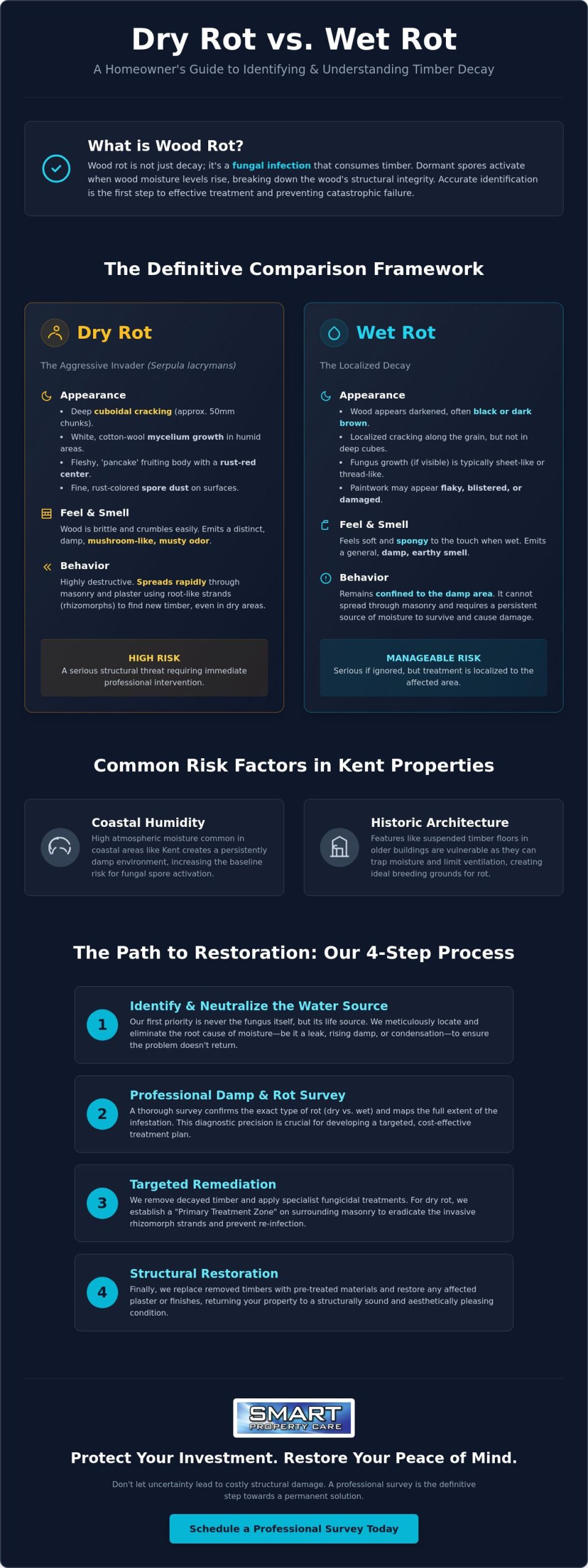
Distinguishing between these two fungal threats is the most critical step in property preservation. While dry rot is often viewed as the primary “villain” due to its predatory nature, assuming wet rot is harmless is a dangerous misconception. Both can compromise your home’s structural integrity if ignored. The fundamental difference lies in their survival strategies and moisture requirements. Identifying dry rot vs wet rot requires an understanding of how each fungus interacts with the environment. Wet rot, typically caused by Coniophora puteana, is a localized specialist that thrives in saturated timber where moisture levels exceed 50%. Dry rot is far more versatile, capable of germinating and spreading at moisture levels as low as 20%.
The “misidentification trap” is a significant concern highlighted by bodies like the Royal Institution of Chartered Surveyors (RICS). If a homeowner treats a dry rot outbreak using wet rot protocols, the result is almost always a failed restoration. Wet rot treatments focus on the immediate area of dampness. However, because dry rot travels through masonry, a localized fix leaves the underlying infection intact. Precision in your initial diagnosis prevents the frustration of recurring decay and the unnecessary expense of repeated repairs. A professional eye looks beyond the surface to determine the exact fungal species before a single floorboard is lifted.
Wet Rot Identification (Coniophora puteana)
Wet rot is most frequently found in “hotspots” where water ingress is constant, such as leaking window frames, blocked roof valleys, or beneath failing plumbing. Unlike the deep, chunky cuboidal cracking of dry rot, wet rot typically causes the wood to darken and split in a longitudinal pattern. The timber often feels soft or spongy to the touch. Depending on the specific species, the wood may appear “tanned” or even bleached. While it lacks the aggressive spread of dry rot, it will continue to consume the wood as long as the moisture source remains active, eventually turning structural beams into a soft, useless pulp.
Dry Rot vs Wet Rot: The Quick Reference Table
To help you navigate the initial assessment, use this comparison framework to evaluate the damage in your property. While this guide is a powerful tool for homeowners, remember that only a specialist survey provides the legal and structural certainty required for high-end property maintenance.
| Feature | Dry Rot (Serpula lacrymans) | Wet Rot (Coniophora puteana) |
|---|---|---|
| Texture | Brittle, dry, and crumbly. | Soft, spongy, and fiberous. |
| Cracking | Deep “cuboidal” chunks (50mm). | Thin, longitudinal cracks. |
| Spread | Aggressive; travels through walls. | Localized to the damp area. |
| Smell | Strong, mushroom-like odour. | Damp, musty, or earthy. |
| Masonry | Penetrates brick and mortar. | Does not grow through masonry. |
Pro Tip: The Knife Test. Take a small pocket knife or screwdriver and press it firmly into the affected timber. If the blade sinks in easily with a soft, yielding resistance, you are likely dealing with wet rot. If the wood feels brittle and cracks away in dry chunks upon contact, dry rot is the probable culprit. Regardless of the result, identifying the source of the water remains your absolute priority to halt further decay.
Root Causes: Why Kent Properties Face Rot Risks
Kent’s unique geographic location and diverse architectural heritage create a specific set of challenges for property owners. In coastal towns like Margate and Ramsgate, high humidity levels significantly elevate the moisture content in structural timbers. This environmental factor makes identifying dry rot vs wet rot particularly difficult, as the wood often stays damp enough for spores to germinate throughout the year. Coastal properties also contend with hygroscopic salts. These salts are deposited by sea spray and can absorb moisture directly from the air, keeping timber damp even after a primary leak is repaired. This persistent moisture creates a permanent breeding ground for fungal decay.
In historic hubs like Canterbury, the challenge is architectural rather than purely environmental. Many Victorian and Edwardian homes feature suspended timber floors that rely on a constant flow of air through sub-floor voids. When air bricks are blocked by debris or ground levels are raised during modern landscaping, this vital ventilation ceases. This creates a stagnant, humid microclimate where dry rot thrives. Unlike the penetrating damp caused by driving rain on the Kent coast, which often results in localized wet rot, these sub-floor issues can lead to widespread structural decay that remains hidden beneath your feet for years.
Common Failure Points in East Kent Homes
We frequently encounter rot outbreaks caused by modern “improvements” applied to historic buildings. Applying non-breathable renders or masonry paints to older timber-framed properties traps moisture within the walls, preventing the structure from “breathing” naturally. This trapped water is then absorbed by the internal timber frame, creating the perfect environment for fungal growth. Additionally, simple maintenance failures, such as overflowing gutters or blocked downpipes, allow water to saturate fascia boards and rafters. This consistent water ingress is the primary driver for wet rot, which can quickly compromise the roofline if left unaddressed.
The “Peace of Mind” Survey: Why Local Knowledge Matters
Effective remediation starts with understanding the building’s history and the local environment. A generic approach often leads to unnecessary work or, worse, missing the root cause entirely. Commissioning a professional damp and timber report ensures that every variable is considered. At Smart Property Care Ltd, we don’t just identify the fungus; we pinpoint the exact moisture source, whether it’s salt-induced dampness or a failing sub-floor void. Our local knowledge allows us to distinguish between minor damp issues and serious structural threats with absolute precision.
We provide a clear, costed specification for remedial works, ensuring you only pay for the treatments your property actually needs. This level of precision avoids the “overtreatment” often seen in the industry and gives you a definitive roadmap for restoration. If you’re concerned about the health of your home’s timber, book a specialist survey today to secure your property’s future with expert craftsmanship and reliable local expertise from Smart Property Care Ltd.
Professional Remediation: The Smart Property Care Ltd Process
Once the technical phase of identifying dry rot vs wet rot is complete, the process transitions from diagnosis to disciplined execution. Smart Property Care Ltd employs an “Expert Craftsman” approach that prioritizes the long-term health of your property over quick, superficial fixes. Our protocol is built on three non-negotiable pillars: neutralizing the water source, eradicating the fungal infection, and fortifying the structure against future attacks. This methodical sequence ensures that we don’t just treat the symptoms but solve the underlying moisture failure that allowed the rot to germinate in the first place.
For dry rot outbreaks, we utilize the “Primary Treatment Zone” (PTZ) concept. Because Serpula lacrymans can send microscopic strands deep into masonry, simply replacing visible decay is insufficient. We remove all affected timber and strip back contaminated plaster to a radius of 1 metre beyond the last visible sign of fungal growth. This rigorous standard ensures that dormant strands aren’t left behind to re-infect your home. Following this, we irrigate the exposed masonry with professional-grade fungicidal sterilisers, creating a chemical barrier that the fungus cannot penetrate.
Treating the Timber and the Fabric
We treat all retained and new timbers with high-performance, dual-purpose preservatives. These advanced formulas provide both rot prevention and woodworm treatment, ensuring your home’s skeleton is protected from multiple biological threats simultaneously. When rot is discovered in cellars or lower-ground floors, we often recommend basement waterproofing to address the high hydrostatic pressure common in Kent’s coastal areas. Our team replaces compromised structural beams with pre-treated, high-grade alternatives, ensuring the structural load is safely supported for decades to come.
Long-Term Prevention and Peace of Mind
The final stage of our process is the complete restoration of your living environment. We believe a professional service should leave your home in a better state than we found it. Our team provides specialist plastering using salt-retardant mixes and expert carpentry to seamlessly integrate new timber with existing features. To prevent recurrence, we assess your home’s ventilation and may suggest condensation control systems to maintain a stable, dry atmosphere. This comprehensive approach provides the documented evidence needed for mortgage and insurance purposes, backed by a professional guarantee that secures your investment. If you’ve spotted the signs of timber decay, don’t wait for the damage to spread. Contact Smart Property Care Ltd today for a specialist rot survey and let us restore your peace of mind.
Securing Your Property’s Future
Protecting your home from timber decay requires more than a surface-level fix. Precision in identifying dry rot vs wet rot is the essential first step toward a permanent solution. Whether you face the aggressive spread of dry rot through masonry or the localized destruction of wet rot, the priority remains the same. You must identify the moisture source and neutralize the infection with expert care to prevent recurring damage.
As a family-run business with over 20 years of property preservation experience, Smart Property Care brings deep local expertise to every project. We provide comprehensive damp and timber reports for homeowners across Herne Bay, Canterbury, and East Kent. This ensures your restoration is based on factual evidence rather than guesswork. Our disciplined approach secures your home’s structural integrity while providing the long-term reassurance you deserve.
Don’t let timber decay compromise your investment. Book Your Specialist Damp & Timber Survey in Kent today to receive a definitive diagnosis and a clear path to restoration. We are ready to help you safeguard your property with the highest standards of craftsmanship and reliable local service.
Frequently Asked Questions
Can I live in a house with dry rot?
You can technically remain in your home while dealing with an outbreak, but the structural safety of the building must be your primary concern. Dry rot isn’t toxic like certain moulds, but it’s a relentless consumer of structural timber. If the infection has reached critical floor joists or roof trusses, specific areas of the property may become dangerous. We recommend a professional assessment to ensure your living environment remains safe during the restoration process.
Is dry rot or wet rot more expensive to fix?
Dry rot is generally more expensive to remediate because it’s a more aggressive and invasive fungus. When identifying dry rot vs wet rot, the treatment scope for dry rot is much wider, requiring the removal of plaster and timber within a one-metre radius of the infection. This extensive Primary Treatment Zone and the need for specialized masonry sterilization make the process more labor-intensive than the localized repairs typically required for wet rot.
Does home insurance cover dry rot and wet rot treatment?
Most standard home insurance policies don’t cover the cost of rot treatment because insurers view fungal decay as a maintenance issue rather than a sudden peril. However, you might find coverage if the rot is a direct result of a covered event, such as a burst pipe that was reported immediately. It’s essential to review your specific policy wording or consult your provider to understand your coverage regarding timber decay and moisture ingress.
How fast does dry rot spread through a property?
In optimal conditions of high humidity and stagnant air, dry rot can spread by up to 80mm every month. This rapid growth is powered by its root-like rhizomorphs, which act like a plumbing system to transport moisture to dry parts of your home. Because the fungus often grows behind plaster or under floorboards, it can compromise a significant portion of your property before you even realize there is a problem.
Can I treat dry rot myself with shop-bought chemicals?
DIY treatment is highly discouraged because retail chemicals lack the potency required to penetrate deep into masonry and timber. Standard shop-bought products also cannot address the root cause of the moisture failure. Identifying dry rot vs wet rot correctly is essential; a mistake here means the fungus will continue to spread behind your walls. Professional-grade sterilisers and structural carpentry are necessary to ensure the infection is completely eradicated and won’t return.
What does dry rot smell like in a basement?
Dry rot produces a distinct, heavy, and mushroom-like odour that is often the first warning sign in enclosed spaces like basements. This earthy scent is caused by the fungus releasing millions of spores as it consumes the timber. Unlike the sharp, musty smell of general dampness, the dry rot scent is thick and organic. If you notice this specific aroma in a cellar or under-stair cupboard, it’s a strong indicator of an active fungal fruiting body.
How do I know if my wet rot has turned into dry rot?
Wet rot cannot turn into dry rot because they are entirely different species of fungi with unique biological structures. However, both can exist in the same property if the conditions are right. If a moisture source is partially addressed but the timber remains at about 20% moisture, the environment may become less favorable for wet rot and perfect for a dry rot outbreak. Professional identification is required to see if a secondary infection has taken root.
Why is dry rot called “dry” if it needs moisture?
The term dry rot is a historical misnomer that describes the appearance of the timber after the fungus has finished its attack. The wood becomes brittle, crumbly, and looks completely desiccated. Additionally, the name refers to the fungus’s unique ability to transport water through its strands, allowing it to attack and consume timber that appears dry. Despite the name, no rot can begin without an initial source of moisture to germinate the spores.