
Ramsgate’s iconic Victorian seafront hides a persistent enemy that thrives on the very salt air we love. If you’ve discovered a suspicious orange dust or mushroom like growth behind your skirting boards, you’re facing a specialist preservation challenge. Dealing with the unique combination of high coastal humidity and salt saturated masonry requires more than a generic fix. It demands professional dry rot treatment ramsgate to ensure your heritage property remains structurally sound. We know the anxiety that follows the discovery of fungal decay, especially when you’re balancing the need for specialist repairs with the rising costs of property maintenance in 2026.
You deserve the peace of mind that comes from a dry, healthy home that retains its Edwardian or Victorian charm. This guide provides the definitive roadmap to identify, treat, and permanently eradicate dry rot using expert local preservation techniques. We will preview the essential components of a certified dry property report, explain the impact of salt laden moisture on seaside brickwork, and outline the precision methods used to restore your property’s historic features to their original standard.
Key Takeaways
- Understand how Ramsgate’s unique coastal environment and hygroscopic salts accelerate timber decay in historic Victorian and Edwardian properties.
- Learn to spot the biological warning signs of wood-destroying fungi and why expert dry rot treatment ramsgate is required to stop spores from migrating through masonry.
- Discover the importance of specialist thermal imaging and salt analysis to avoid the false positives common with basic moisture meters in seaside homes.
- Follow a professional two-step restoration strategy that eliminates moisture sources and sterilises infected masonry for permanent fungal eradication.
- Access local preservation guidance backed by two decades of experience protecting the structural integrity of East Kent’s coastal heritage.
The Challenge of Dry Rot in Ramsgate’s Coastal Environment
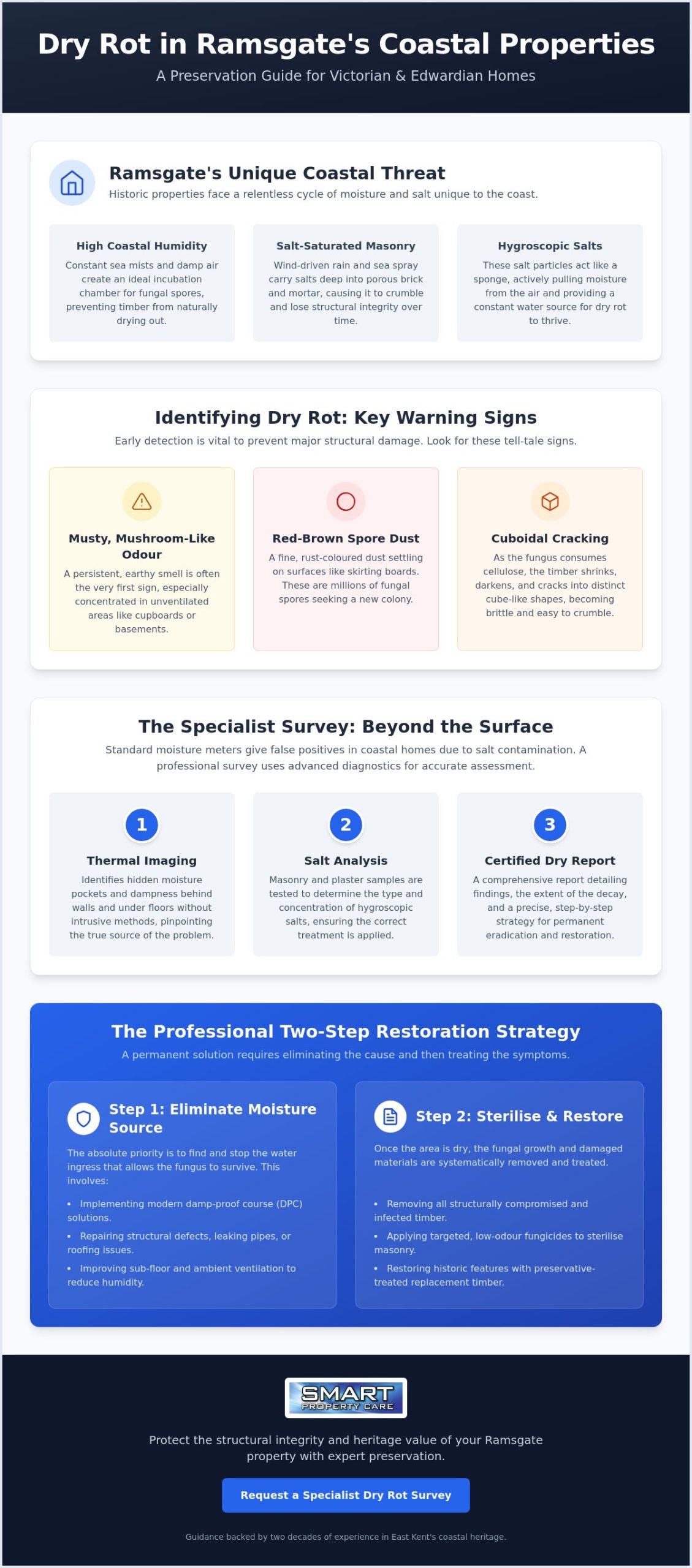
Ramsgate’s coastal position provides stunning views, but it subjects our historic building stock to a relentless cycle of moisture and salt. The town’s Victorian and Edwardian terraces are particularly vulnerable. These properties were constructed long before the advent of modern moisture barriers, leaving them open to the penetrating sea mists that roll off the English Channel. When this moisture enters the building fabric, it creates an ideal incubation chamber for fungal spores. Specialist dry rot treatment ramsgate is essential because coastal decay behaves differently than inland issues. The high humidity levels common in East Kent mean that timber rarely has the chance to dry out naturally, allowing wood-destroying fungi to establish a permanent foothold.
To understand the severity of the threat, we must look at the biology of the organism. What is Dry Rot? Scientifically known as Serpula lacrymans, it is an aggressive fungus that doesn’t just sit on the surface of the wood. It can transport its own moisture and travel through porous masonry to find new timber sources. In seaside towns, this process is accelerated by hygroscopic salts. These salt particles are carried in the sea air and settle into the grain of the wood and the pores of the brickwork. They act like a sponge, pulling moisture from the air even on dry days. This ensures the fungus has a constant supply of water, making standard DIY fungicides almost entirely ineffective. These shop-bought solutions fail to penetrate the masonry where the fungal “roots” or mycelium are hidden.
Coastal Masonry and Salt Contamination
Properties near the Royal Harbour face the brunt of wind-driven rain and sea spray. This salt-saturated water penetrates deep into porous red bricks and traditional lime mortar. Over time, the salt crystallises, causing the mortar to crumble and lose its structural integrity. This breakdown often occurs right where timber wall plates sit, providing a direct bridge for moisture to reach the floor joists. Homeowners often mistake salt efflorescence, a white powdery substance on basement walls, for fungal growth. However, both indicate a moisture problem that requires a professional technical inspection to prevent a full scale outbreak of dry rot.
Ramsgate’s Period Architecture: A Breeding Ground for Rot
The CT11 postcode is famous for its grand converted seaside apartments and atmospheric basement flats. These lower-ground levels are often in direct contact with Ramsgate’s chalk-based geography. Chalk is highly porous and can hold significant amounts of ground water, creating a damp microclimate around the foundations. Without a modern damp-proof course, this moisture rises through capillary action, saturating the historic timber features that give these homes their character. Preserving these Victorian and Edwardian aesthetics requires a delicate balance. We implement modern damp proofing kent solutions that protect the building’s structural integrity without compromising its heritage value. Our approach ensures that your property remains a safe, dry environment while respecting the craftsmanship of the past.
Identifying Dry Rot: Signs, Symptoms, and Biology
Dry Rot is a wood-destroying fungus that possesses the unique ability to travel through masonry to find new timber sources. Unlike other fungal decays, it doesn’t need to stay on the wood surface to survive. Often, the first sign isn’t something you see, but something you smell. A persistent, heavy musty odour, often described as “mushroom-like” or “earthy,” typically permeates the room. In the humid conditions of Ramsgate, this scent becomes particularly concentrated in unventilated spaces like under-stair cupboards or behind heavy furniture. If you notice this smell, it’s vital to seek professional dry rot treatment ramsgate before the structural integrity of your home is compromised.
Visual cues provide the next level of confirmation. You should look for two specific indicators:
- Red-brown spore dust: This fine, rust-coloured dust often settles on horizontal surfaces like skirting boards or bookshelves. It’s actually millions of fungal spores looking for a moist environment to start a new colony.
- Cuboidal cracking: As the fungus consumes the cellulose within the wood, the timber shrinks and cracks into distinct cuboidal shapes. The wood becomes brittle and will crumble easily between your fingers.
Behind plasterboard or under floorboards, you might find white or grey wool-like strands known as mycelium. These cotton-wool clumps can spread rapidly across walls, searching for the next piece of structural timber. In advanced stages, these strands can turn yellowish or even lilac, indicating a mature and aggressive infestation that is actively colonising your property’s framework.
Dry Rot vs. Wet Rot: The Ramsgate Comparison
Wet rot is common in areas with localized leaks, such as around a faulty window frame or a leaking pipe. The wood feels soft and spongy, but the damage is usually contained to the wet area. Conversely, dry rot is far more dangerous because it navigates through brickwork and mortar to infect dry timber in other parts of the house. Because the two can look similar to the untrained eye, both require a damp survey for an accurate and definitive diagnosis.
The “Fruiting Body” (Sporophore)
The appearance of a fruiting body, or sporophore, signals a structural emergency. This pancake-shaped growth has a fleshy texture and a deep ochre or reddish-brown centre. It’s the “factory” for new spores. In the terraced seaside homes of Ramsgate, these airborne spores can easily migrate through shared walls or floor voids, potentially infecting neighbouring properties. Identifying a sporophore means the fungus has reached a mature stage and is actively reproducing. Securing expert dry rot treatment ramsgate at this stage is the only way to prevent widespread timber collapse and protect the long-term value of your coastal heritage home.
The Specialist Damp and Timber Survey Process
Many homeowners are misled by basic damp meters that only provide surface-level readings. In coastal environments like Ramsgate, these devices often trigger high readings simply because of the salt content in the walls. These are false positives that don’t necessarily indicate a fungal outbreak. A professional technical survey for dry rot treatment ramsgate goes much deeper than a simple “red light” on a handheld tool. We focus on identifying the exact type of moisture present and its origin, ensuring we don’t recommend unnecessary work.
Our diagnostic process utilizes high-resolution thermal imaging to track temperature variances behind plaster and floorboards. This allows us to see hidden moisture paths that the naked eye cannot detect. We also conduct laboratory-grade salt analysis. This testing distinguishes between hygroscopic salts from sea spray and nitrates or chlorides from ground-level rising damp. Identifying whether the moisture source is a blocked gutter on a Victorian terrace or sea spray ingress is the only way to stop the rot permanently. We provide a costed specification that serves as a definitive roadmap for your property’s restoration.
Technical Diagnosis for Ramsgate Homeowners
With over 20 years of local experience, we’ve identified specific building failures unique to the Ramsgate coastline. A general homebuyer survey might flag “damp,” but it won’t uncover the hidden fungal map colonising your joist ends. Our specialist inspections are comprehensive, often covering both rot and woodworm treatment needs in a single visit. This surgical level of detail gives you total peace of mind, ensuring that every hidden strand of mycelium is accounted for before work begins.
Reports for Property Transactions
Lenders in East Kent are increasingly cautious about Victorian seaside properties. They frequently mandate a specialist report before approving a mortgage or releasing funds for a purchase. Our technical reports protect the value of your Ramsgate investment by providing transparent pricing and clear remedial paths. Whether you’re a buyer looking for a price negotiation tool or a seller needing to prove your home is structurally sound, our documentation provides the professional weight required for insurance claims and property transactions. We ensure that all parties have a clear understanding of the necessary steps to achieve a dry-property certificate.
Comprehensive Dry Rot Treatment and Restoration
Successful dry rot treatment ramsgate follows a disciplined, multi-stage protocol designed for permanent eradication. We don’t just treat the symptoms; we address the environmental failures that allowed the fungus to take hold. Our process begins with a “scorched earth” approach to the infected area, ensuring no dormant spores remain to trigger a secondary outbreak. This level of precision is the only way to protect the long-term structural integrity of coastal properties.
Our restoration sequence involves five critical steps executed to the highest industry standards:
- Step 1: Moisture Control. We identify and eliminate the primary moisture source, whether it’s a leaking gutter, a failed damp-proof course, or salt-saturated masonry. Without this, any treatment is temporary.
- Step 2: Aggressive Removal. We remove all infected timber and plaster, cutting back at least 500mm beyond the last visible sign of fungal growth to ensure every hidden strand of mycelium is gone.
- Step 3: Masonry Sterilisation. We apply professional-grade fungicidal masonry sterilants to the surrounding brickwork. This creates a deep chemical barrier that prevents the fungus from travelling through the wall.
- Step 4: Structural Replacement. Every piece of removed timber is replaced with high-quality, pre-treated wood. This provides immediate structural support and long-term resistance to future decay.
- Step 5: Specialist Restoration. We finish the area using salt-retardant plaster and traditional techniques to restore the aesthetic and functional value of your home.
If you’ve identified the warning signs of decay, it’s time to act. You can book a specialist technical inspection to secure your property’s future today.
Specialist Plastering: The Essential Final Step
Standard gypsum plaster is a common mistake in coastal renovations. In Ramsgate’s salt-heavy air, gypsum acts like a sponge, pulling moisture from the atmosphere and causing walls to “sweat” or blister. We use specialist salt-retardant plastering systems that are breathable yet resistant to hygroscopic salt migration. This is particularly vital when restoring the grand historic cornices and skirting boards found in Ramsgate’s heritage stock. Our craftsmen ensure these period features are perfectly replicated, maintaining the building’s Edwardian or Victorian character while providing a modern moisture barrier.
Mould Remediation and Air Quality
Dry rot doesn’t exist in a vacuum; it’s often accompanied by high levels of airborne spores and black mould. Once the fungus is eradicated, we focus on restoring a healthy indoor environment. This often involves professional mould remediation to remove toxic spores that can cause respiratory issues. We also assess your property’s ventilation. By improving airflow through the installation of passive vents or mechanical systems, we prevent the condensation-driven moisture that fuels fungal growth. This comprehensive approach ensures your home isn’t just structurally sound, but safe for your family to live in.
Smart Property Care Ltd: Your Ramsgate Preservation Experts
Protecting the structural integrity of East Kent’s coastal homes requires more than just technical knowledge; it demands a deep respect for local heritage. We have spent over 20 years refining our approach to dry rot treatment ramsgate, building a reputation for excellence across the region. As a family-run business, Smart Property Care Ltd doesn’t just see properties; we see homes and investments that deserve the highest standard of care. Our team combines the precision of modern chemical treatments with the delicate touch required for traditional property renovation.
We take immense pride in our role as the region’s Expert Craftsmen. Smart Property Care Ltd ensures every project is completed punctually and to a premium standard. Our disciplined approach moves swiftly from identifying a need to providing a comprehensive restoration. When you choose us, you’re choosing a partner committed to long-term results. We provide:
- Proven Expertise: Two decades of experience dealing with the aggressive fungal strains unique to seaside environments.
- Specialist Knowledge: A deep understanding of both Victorian building methods and 2026 preservation standards.
- Total Reliability: A professional, organized service that prioritizes cleanliness and minimal disruption to your daily life.
- Guaranteed Results: Comprehensive guarantees that offer long-term peace of mind in our challenging coastal climate.
Serving Residential and Commercial Clients in East Kent
Our services are tailored to meet the diverse needs of the local community. Smart Property Care Ltd works closely with Ramsgate landlords to ensure their portfolios remain compliant and safe, especially following the implementation of Awaab’s Law. We provide prompt, professional service across Ramsgate, Margate, and Sandwich. Whether you own a grand period home in Dover or a commercial property in Canterbury, we deliver authoritative property care. Our commitment to high-end craftsmanship means we don’t just stop the rot; we restore the aesthetic value of your building, ensuring it remains a standout feature of the Kent coast.
Begin Your Property Restoration
The first step toward a dry, healthy home is a professional assessment. Smart Property Care Ltd begins with a technical survey and a costed specification, providing you with a clear, transparent path to recovery. We don’t believe in guesswork. We use evidence-based diagnostics to identify the full extent of the issue before recommending a solution. If you’ve noticed a musty odour or suspect timber decay, don’t wait for the problem to escalate. Contact the team at Smart Property Care Ltd today for specialist advice on damp, woodworm, or dry rot treatment ramsgate. We are ready to restore your property’s safety and your peace of mind with a transformed, fungal-free environment.
Secure Your Ramsgate Property’s Future
Preserving a coastal home requires a proactive approach to timber health. We have explored how Ramsgate’s unique salt-laden air and porous masonry create a high-risk environment for fungal decay. Identifying the early warning signs, such as cuboidal cracking or a persistent musty odour, is the first step in preventing structural failure. By utilizing advanced diagnostics like thermal imaging and salt analysis, you ensure that any dry rot treatment ramsgate is targeted, effective, and permanent. This specialized focus is what distinguishes a long-term solution from a temporary fix.
As a family-run business based in East Kent, we bring over 20 years of industry experience to every project. We specialize in coastal property preservation, balancing modern technical precision with a deep respect for Victorian and Edwardian architecture. Our disciplined restoration process doesn’t just stop the rot; it transforms your environment into a safe, dry, and healthy space once again. Don’t let fungal decay compromise your investment or your peace of mind. Our team is ready to deliver the high-end craftsmanship your heritage property deserves.
Book Your Specialist Dry Rot Survey in Ramsgate Today and let our expert craftsmen protect your home for years to come. Your property’s restoration is just a professional technical inspection away.
Frequently Asked Questions
Is dry rot treatment permanent for my Ramsgate home?
Dry rot treatment is permanent as long as the underlying moisture source is completely eliminated and the masonry is correctly sterilised. In coastal environments, this requires ongoing maintenance of external pointing and guttering to prevent sea spray or rainwater from re-entering the building fabric. Our multi-stage process ensures the fungus is eradicated and the environment is no longer hospitable to new spores.
How much does a specialist dry rot survey cost in Ramsgate?
The cost of a specialist technical inspection depends on the size of the property and the complexity of the building’s structure. We provide a detailed technical report that includes a costed specification for any necessary remedial works. This document is often a requirement for mortgage approvals or insurance claims for Victorian seaside properties in East Kent.
Can I stay in my property while dry rot treatment is being carried out?
You can usually remain in your home while we carry out the work, although the specific rooms being treated will be temporarily off-limits. Our team uses dust extraction and clear site isolation to ensure the rest of your living space remains clean and habitable. We coordinate the project phases to minimise disruption while maintaining the high standards of safety and precision our clients expect.
Does dry rot always mean I have a damp problem?
Yes, dry rot cannot germinate or thrive without a consistent source of moisture. While the fungus is capable of transporting water through its mycelium, it initially requires timber moisture content to be around 20% to survive. Identifying the specific source of dampness, such as a hidden leak or rising damp, is a critical component of professional dry rot treatment ramsgate.
Why has fungal growth returned after I used a DIY spray?
DIY sprays are surface-level treatments that fail to reach the fungal “roots” or mycelium hidden deep within masonry and mortar joints. Professional eradication requires aggressive timber removal and industrial-grade masonry sterilants that penetrate the building fabric. Without sterilising the surrounding area, the fungus will simply regrow once the surface chemical dissipates, leading to further structural damage.
Does professional dry rot treatment increase my property value in Ramsgate?
Professional treatment protects your property’s market value by ensuring the building is structurally sound and mortgageable. Many lenders in Thanet will refuse to release funds for a purchase if active fungal decay is detected during a survey. Providing a certified dry-property report removes this obstacle, giving potential buyers and surveyors the confidence that the home is a safe investment.
How long does the dry rot eradication process typically take?
Most domestic projects are completed within 3 to 7 working days, depending on the extent of the timber replacement required. This timeframe includes the removal of infected materials, masonry sterilisation, and the installation of pre-treated structural timbers. We provide a clear schedule of works before starting, ensuring you know exactly how long each phase of the restoration will take.
Are your dry rot and timber treatments guaranteed?
We provide comprehensive guarantees for our remedial timber treatments and dry rot eradication work. This commitment to quality offers long-term peace of mind for homeowners facing the challenging coastal climate of East Kent. Our guarantees are a trust signal that reflects our 20 years of experience and the high-end craftsmanship we bring to every property preservation project.