
What if the room meant for your recovery is actually the primary source of your exhaustion? For many homeowners in Kent, waking up with a heavy chest or a persistent cough isn’t just a sign of a seasonal cold, it’s often a direct response to the environment. The health risks of black mould in bedroom settings are particularly severe because your respiratory system remains exposed to concentrated spores for hours on end while you sleep.
You deserve a home that protects your family rather than causing anxiety about what they’re breathing in. It’s exhausting to watch stubborn black spots reappear just days after you’ve scrubbed them away. This 2026 guide provides the clarity you need to understand the neurological and respiratory impacts of dampness. We’ll examine the latest statutory standards and show you how to identify the root cause of moisture. By the end of this article, you’ll know exactly how to secure a permanent solution that restores your peace of mind and keeps your home healthy.
Key Takeaways
- Understand why the health risks of black mould in bedroom environments are intensified during sleep and how to recognize chronic respiratory symptoms.
- Identify the “perfect storm” of warmth and low ventilation that allows toxic Stachybotrys chartarum to colonize your sleeping quarters.
- Learn to distinguish between surface condensation and structural penetrating damp to ensure the correct remediation method is applied.
- Discover why professional mould remediation and a specialist damp survey are essential for eliminating spores permanently rather than just cleaning the surface.
- Stay informed on the 2026 legal standards for home safety and how these regulations prioritize the building’s performance over tenant lifestyle.
What is Black Mould and Why Does it Thrive in Bedrooms?
Understanding the nature of the fungal growth in your home is the first step toward a permanent solution. What many homeowners identify as “black mould” is often Stachybotrys chartarum, a slow-growing fungus that requires significant, consistent moisture to colonize. It typically appears as slimy, dark green or black patches across walls and ceilings. Mycotoxins are the toxic secondary metabolites produced by certain fungi. Unlike surface-level mildew, which is often powdery and easily wiped away, true black mould can become deep-rooted within your plasterwork, feeding on the organic materials behind the paint until the structural integrity of the finish is compromised.
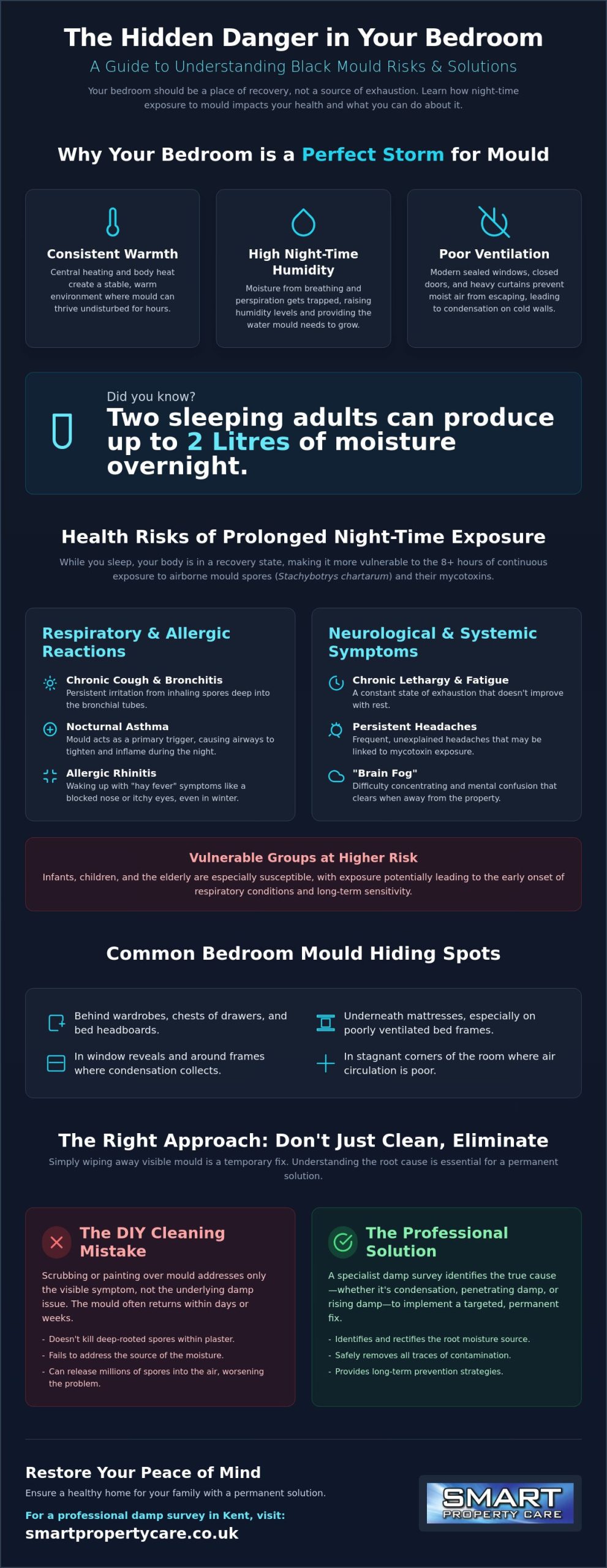
Bedrooms create a unique microclimate that encourages this growth. You have a consistent heat source, limited air movement, and a steady influx of humidity that peaks while you sleep. The health risks of black mould in bedroom environments are heightened because these conditions remain constant for eight to ten hours every single night. This creates a “perfect storm” where the thermal envelope of the room fails to shed moisture, allowing spores to settle and germinate in the very places you should feel safest.
The Role of Night-time Humidity
Your breathing alone changes the room’s atmosphere. Two sleeping adults can produce up to two litres of moisture overnight through respiration and perspiration. In modern Kent homes, this moisture often has nowhere to escape. High-performance, “sealed” windows without functional trickle vents effectively trap this damp air inside the room. When you combine this with heavy, floor-to-ceiling curtains, you create a pocket of stagnant, moist air against cold external walls. This leads to rapid condensation, providing the exact hydration black mould needs to thrive. The health risks of black mould in bedroom settings often start here, as the airborne spores are most active when the air is saturated.
Common Hiding Spots for Bedroom Mould
Fungal growth rarely starts in the middle of a wall where air flows freely. It seeks out stagnant corners where the temperature drops. We frequently find extensive colonies hidden behind large wardrobes or headboards where air circulation is non-existent. Window reveals and the “cold bridges” around structural lintels are also primary targets for moisture accumulation. Perhaps most concerning is the growth found underneath mattresses in poorly ventilated bed frames. In these areas, body heat and trapped moisture provide an ideal, undisturbed breeding ground that can go unnoticed for months while still impacting your respiratory health.
The Respiratory and Neurological Health Risks of Sleep-Time Exposure
Sleeping in a contaminated room forces your body to process fungal spores during its most vital recovery phase. The health risks of black mould in bedroom environments often manifest first as chronic respiratory irritation. When you inhale these microscopic spores over several hours, they settle deep in the bronchial tubes, potentially leading to persistent bronchitis that doesn’t respond to standard cough medicines. This isn’t a simple allergy; it’s a continuous inflammatory response to a hostile environment.
For many Kent residents, the first sign of trouble is nocturnal asthma. Mould acts as a primary trigger, causing the airways to tighten and inflame specifically during the night. You might also experience allergic rhinitis, where you wake up with “hay fever” symptoms like a blocked nose or itchy eyes, even in the middle of winter. According to the CDC Facts on Black Mould, while scientific debate continues regarding certain severe symptoms, the link between indoor dampness and upper respiratory tract issues is well-documented and requires immediate attention.
Beyond the lungs, we’re seeing more reports of neurological impacts, often categorized as “toxic mould syndrome.” This isn’t just a physical ailment; it’s a mental one. Residents frequently report chronic lethargy, persistent headaches, and a debilitating “brain fog” that clears only when they spend significant time away from the property. If you’re noticing these symptoms, it’s vital to investigate professional remediation before the condition worsens and impacts your long-term wellbeing.
Vulnerable Groups: Children and the Elderly
Infants and young children are particularly susceptible to long-term damage. Their lungs are still developing, and exposure to high spore counts can lead to permanent respiratory sensitivity or the early onset of childhood asthma. Similarly, elderly residents often have weakened immune systems or existing conditions like COPD. For these groups, the health risks of black mould in bedroom settings are significantly higher, as a mouldy room isn’t just an inconvenience; it’s a medical hazard that complicates recovery from simple seasonal illnesses.
The Sleep Quality Connection
You can’t achieve restorative rest in a room with poor air quality. Constant coughing and nasal congestion disrupt your sleep patterns, preventing your brain from reaching deep REM cycles. Over time, this lack of quality sleep leads to chronic fatigue and increased anxiety. When humidity levels peak at night, the concentration of spores increases, creating a cycle of poor health and exhausted mornings that only a permanent, structural solution can break.
Why Sleeping in a Mouldy Room is Uniquely Harmful
Most people view their bedroom as a sanctuary. However, it’s the one place where you are most vulnerable to environmental toxins. The health risks of black mould in bedroom spaces are uniquely dangerous due to the sheer duration of exposure. You likely spend eight consecutive hours in this room, often with the door and windows firmly shut for warmth or privacy. This creates a stagnant environment where you’re effectively trapped with whatever is in the air, allowing spores to accumulate to levels far higher than those found in your living room or kitchen.
Your body’s natural defences also shift during deep sleep. Your breathing becomes deeper and more rhythmic, while your immune system reallocates its resources toward internal repair rather than filtering external pollutants. If your bed is positioned within inches of a mouldy window reveal or a damp external wall, you’re inhaling a concentrated dose of spores at a time when your respiratory system is most relaxed. This proximity means you aren’t just breathing “bad air”; you’re directly ingesting the secondary metabolites of a living fungal colony for a third of your life.
Concentrated Spore Inhalation
Night-time is when bedroom conditions are most volatile. As you sleep, CO2 and humidity levels peak because there’s no mechanical air exchange. Spore counts rise rapidly in this stagnant air. While some homeowners turn to portable air purifiers, these often fail to solve the root cause. A filter might capture some airborne particles, but it can’t stop the “re-entry” effect. This occurs when you simply pull back the duvet or draw the curtains, physically disturbing the mould and releasing a fresh cloud of spores directly into your breathing zone. The health risks of black mould in bedroom settings persist as long as the moisture source remains active behind your furniture.
The Psychological Toll of a “Sick” Bedroom
There’s a heavy emotional burden to living with dampness that’s often overlooked. A bedroom should be a place of recovery, not a source of anxiety. Knowing your sanctuary is potentially hazardous causes genuine stress that can lead to insomnia. You might worry about the long-term impact on your family’s health or the declining structural integrity of your property. The persistent, musty odour of dampness is more than an inconvenience; it’s a constant sensory reminder that your home environment is compromised. This psychological weight prevents the mental relaxation required for restorative sleep, creating a cycle of physical and mental exhaustion.
Identifying the Root Cause: Condensation vs Structural Damp
The health risks of black mould in bedroom settings can only be managed once you stop the moisture at its source. It’s a common mistake to treat all fungal growth with the same cleaning spray, but a surface-level fix won’t help if your property has a structural defect. Condensation is the most frequent culprit, typically appearing as small, pepper-like black spots on cold surfaces, window reveals, and in the stagnant air of room corners. In contrast, penetrating damp often manifests as isolated, dark patches or “tide marks” that become more pronounced immediately after heavy rainfall.
Ground-floor bedrooms face an additional challenge known as rising damp. This occurs when groundwater is drawn up through porous masonry, typically affecting only the lower 1 metre of the wall. Unlike condensation, which sits on the paint, rising damp originates from within the structure itself. Effectively, rising damp requires a specialist chemical DPC rather than just better ventilation. Distinguishing between these moisture types is the only way to ensure your family isn’t living in a cycle of temporary cleaning and inevitable regrowth.
The Condensation Trap in Modern Kent Homes
Modern energy-efficiency measures often have unintended consequences for indoor air quality. High-performance double glazing without adequate condensation control creates a “plastic bag” effect, sealing every bit of moisture inside the thermal envelope of your home. This problem is significantly worsened by lifestyle habits, such as drying laundry on bedroom radiators. This practice releases litres of water vapour into a room where air movement is already restricted. If you see “black spot mould” spreading across your ceiling or window frames, it’s a clear signal that your bedroom’s humidity levels are consistently exceeding the dew point.
When to Suspect Structural Failure
In East Kent coastal properties, the environment is particularly harsh on a building’s exterior. Driving rain and salt spray can lead to failed rendering or blocked gutters, allowing moisture to bypass your home’s outer defences. We also see frequent issues in older Victorian homes where the original damp proof course has degraded over a century of service. These structural failures provide a constant water supply for fungal colonies, making it impossible to mitigate the health risks of black mould in bedroom areas without professional intervention. Before you invest in expensive dehumidifiers or DIY kits, a professional damp survey is essential to pinpoint the exact failure in your property’s moisture barrier.
Professional Mould Remediation and Prevention in Kent
Professional intervention is about more than just aesthetics. Many homeowners mistakenly believe that a quick scrub with household bleach will solve the problem. In reality, bleach only removes the surface pigment; the fungal roots remain alive deep within the porous plasterwork. Choosing professional mould remediation ensures that the colony is fully neutralized and that contaminated materials are removed without spreading spores throughout the rest of your property. This level of precision is the only way to effectively eliminate the long-term health risks of black mould in bedroom environments.
The diagnostic process begins with a comprehensive damp survey. We don’t just look at the visible growth; we use advanced moisture meters and thermal imaging to identify the hidden moisture source within your walls. Once we’ve pinpointed the cause, we implement specialist treatments that go far beyond basic cleaning. This includes the application of high-performance anti-fungal coatings and, where necessary, structural preservation to ensure the damp cannot return. We focus on long-term protection by recommending thermal improvements and passive ventilation systems that maintain a healthy equilibrium in your home.
The Smart Property Care Ltd Approach
We bring over 20 years of experience to every project, serving homeowners across Herne Bay, Canterbury, and the wider Kent area. Smart Property Care Ltd operates with the discipline of an expert craftsman, ensuring that every restoration is handled with punctuality and pride. Our team follows a rigorous four-stage process: Survey, Identify, Treat, and Restore. This includes specialist plastering that resists future moisture ingress. As a family-run business, Smart Property Care Ltd combines this reliability with modern technological diagnostics to provide a service that is both personal and highly polished.
Next Steps for a Healthy Bedroom
Restoring your peace of mind starts with an accurate assessment. If you’re based in Dover, Ramsgate, or Margate, booking a specialist inspection is the most direct route to a mould-free home. During a professional damp and timber report, our surveyors will provide a clear, technical breakdown of your property’s condition and a transparent plan for remediation. Don’t let environmental hazards dictate your family’s wellbeing. Protect your health and your home—book a professional damp survey today.
Restore a Healthy Sleep Environment in Your Kent Home
Addressing the health risks of black mould in bedroom spaces requires a shift from temporary cleaning to permanent structural solutions. You now understand how night-time humidity and stagnant air pockets allow toxic spores to thrive, impacting your family’s respiratory and neurological wellbeing. By distinguishing between simple condensation and deep-seated structural damp, you can finally stop the cycle of recurring mould and protect your property’s value.
Smart Property Care Ltd provides the expertise needed to transform your home back into a safe sanctuary. With over 20 years of local Kent experience, we’re specialists in Mould Remediation and Condensation Control. We provide comprehensive technical reports for both residential and commercial properties, ensuring every moisture source is identified and neutralized with precision. Don’t wait for symptoms to worsen before taking action. Your family deserves the peace of mind that comes with a professionally restored environment. Book a Specialist Damp Survey in Kent Today and take the first step toward a healthier, drier home.
Frequently Asked Questions
Can sleeping in a room with black mould kill you?
While rare, prolonged exposure to toxic black mould can lead to fatal respiratory conditions. The 2025 enactment of Awaab’s Law highlighted how severe damp and mould can become a critical life safety issue, particularly for children and those with weakened immune systems. If you’re experiencing severe breathing difficulties or persistent chest infections, you must seek medical advice and address the environmental cause immediately.
How long does it take for bedroom mould to affect your health?
Health impacts can manifest in as little as 48 hours for individuals with existing allergies or asthma. For others, the health risks of black mould in bedroom spaces may take weeks or months to become apparent as chronic inflammation builds up in the respiratory system. The speed of onset depends on the spore concentration and the room’s specific ventilation levels.
Will an air purifier help with black mould in my bedroom?
An air purifier will capture some airborne spores, but it’s not a solution for the underlying growth. It cannot reach the mould growing behind wardrobes, under mattresses, or deep within the plasterwork. To eliminate the health risks of black mould in bedroom areas permanently, you must address the moisture source through professional condensation control or damp proofing rather than just filtering the air.
Does opening windows in winter stop bedroom mould?
Opening windows provides essential ventilation, but it’s often a counterproductive strategy during a cold Kent winter. If the internal walls become too cold, the warm, moist air inside will condense even faster once the window is closed. Professional mechanical ventilation or thermal improvements are typically required to maintain a balanced, mould-free environment without compromising your home’s energy efficiency.
Is black mould in the bedroom a landlord’s responsibility in the UK?
Yes, as of mid-2026, the Renters’ Rights Act makes properties with serious mould legally “non-decent.” Landlords are now strictly required to investigate reports within 14 days and begin repairs within 7 days if a hazard is identified. Local councils have the power to issue fines of up to £7,000 for non-compliance, which can rise to £30,000 for serious or repeated breaches.
What are the first signs of mould-related illness?
The earliest signs often mimic seasonal allergies or a lingering common cold. You might wake up with a persistent dry cough, a blocked nose, or itchy eyes that clear up shortly after you leave the property. Chronic lethargy and “brain fog” are also common indicators that your bedroom’s air quality is being compromised by high concentrations of fungal spores.
Can I sleep in a room after cleaning mould with bleach?
You should avoid sleeping in the room immediately after using bleach. Bleach releases strong chlorine fumes that can irritate the lungs, and it doesn’t actually kill the fungal roots in porous plaster. It merely removes the surface stain, meaning the colony remains active and will likely return while you continue to breathe in both chemical fumes and invisible spores.
Why does mould keep coming back even after I paint over it?
Painting over mould only hides the aesthetic problem while the moisture continues to feed the fungus underneath. Standard emulsion paint actually provides an organic food source for the mould to grow through. Until you fix the structural damp or condensation issue at its root, no amount of “anti-mould” paint will provide a permanent solution for your home’s health.