
In a coastal town like Herne Bay, where the London Clay and Thanet Sands are constantly shifting under the weight of the North Sea, a standard barrier approach to damp proofing is often a recipe for failure. You’re likely worried that a basement conversion might just be an expensive way to invite leaks into your home, especially with the local water table being what it is. It’s a valid concern because nobody wants to invest their hard-earned money only to find their new living space smells of mildew six months later. This guide shows you how to secure your home using professional basement waterproofing herne bay techniques that transform even the dampest cellar into a bone-dry, compliant, and high-value living area.
We’ll break down the technical differences between traditional tanking and modern cavity membranes, explain the latest 2026 Building Regulations, and show you why a managed drainage strategy is the only way to guarantee peace of mind. You’ll discover how to navigate the complexities of the Party Wall Act and the new Renters’ Rights Act 2026 to ensure your project is legally sound and structurally superior. By the end of this guide, you’ll have a clear roadmap to a warm, dry, and expertly crafted extension that adds significant value to your property.
Key Takeaways
- Understand how Herne Bay’s unique coastal geology and hydrostatic pressure necessitate a managed drainage approach rather than simple barriers.
- Learn why modern Type C cavity drain membranes are the industry standard for basement waterproofing herne bay to ensure a bone-dry, habitable living space.
- Navigate the critical 2026 legal requirements, including Kent Building Regulations and the Party Wall Act, to ensure your conversion is fully compliant.
- Evaluate the cost-to-value ratio of your project, focusing on how a high-quality cellar conversion significantly boosts property value in the local market.
- Discover the importance of a precision technical survey in creating a bespoke, long-term solution that eliminates the risk of future leaks.
The Challenges of Basement Conversions in Herne Bay: Coastal Damp & Geology
Converting a cellar in a seaside town like Herne Bay isn’t a simple renovation project. It’s a complex exercise in structural preservation. True basement damp proofing involves a multi-stage process designed to keep water out while managing the moisture that naturally exists in the ground. For homeowners here, the primary hurdle isn’t just the age of the property but the unique geological conditions of East Kent. You aren’t just fighting humidity; you’re often managing the immense weight of the local water table.
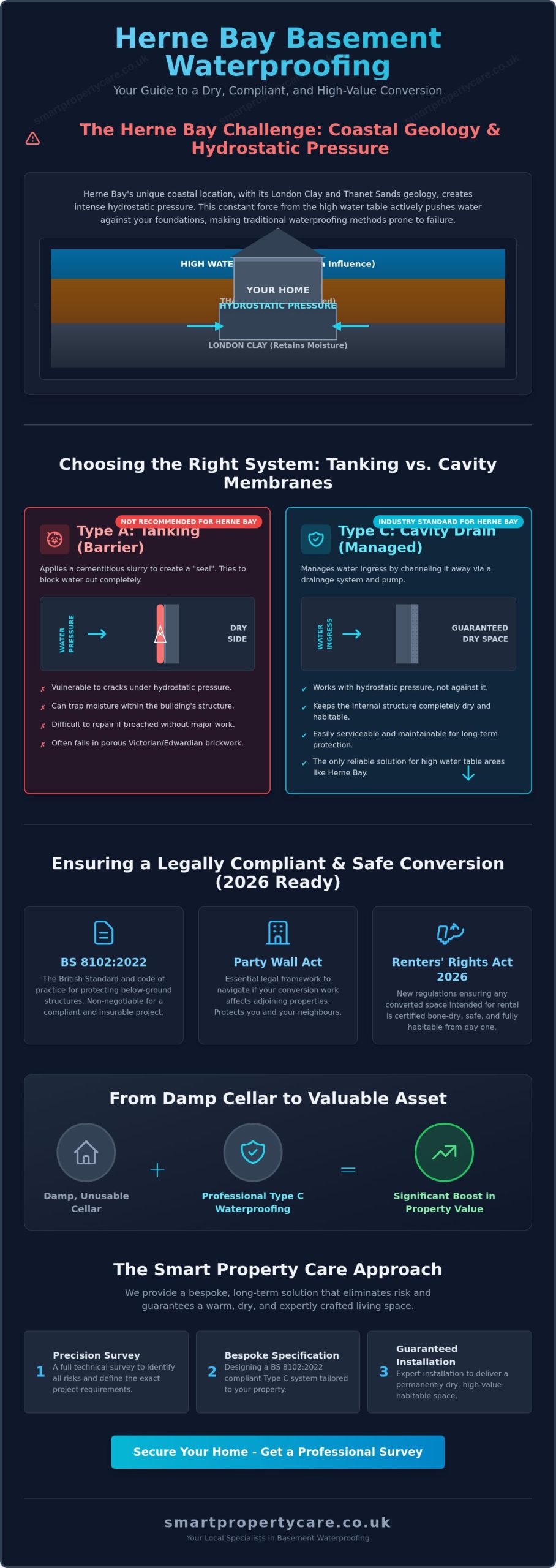
Herne Bay sits on a mix of London Clay and Thanet Sands. These materials retain moisture effectively, creating significant hydrostatic pressure against subterranean walls. When the North Sea tides rise or seasonal rainfall saturates the ground, this water doesn’t just sit there. It actively pushes against your foundations. If you’re researching basement waterproofing techniques, you must understand that this pressure can find the smallest crack in a traditional barrier or tanking system. It’s the difference between simple dampness, which feels like a cold chill, and active water ingress, where liquid physically enters the room.
Most of the town’s housing stock consists of Victorian and Edwardian properties. Their cellars were never intended to be bone-dry living spaces. They were designed as “cool rooms” with porous brickwork that allowed moisture to move freely. Today, converting these into habitable rooms requires more than just a lick of waterproof paint. It demands a professional approach to basement waterproofing herne bay that respects the history of the building while providing modern protection.
Understanding Hydrostatic Pressure in Coastal Properties
In Herne Bay, the local water table is heavily influenced by the proximity to the coast. During high tides or heavy Kentish winters, the water table rises, increasing the force exerted on your basement walls. Traditional barrier methods often fail here because they try to hold the water back entirely. Once the pressure becomes too great, the system breaches. We focus on managing this pressure by diverting water away from the structure, ensuring your conversion remains dry regardless of the weather outside.
The Role of BS 8102:2022 in Modern Waterproofing
Every project we undertake follows the strict guidelines of BS 8102:2022. This is the industry gold standard for protecting below-ground structures against water from the ground. Before any structural work begins, a professional damp survey is essential to identify the specific risks your property faces. This ensures the technical specification is accurate from day one. BS 8102:2022 acts as the definitive code of practice for ensuring subterranean spaces remain safe, dry, and compliant with UK building standards.
Choosing the Right Waterproofing System: Tanking vs. Cavity Drain Membranes
Selecting the correct methodology for basement waterproofing herne bay determines the long-term success of your conversion. In the UK, we categorize these systems into three distinct types. For residential conversions in coastal Kent, the choice almost always falls between Type A barrier protection and Type C drained protection. Each has its merits, but the coastal environment often dictates a more sophisticated approach than a simple internal seal.
Managed drainage is generally the safer route for the period properties found throughout Herne Bay. Rather than attempting to block water out entirely, which can lead to a build-up of immense pressure against your foundations, a managed system allows the building to breathe. It works with the structure rather than against it. This approach is particularly effective for Victorian and Edwardian homes where the original brickwork is porous and sensitive to changes in moisture levels.
Type A Tanking: The Traditional Barrier Approach
Type A waterproofing involves applying an impermeable layer, such as a cementitious tanking slurry, directly to the internal walls. This creates a physical seal against groundwater. While this method is a staple of the industry, rigid systems carry inherent risks. In Herne Bay, the local clay soils can lead to minor building movement or settlement. These rigid barriers can develop hairline cracks over time. Once a barrier is breached, hydrostatic pressure forces water through the failure point, often leading to localized damp patches. It’s a method best reserved for non-habitable storage spaces where a perfectly dry, decorated environment isn’t the primary goal.
Type C Cavity Drain Membranes: The Professional Choice
Modern habitable conversions favor Type C systems because they don’t fight water pressure; they manage it. This setup uses high-density polyethylene (HDPE) studded membranes fixed to the walls and floors. Water is allowed to seep through the brickwork but is immediately captured behind the membrane. It then flows freely into a perimeter drainage channel, often referred to as an AquaChannel. This is the gold standard for basement waterproofing in Kent because it’s less invasive and doesn’t stress the original heritage brickwork.
A Type C system is only as reliable as its discharge point. This requires an integrated sump pump system to collect the captured water and pump it safely away to a storm drain. We always install high-level alarms and battery backups as standard. These safety features provide an immediate alert if the pump encounters a blockage or loses power during a storm. This level of redundancy is vital for coastal properties where water tables can fluctuate rapidly. Before you begin, you must also consider the legal framework. Structural alterations often require you to follow the Party Wall Act 1996 guidance, especially in the terraced streets of Herne Bay. Ensuring your project is compliant from the start protects your investment. If you’re ready to explore your options, booking a specialist technical assessment is the most reliable way to secure your home’s future.
Calculating the Cost and Value of a Cellar Conversion in 2026
A basement conversion is one of the most significant investments you can make in your Herne Bay property. Unlike a loft conversion, which adds space under the eaves, a cellar conversion expands your home’s footprint from the ground up. The total cost is influenced by several technical factors. These include the current depth of the cellar, the total square footage, and the structural state of the existing masonry. If excavation is required to achieve a habitable head height, the complexity and expense increase naturally.
In the current market, adding a high-quality bedroom or a quiet home office can significantly boost your home’s market value. Properties in East Kent, particularly those near the seafront, command a premium for additional living space. Beyond the primary basement waterproofing herne bay system, you must account for “hidden” costs. These often include specialist salt-resistant plastering, moisture-rated electrical circuits, and potentially new plumbing for a subterranean cloakroom. Viewing these as a one-time investment is crucial. A correctly installed system prevents the cycle of repeat repairs that plagues many DIY or budget attempts.
Investment Framework for Kent Homeowners
When comparing home extensions, basements often offer a unique ROI that lofts cannot match. While a loft adds a bedroom, a basement provides a versatile snug or home cinema that feels like a natural part of the ground floor living area. Professional waterproofing typically pays for itself in equity gain. In coastal towns where space is at a premium, creating a dry, warm, and usable subterranean level is a strategic financial decision that pays dividends when it comes time to sell.
Avoiding the “Cowboy Builder” Trap
It’s tempting to opt for the lowest quote, but in the world of structural preservation, cheap usually means catastrophic. We often see homeowners who chose a budget builder only to find active leaks and mould within 24 months. These failures are expensive to rectify because they often require stripping the space back to the bare brick. Always look for contractors who provide insurance-backed guarantees (IBGs). When vetting a specialist, ask about their specific experience with damp proofing Kent standards. A true expert will prioritize a long-term, dry outcome over a quick, surface-level fix.
Navigating Building Regulations and Party Wall Agreements in Kent
Securing a dry subterranean environment is only half the battle. To ensure your conversion is legally recognized as a habitable living space, you must achieve full compliance with UK Building Regulations. This legal framework isn’t just about red tape. It’s a vital safety net that guarantees your new room is fire-safe, well-ventilated, and structurally sound. For any project involving basement waterproofing herne bay, obtaining a completion certificate from building control is essential for protecting your property’s future resale value.
In the dense residential streets of Herne Bay, many projects also trigger the requirements of the Party Wall Act 1996. If your property is terraced or semi-detached, you’ll likely be working on or near a shared boundary. This legislation requires you to serve formal notice to your neighbours before work begins. It’s a process designed to prevent disputes by documenting the condition of the adjoining property and ensuring the proposed structural alterations won’t cause damage. A specialist surveyor plays a critical role here, managing the technical notices and securing the necessary permissions so your project can proceed without delay.
Habitable Space Requirements for 2026
The standards for basement conversions have become more stringent in 2026, particularly regarding energy efficiency and life safety. If you plan to use the space as a bedroom, you must provide a protected fire escape route leading directly to the outside. Minimum ceiling heights are also strictly enforced to ensure the room doesn’t feel cramped or unsafe. To prevent internal condensation, we integrate Mechanical Ventilation with Heat Recovery (MVHR) systems. These units provide a constant flow of fresh air while retaining thermal energy, meeting the high standards of Part L energy efficiency regulations. This ensures your basement isn’t just dry, but also warm and cost-effective to run.
The Party Wall Process Simplified
Most Herne Bay conversions involve some level of structural modification, such as deepening the floor or underpinning existing walls. Under the Party Wall Act, you must serve notice at least two months before starting any work that affects a shared structure. This includes the installation of perimeter drainage channels if they sit close to a neighbour’s foundations. Smart Property Care Ltd supports the technical side of your application by providing detailed plans and method statements that reassure both building control and your neighbours. Managing these structural alterations safely is our priority, ensuring the integrity of your home and the one next door remains uncompromised. If you’re concerned about the legalities of your project, you can book a regulatory consultation with Smart Property Care Ltd to clarify your obligations.
The Smart Property Care Approach: Precision Waterproofing in Herne Bay
Choosing a partner for your conversion project requires more than just a quote. It demands a specialist who understands the structural nuances of East Kent’s coastal properties. At Smart Property Care Ltd, we bring a 20-year legacy as a family-run damp proofing specialist to every home we enter. Our approach is rooted in an “Expert Craftsman” philosophy. This means we combine industry-leading technology, such as advanced cavity drain membranes, with the traditional building skills necessary to preserve heritage brickwork. We don’t just apply a system; we engineer a long-term solution for basement waterproofing herne bay homeowners can trust for decades.
A successful conversion starts long before the first membrane is fixed. It begins with our initial technical survey. This isn’t a cursory glance; it’s a deep-dive assessment into your property’s specific moisture profile. We use this data to create an accurate technical specification that eliminates guesswork. Once the waterproofing is secure, the team at Smart Property Care Ltd provides the essential finishing touches. From specialist salt-resistant plastering and rendering to full property renovation, we manage the transition from a damp cellar to a polished living environment with clinical precision. We take pride in delivering a space that is as aesthetically pleasing as it is structurally sound.
Why Our Local Experience Matters
Herne Bay’s geology varies significantly from street to street. Our two decades of experience in the area mean we understand how the local water table interacts with specific housing blocks. We don’t just treat every basement the same. Instead, we adapt our methods to suit the unique hydrostatic pressures found near the seafront. On-site, our discipline is absolute. Smart Property Care Ltd maintains clean, organized, and punctual job sites because we respect that we’re working in your home. Every project is backed by comprehensive remedial guarantees and full insurance, providing the emotional peace of mind that comes with high-end craftsmanship.
Your Next Steps to a Dry Basement
Transforming your cellar into a habitable asset is a logical step for any Herne Bay homeowner looking to add value. The process is straightforward. First, you book a specialist property survey with our Kent-based team. We’ll visit your property to conduct a thorough analysis of the ground conditions and structural integrity. Following this, you’ll receive a detailed technical report. This document includes a fully costed specification, outlining exactly what’s required to achieve a bone-dry, compliant result. Contact Smart Property Care Ltd today for a bespoke consultation. Let’s discuss how we can bring precision basement waterproofing herne bay to your conversion project and turn your vision into a dry, warm reality.
Secure Your Property’s Future with a Dry Basement Conversion
Transforming a cellar into a habitable asset is a strategic move that requires the specialized, technical approach we’ve discussed. By prioritizing managed drainage over rigid barriers, you’re effectively future-proofing your home against the unique hydrostatic pressures of the Kent coast. Ensuring your project meets the 2026 Building Regulations and the Party Wall Act isn’t just about legal compliance; it’s about protecting your financial investment and your family’s safety for the long term.
Smart Property Care Ltd brings over 20 years of local property preservation experience to every project. As a family-run business with a 9.95 Checkatrade rating from over 200 satisfied local reviews, we provide the high-end craftsmanship and insurance-backed guarantees your home deserves. Our disciplined approach to basement waterproofing herne bay ensures that your new living area remains warm, dry, and structurally sound regardless of the weather outside. We take immense pride in delivering results that provide total peace of mind.
Book Your Specialist Basement Damp Survey in Herne Bay Today. Let Smart Property Care Ltd provide the precision and reliability your conversion project requires to succeed.
Frequently Asked Questions
Do I need planning permission for a basement conversion in Herne Bay?
Planning permission isn’t usually required if you’re converting an existing cellar without changing the building’s external appearance. Most internal works fall under Permitted Development. However, you’ll likely need permission if you’re adding light wells, altering the roofline, or creating a separate dwelling. It’s vital to check with Kent Building Control to ensure your specific project meets all local requirements before you begin structural work.
How long does it take to waterproof a cellar for habitation?
The waterproofing phase of a conversion typically takes between seven and fourteen working days to complete. This timeframe includes the installation of cavity drain membranes, perimeter drainage channels, and the sump pump system. While the technical waterproofing is swift, a full conversion including insulation, electrical work, and specialist plastering will extend the project duration. We provide a clear, disciplined schedule after your initial technical survey.
Can I waterproof my basement from the inside using tanking?
You can use internal tanking, but it isn’t always the most reliable solution for habitable living spaces. Tanking creates a rigid barrier that can crack if the property settles, leading to localized leaks under hydrostatic pressure. While suitable for basic storage, we prefer managed drainage systems for residential conversions. These modern systems are more resilient and better suited to the shifting clay soils found across East Kent.
What is the difference between tanking and a cavity drain system?
Tanking is a barrier method that attempts to block water from entering the walls entirely. A cavity drain system is a managed approach that allows water to enter the structure but captures it behind a studded membrane. This water is then safely diverted to a sump pump. This managed drainage is the industry standard for basement waterproofing herne bay because it doesn’t rely on the masonry’s strength to hold back water.
Will a standard damp proof course stop water in my basement?
A standard damp proof course (DPC) won’t protect a basement from groundwater ingress. DPCs are designed to stop moisture from rising vertically through walls above ground level. Basements face lateral pressure from the surrounding earth, which requires a comprehensive, subterranean waterproofing system. Relying on a DPC alone in a cellar will result in persistent dampness and will fail to meet 2026 building safety standards.
How much value does a basement conversion add to a house in Kent?
A high-quality basement conversion can add between 10% and 20% to your property’s market value. In Herne Bay, where coastal space is at a premium, adding a dry, habitable bedroom or office is a significant asset. To realize this gain, the space must be fully compliant with building regulations. A professional basement waterproofing herne bay installation ensures the conversion is a long-term financial benefit rather than a future liability.
What happens if my sump pump fails during a heavy storm?
We install high-level alarms and battery backup systems to prevent flooding in the event of a pump failure or power cut. If the primary pump stops, the alarm alerts you immediately while the backup pump takes over the drainage duties. This level of redundancy is a non-negotiable part of our craftsmanship. It provides essential peace of mind for homeowners during the heavy rainfall and high tides common in coastal Kent.
Is it possible to convert a cellar that currently suffers from flooding?
It’s entirely possible to transform a flooding cellar into a bone-dry room. Many of our projects involve cellars that have suffered from standing water for years. By using Type C cavity drain technology, we manage the water ingress at its source and pump it away before it reaches your living area. This approach effectively “waterproofs” the room’s environment rather than trying to make the old Victorian brickwork perfectly watertight.