
The very materials used to “fix” your damp walls might be the exact reason the moisture keeps coming back. If you’re covering historic masonry with modern, impermeable gypsum, you aren’t solving the issue; you’re trapping it within the structure of your home. This approach often leads to the recurring salt stains and musty smells that many local homeowners find so exhausting. Utilizing specialist breathable plaster for damp walls canterbury is no longer just an aesthetic choice; it’s a critical moisture-management system required to protect your property’s structural integrity.
We understand the fear of damaging a period property with the wrong materials, especially with Canterbury City Council’s strict mandates on traditional lime-based finishes for listed buildings. You deserve a solution that provides peace of mind and a salt-free finish that lasts for decades. This 2026 guide explains how modern retrofitting standards, including PAS 2035:2023, prioritize breathability to preserve property value. We’ll preview the specialist techniques that transform damp, failing surfaces into dry, healthy environments, ensuring your home remains a source of pride rather than a source of stress.
Key Takeaways
- Understand why standard gypsum plaster traps moisture and how breathable alternatives allow water vapour to escape your walls naturally.
- Learn the critical differences between traditional lime and modern salt-retardant systems to choose the right breathable plaster for damp walls canterbury.
- Discover why a professional damp survey is the essential first step to identify the root cause before any remedial plastering begins.
- Identify when heritage regulations in East Kent mandate specific breathable materials to protect the character of your listed property.
- Master the restoration process required to eliminate musty smells and salt staining for a high-end finish that lasts for decades.
What is Breathable Plaster and Why is it Essential for Canterbury Homes?
Canterbury’s architectural heritage is defined by its stunning solid-walled properties, yet these buildings face a constant battle with the local environment. The city sits on a landscape of chalky soil and a high water table, which keeps ground moisture levels consistently high. When this moisture meets the solid brickwork typical of East Kent’s historic homes, it needs a way to escape. Using specialist breathable plaster for damp walls canterbury provides the necessary exit route for this moisture, ensuring it doesn’t become trapped within the masonry.
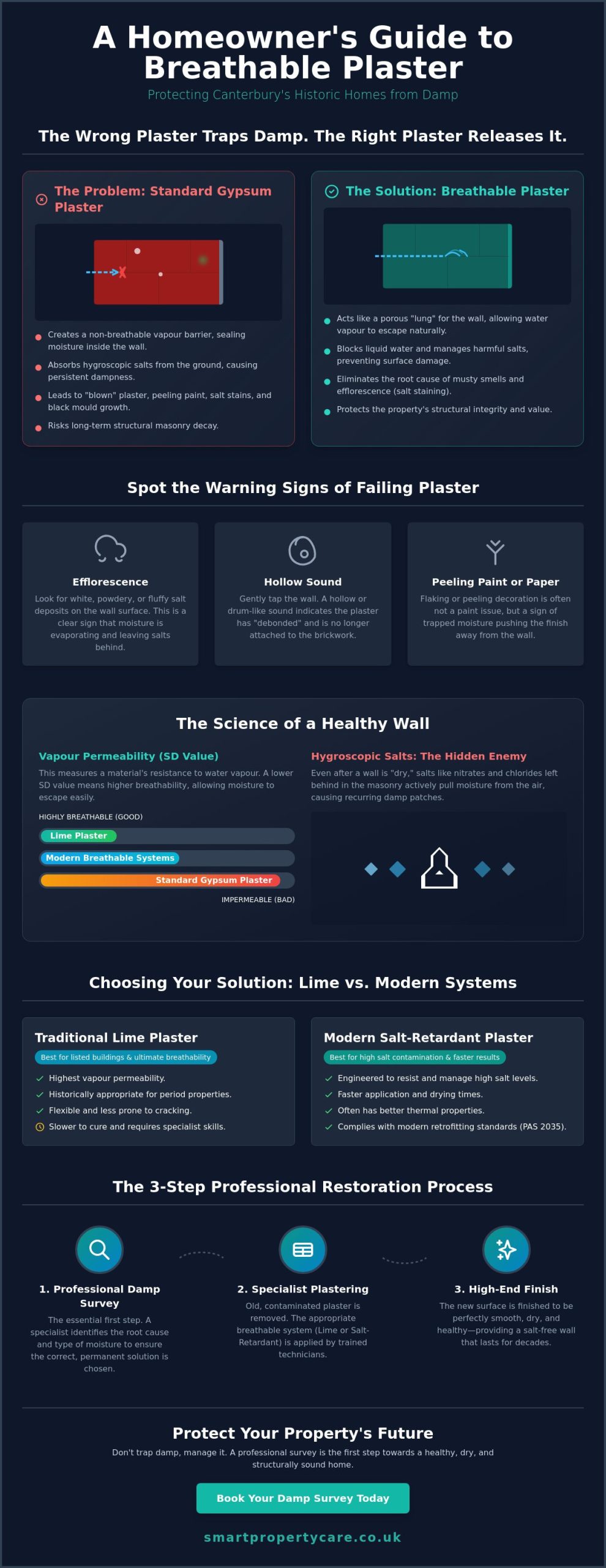
In essence, breathable plaster acts as a porous masonry lung for older properties, allowing the building to regulate its own internal moisture levels naturally. Unlike modern alternatives, these specialist materials allow water vapour to pass through the substrate while simultaneously blocking liquid water and harmful salts from reaching the interior surface. Without this ability, moisture remains trapped, leading to a cycle of decay that threatens both the aesthetics and the structural health of your home.
The Problem with Standard Gypsum in Older Properties
Modern gypsum plaster acts as a vapour barrier, sealing moisture inside solid brickwork. It absorbs hygroscopic salts from the ground, creating a “sweating” effect that fuels black mould growth. Traditional Lime plaster avoids this by maintaining high vapour permeability. Using non-breathable materials on historic masonry isn’t just a cosmetic error; it’s a structural risk that leads to “blown” surfaces and long-term masonry decay.
Recognising Falling Plaster in Your Home
Early signs of plaster failure are easy to spot if you know what to look for. Check for efflorescence, which appears as white, powdery salt deposits on the surface. Tap the wall; a hollow sound means the plaster has debonded from the brickwork. Often, peeling paint is actually a sign of trapped moisture pushing the decorative finish away. Identifying these signals early allows for a timely intervention with breathable plaster for damp walls canterbury, protecting your property’s value.
The Science of Breathability: How Specialist Plaster Manages Moisture
Understanding how moisture behaves in Canterbury brickwork is the first step toward a permanent solution. Capillary action draws water from the wet Kentish soil into the tiny pores of solid masonry, moving it upward and inward. Without the right materials, this moisture becomes trapped. Using breathable plaster for damp walls canterbury changes the dynamic of your wall from a sealed box to an active moisture-management system. We measure this effectiveness through SD values, which represent the equivalent air layer thickness of a material. A lower SD value means higher vapour permeability, ensuring your walls don’t hold onto damaging humidity.
Specialist plasters don’t just let air through; they are engineered to retard salt movement. When moisture evaporates, it leaves behind minerals that expand and destroy standard finishes. These specialist systems provide a sacrificial space for salt crystallisation to occur safely within the plaster’s structure, preventing it from reaching the surface. There is also a distinct thermal benefit. Breathable materials often feel warmer to the touch than cold, dense cement, reducing the risk of surface dew points where mould typically thrives.
Hygroscopic Salts: The Hidden Enemy
Ground salts, such as nitrates and chlorides, are the primary reason damp problems recur even after a wall seems dry. These salts are hygroscopic, meaning they actively pull moisture from the air. Even if the original leak is fixed, the salts remain. As detailed in this National Park Service Preservation Brief, using the wrong materials can exacerbate this by forcing salts deeper into the masonry. Specialist breathable plaster for damp walls canterbury manages this crystallisation process without cracking, shifting the focus from “drying out” to “managing moisture” for the long term.
Vapour Permeability Explained
Constant air circulation is the natural enemy of rot. Specialist plastering supports modern condensation control by allowing internal water vapour to migrate through the wall rather than condensing on the surface. This works in harmony with external lime rendering to create a unified, breathable envelope. If you’re concerned about the health of your home’s fabric, a professional property assessment can identify exactly how moisture is moving through your specific structure. This technical approach ensures that every layer of your wall contributes to a dry, stable environment.
Lime vs. Modern Breathable Plasters: Choosing the Right Solution
Selecting the correct material for your restoration is a balance between heritage compliance and modern performance. In Canterbury, the choice often depends on the age and legal status of your property. While traditionalists might suggest that lime is the only answer, modern engineering has introduced salt-retardant renovation plasters that offer distinct advantages for 20th-century homes. Both systems qualify as breathable plaster for damp walls canterbury, but they serve different structural needs. Precision in this selection process prevents future failure and ensures your home remains dry and healthy for decades.
The decision isn’t just about breathability; it’s about how the material interacts with the specific masonry of your house. Older buildings in the city centre often require a finish that can accommodate the natural movement of timber frames or soft red bricks. Conversely, a post-war semi-detached home might benefit from a faster-setting solution that specifically targets residual ground salts. We evaluate every project individually to match the plaster’s SD value and salt-handling capacity to the building’s requirements.
Traditional Lime Plastering
Traditional lime is the gold standard for pre-1900 listed buildings and timber-framed properties across East Kent. It offers the highest level of vapour permeability, acting as a natural regulator for moisture. Because lime is flexible, it moves with the building rather than cracking under stress. It’s also an eco-friendly choice, as it re-absorbs carbon dioxide during the curing process. However, you must account for longer timelines. Lime can take several weeks to cure fully, and it requires a specialist hand to apply correctly. For many Canterbury homeowners, this investment is mandatory to comply with local heritage regulations and preserve the historic fabric of their property.
Modern Renovation Plasters
Modern renovation plasters are the ideal choice for post-damp-course remediation in 20th-century homes. These systems are specifically engineered to handle high concentrations of hygroscopic salts that linger in the masonry even after the damp source is removed. They dry significantly faster than lime, often allowing for decoration within days rather than weeks. While their breathability is slightly lower than pure lime putty, it’s more than sufficient for buildings with a standard damp proof course. These plasters provide a robust, salt-resistant barrier that can be finished with modern breathable paints, making them a practical and durable solution for the majority of urban property maintenance projects. Choosing the right breathable plaster for damp walls canterbury means weighing these drying times and salt-resistance factors against your specific property goals.
The Restoration Process: From Damp Survey to Specialist Finish
Successful remediation in Canterbury requires a systematic approach that respects the city’s unique environmental pressures. Given the high water table and chalky soil prevalent in East Kent, moisture pressure against solid masonry is a constant reality. We don’t just patch over the problem. Our team follows a disciplined, multi-stage protocol designed to extract damaging elements and install a permanent moisture-management system. This process ensures your home remains dry, healthy, and structurally sound for decades.
The physical application of breathable plaster for damp walls canterbury follows a strict technical sequence. First, we remove all contaminated plaster to a height of at least 1 metre, or 500mm above the last sign of moisture, to ensure no salt-saturated material remains. We then rake out the mortar joints to a depth of 15mm. This isn’t just for adhesion; it allows us to remove the concentrated “salt crust” that often forms within Canterbury’s porous brickwork. Following this, we apply a breathable scratch coat and a floating coat, building the system’s vapour-permeable layers before finishing with a specialist skim.
Why a Survey Must Come First
We never begin work without a professional damp survey to identify the root cause of the moisture. It is essential to determine if the issue stems from a leaking gutter, high external ground levels, or a failed damp proof course. We also test for specific salt levels to calibrate the type of plaster required for your specific masonry. This diagnostic phase prevents the common mistake of treating a symptom while the underlying cause continues to damage the building fabric. Ensuring the wall is structurally sound before application is the only way to guarantee a result that lasts.
Decorating Breathable Plaster
The most common cause of failure after a specialist restoration is the “Paint Trap.” Applying standard vinyl emulsion seals the pores of your new plaster, effectively turning it back into a non-breathable surface. To maintain the system’s efficiency, you must use clay-based or silicate-based paints. These finishes allow for maximum airflow while providing a premium aesthetic. We generally advise waiting until the plaster has fully cured and changed to a uniform light colour before decorating. Choosing the right finish is just as important as the breathable plaster for damp walls canterbury itself. If you are ready to restore your home correctly, you can schedule your damp survey with our expert team today.
Why Smart Property Care Ltd is Canterbury’s Choice for Specialist Plastering
Smart Property Care Ltd has spent over 20 years mastering the unique damp challenges of East Kent. We understand that a home in Canterbury requires more than just a standard fix; it needs a solution tailored to its specific history and environment. As a family-run business with deep roots in Herne Bay and Canterbury, we take immense pride in preserving the local building stock. We offer a completely integrated service, managing both the damp proofing and the specialist plastering in-house. This gives our clients a single point of accountability and the peace of mind that every stage of the restoration meets our high standards of craftsmanship.
Our team possesses deep expertise in both traditional lime applications and modern salt-retardant systems. We don’t believe in one-size-fits-all solutions. Instead, we match the material to the masonry, ensuring that your breathable plaster for damp walls canterbury performs exactly as intended. By controlling the entire process from initial diagnosis to the final decorative advice, Smart Property Care Ltd eliminates the communication gaps that often lead to project failure. You aren’t just hiring a contractor; you’re partnering with a specialist dedicated to the long-term health of your property.
Our Commitment to Quality
We know that remedial work can be disruptive. That’s why we prioritise clean, professional site management, which is essential for occupied homes. Our craftsmen treat your property with the respect it deserves, maintaining an organised workspace and minimising dust. We use high-standard materials specifically chosen for their compatibility with Kentish masonry, from porous red bricks to historic flint. To further reassure our clients, Smart Property Care Ltd provides long-term guarantees on our remedial work and specialist finishes. This commitment to quality is the cornerstone of our reputation as a dependable local partner.
Ready to Restore Your Property?
The path to a dry, salt-free home begins with a technical assessment. When you book a survey in Canterbury or the surrounding areas, you receive more than just a quote. You get a detailed survey report that identifies the root cause of moisture, maps salt concentrations, and outlines a clear, step-by-step restoration plan. We provide the clarity you need to make informed decisions about your property’s preservation. Contact our specialist team today for peace of mind and take the first step toward a permanent solution with expert breathable plaster for damp walls canterbury.
Secure Your Property’s Future with Specialist Restoration
Restoring the structural health of your home requires moving beyond temporary fixes to a technically sound moisture-management system. By prioritising vapour permeability and salt retardation, you protect the historic fabric of your building from the inside out. Choosing the correct breathable plaster for damp walls canterbury is the final, vital step in ensuring your living environment remains dry, salt-free, and healthy for the long term. This investment doesn’t just fix a surface issue; it preserves your home’s value for decades.
Smart Property Care Ltd brings over 20 years of local Kent expertise to every project. We specialise in both traditional lime and modern renovation plasters, providing a single point of accountability for your entire restoration. Our comprehensive surveys include detailed technical reports that identify root causes before any work begins. This disciplined approach eliminates guesswork and delivers the peace of mind you deserve. Book Your Specialist Damp Survey in Canterbury Today to begin your home’s transformation. You don’t have to live with recurring damp; a permanent, high-end solution is within reach.
Frequently Asked Questions
Can I use standard emulsion paint on breathable plaster?
No, you shouldn’t use standard vinyl emulsion on specialist breathable finishes. These paints create a non-porous film that acts as a vapour barrier, effectively sealing moisture inside your walls. To maintain the system’s efficiency, you must choose vapour-permeable finishes like clay-based or silicate paints. These allow the wall to continue “breathing,” preventing the surface from bubbling or peeling over time.
How long does breathable plaster take to dry before I can paint it?
Drying times vary significantly depending on the specific product used. Modern renovation breathable plaster for damp walls canterbury can often be ready for decoration within a few days once it reaches a uniform light colour. However, traditional lime-based systems may require several weeks to cure fully. We always recommend waiting until the material has completely stabilised to ensure the best possible bond with your chosen breathable paint.
Is breathable plaster the same as lime plaster?
Lime is a traditional form of breathable plaster, but it isn’t the only option available for your home. While lime is essential for most listed buildings in Canterbury, modern salt-retardant renovation plasters offer a high-performance alternative for 20th-century properties. These modern systems are engineered to manage hygroscopic salts more aggressively while still providing the necessary vapour permeability to keep the underlying masonry healthy and dry.
Do I need a damp proof course if I use breathable plaster?
Breathable plaster is a moisture-management system, not a replacement for a physical or chemical damp proof course (DPC). In many cases, we install a new DPC to stop the source of rising damp while using specialist plastering to manage residual moisture and salts already in the brickwork. Using both ensures a comprehensive solution that protects your home’s structural integrity from both ground water and internal condensation.
Can breathable plaster stop rising damp on its own?
No, breathable plaster cannot stop the physical process of rising damp at the source. Its primary job is to allow moisture already in the wall to evaporate harmlessly without damaging the decorative finish or trapping salts. To stop rising damp effectively, you typically need a targeted damp proofing treatment. We treat the plastering as one part of a wider, integrated strategy to restore your property’s health.
Why is my new plaster still showing damp patches after a week?
It’s common for new plaster to show patches as it cures, especially on solid Canterbury brickwork that holds a high volume of residual moisture. If patches persist, it could indicate that the wall is still equalising its moisture levels or that the underlying damp source requires further investigation. A professional survey identifies if these patches are a normal part of the drying process or a sign of an ongoing structural issue.
How much more expensive is breathable plastering than normal plastering?
Specialist breathable plaster for damp walls canterbury involves a higher initial investment than standard gypsum work. This reflects the advanced technical properties of the materials and the specialist skills required for a durable application. While the upfront cost is higher, it prevents the expensive cycle of recurring damp and failing finishes associated with standard materials. It’s a long-term preservation strategy that protects your property’s market value.
What happens if I use gypsum plaster over a wall with rising damp?
Using gypsum plaster over a wall with rising damp is a recipe for rapid failure. Gypsum is highly absorbent; it pulls moisture and hygroscopic salts from the masonry like a sponge, leading to the plaster “blowing” or debonding from the wall. It also traps moisture behind the surface, which encourages black mould growth and can lead to the decay of nearby timber structures like skirting boards and floor joists.