
Did you know that 28% of the UK population currently lives in a home affected by damp or mould? If you’ve discovered a dark patch spreading across a ceiling or wall in Kent, you’re likely feeling a mix of health anxiety and concern for your property’s value. It’s difficult to distinguish between harmless surface mildew and dangerous spores without expert intervention. Investing in professional toxic mould testing kent is the most reliable way to replace that uncertainty with a definitive assessment of your home’s air quality.
We believe that every homeowner deserves the peace of mind that comes with a dry, safe environment. You’re right to take these signs seriously, especially with the recent legal shifts in the Renter’s Rights Act 2026 and Awaab’s Law highlighting the urgency of property health. This guide will show you how to identify dangerous mould varieties, explain the technical testing process, and help you uncover the underlying damp issues. You’ll gain a clear understanding of the steps required for permanent remediation and long-term protection.
Key Takeaways
- Understand the critical difference between common mildew and dangerous Stachybotrys chartarum to protect your family’s health and property value.
- Discover why professional toxic mould testing kent is essential for detecting hidden spores through specialist air quality sampling and precision moisture mapping.
- Learn to recognise the specific warning signs, such as persistent musty odours or recent water ingress, that necessitate an immediate expert survey.
- Explore advanced remediation protocols, including antimicrobial fogging and HEPA filtration, designed to eliminate spores and restore a safe living environment.
- Identify how addressing the underlying damp issue through specialist treatment provides a permanent solution to prevent future mould growth.
What is Toxic Mould and Why Does it Thrive in Kent Homes?
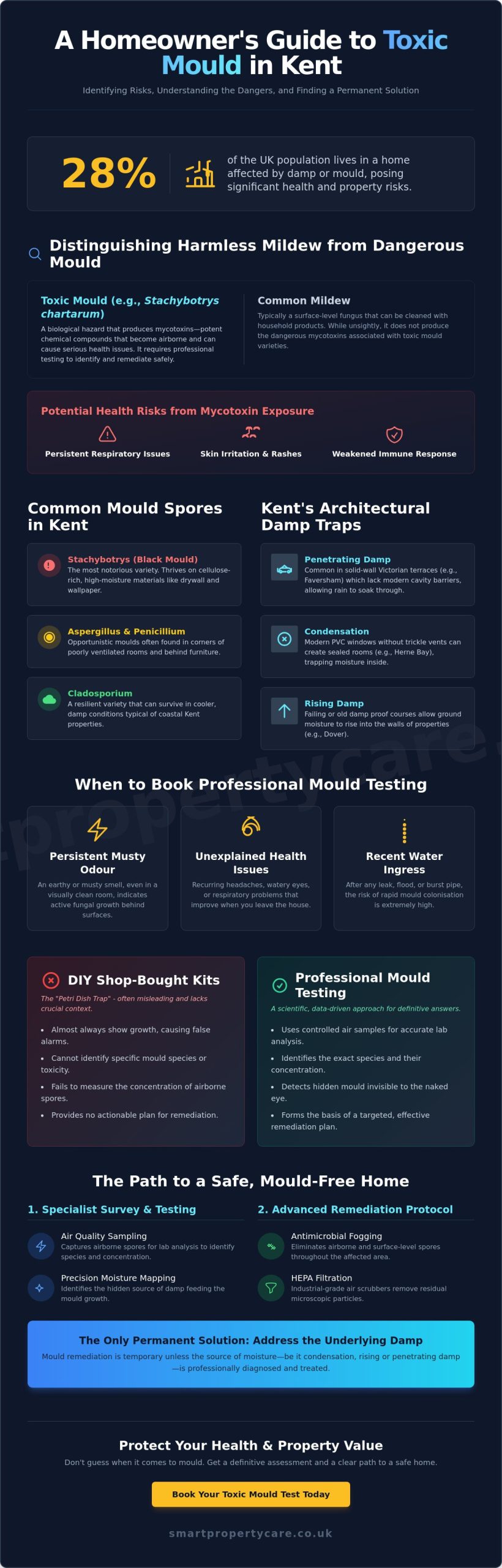
Toxic mould is more than a visual blemish; it’s a complex biological hazard. While the term is often used broadly, it specifically refers to fungi like Stachybotrys chartarum that produce mycotoxins. These secondary metabolites are potent chemical compounds that can linger in the air long after the visible growth is gone. For homeowners, the confusion between surface-level mildew and deep-rooted structural fungal growth can lead to costly delays. Securing professional toxic mould testing kent provides the laboratory-grade data needed to identify exactly which spores are present and how they are impacting your environment.
The legal and health standards of 2026 have shifted the focus from simple cleaning to comprehensive air quality management. Recent regulations like Awaab’s Law emphasize that the health risks of mould are a primary concern for any habitable building. Prolonged exposure can lead to persistent respiratory issues, skin irritation, and weakened immune responses. We approach every survey with this clinical perspective, understanding that a “clean” looking wall can still host millions of invisible, airborne spores that compromise your family’s safety.
Common Spores Found in East Kent Properties
East Kent properties frequently play host to three primary fungal groups. Stachybotrys is the most notorious, requiring high moisture levels and cellulose-rich materials like wallpaper or drywall to thrive. Aspergillus and Penicillium are more opportunistic, often appearing in the corners of poorly ventilated bedrooms in Kentish flats. Finally, Cladosporium is a resilient variety that survives in the cooler, damp conditions typical of coastal Canterbury. Each species requires a tailored remediation strategy to ensure it doesn’t return.
The Role of Kent’s Architecture in Mould Growth
The historical charm of Kentish architecture often conceals hidden moisture traps. Solid-wall Victorian terraces in Faversham are prone to penetrating damp because they lack modern cavity barriers. In towns like Herne Bay, the installation of PVC windows without adequate trickle vents has created “hermetically sealed” rooms where condensation thrives. We also see many Dover properties where damp proof courses installed decades ago are failing; this allows ground moisture to rise and create the perfect laboratory for mould to colonise your home’s structure. Identifying these architectural weaknesses is a core part of our toxic mould testing kent service.
When Should You Book Professional Toxic Mould Testing?
Visible black spots are often just the final stage of a much larger, hidden problem. A persistent, earthy, or musty odour in a room that appears clean is a primary indicator that fungi are active behind the scenes. These smells are caused by microbial volatile organic compounds (mVOCs) released as colonies consume building materials. If your property has recently suffered a significant leak, burst pipe, or flood, the risk of rapid colonisation is extremely high. In these scenarios, toxic mould testing kent acts as a vital diagnostic tool to ensure your environment remains safe for habitation.
Health is the most urgent reason to seek professional intervention. If residents experience recurring respiratory issues, headaches, or watery eyes that mysteriously vanish when they leave the property, the air quality is likely compromised. This is no longer just a matter of comfort; it’s a legal necessity. Under the Renter’s Rights Act 2026, Kent landlords are held to rigorous standards regarding property safety. The official government guidance now classifies damp and mould as high-priority hazards that require immediate investigation. For those looking to buy, ensuring a professional damp survey includes a mould assessment can prevent a dream purchase from becoming a financial burden.
Professional Testing vs. DIY Shop-Bought Kits
Many homeowners fall into the “Petri Dish Trap” by using inexpensive, shop-bought kits. These kits almost always show growth because mould spores exist naturally in almost every environment. They lack the context of a controlled air sample. Our professional toxic mould testing kent involves laboratory analysis to determine the precise spore count per cubic metre. By comparing indoor samples against outdoor controls, we provide a definitive report on whether the concentration in your home is actually hazardous.
Signs of Hidden Mould Behind Walls and Under Floors
Mould thrives in the dark, stagnant voids of a building’s structure. Peeling wallpaper, bubbling paint, or stains on the reverse side of skirting boards are clear warning signals of a deeper issue. We don’t rely on guesswork; we use high-resolution thermal imaging to locate cold spots and moisture reservoirs where condensation colonises. This technical precision allows us to find the root cause before it spreads further. If you’ve noticed these signs, our team provides the expert mould remediation required to protect your property long-term.
The Process: How Specialist Mould Surveys Work
A professional mould survey is a meticulous diagnostic operation. We don’t just identify the presence of fungi; we map the environmental conditions that allowed it to colonise your home. Our process for toxic mould testing kent begins with an exhaustive visual inspection followed by precision moisture mapping. By using high-specification equipment, we can see through the surface of your walls to find hidden damp reservoirs that a standard visual check would overlook. This disciplined approach ensures that no hidden colony is left undetected.
We combine laboratory-grade air sampling with surface analysis to provide a complete picture of your home’s health. This technical rigour is what distinguishes toxic mould testing kent from basic visual assessments. By measuring the concentration of airborne spores, we can determine if a property requires specialist remediation or simple environmental adjustments. Every survey identifies the specific moisture source, such as rising damp, penetrating damp, or structural condensation, so the solution targets the cause rather than just the symptom. This provides you with the clarity needed to make informed decisions about your property’s preservation.
Moisture Mapping and Diagnostic Tools
Precision is the hallmark of our diagnostic phase. We utilise non-invasive moisture meters to detect water within the wall structure without damaging your decor. In coastal Kent properties, where sea air and humidity levels fluctuate, we use hygrometers to measure relative humidity and dew points. This identifies exactly when and where moisture will condense on your surfaces. Thermal imaging cameras allow us to visualise “cold bridges,” which are structural weak points where insulation is lacking and mould is most likely to strike first.
What to Expect in Your Specialist Report
The conclusion of our survey is a comprehensive technical report that serves as a definitive record of your property’s condition. This document provides a detailed breakdown of spore types and concentrations found within the premises. It acts as your “Preservation Plan,” prioritising the correction of the damp source before any mould removal begins. Within this roadmap, you’ll find a clear, costed specification on how to get rid of mould on walls permanently. This ensures your home remains a healthy, dry environment for years to come.
Beyond Testing: Remediation and Long-Term Prevention
Once the results of your toxic mould testing kent identify a hazard, the priority shifts to clinical elimination. We don’t just scrub surfaces; we implement rigorous removal protocols designed to protect both the building and its inhabitants. This involves HEPA vacuuming to capture microscopic spores and antimicrobial fogging to neutralise airborne toxins. For Kent landlords, these steps are now a matter of legal compliance. Under Awaab’s Law and the 2026 habitation regulations, property owners face strict timelines to resolve significant hazards. Failing to address the root cause doesn’t just risk property devaluation; it now carries substantial legal liability.
Many homeowners mistakenly reach for “anti-mould” paint as a first resort. This is often a temporary sticking plaster that masks the issue while the fungi continue to consume the structure underneath. True prevention requires a permanent barrier against moisture. This is why damp proofing in Kent is essential. By blocking moisture at the source, we ensure the environment remains hostile to fungal growth, protecting your investment for the long term. Restoring the property with specialist plastering and rendering ensures that once the mould is gone, it cannot find a foothold again.
Structural Solutions: Damp Proofing and Tanking
If our diagnostic phase identifies rising damp, we install a new damp proof course (DPC) to sever the capillary path of groundwater. For cellar conversions in Canterbury and Herne Bay, we utilise basement tanking. This creates a robust, waterproof seal that keeps subterranean spaces dry and habitable. We also focus on improving sub-floor ventilation. Ensuring a constant flow of air beneath your floorboards keeps timbers dry and prevents the stagnant, damp conditions that invite mould colonisation.
Condensation Control and Specialist Plastering
Modern property preservation frequently involves Positive Input Ventilation (PIV) systems. These units replace stagnant, moisture-laden air with fresh, filtered air to eliminate the condensation that fuels mould. After a damp-related outbreak, standard gypsum plaster is insufficient because it traps salts. We use salt-neutralising plaster to prevent hygroscopic salts from ruining your new decor. For exposed coastal properties, we also perform external rendering repairs to stop penetrating damp from breaching your home’s envelope during heavy Channel storms.
Ready to restore your home’s health? Book your professional mould remediation today to secure a dry, spore-free future for your property.
Choosing a Trusted Kent Specialist for Mould and Damp
Selecting a partner to safeguard your property is a decision that impacts your home’s longevity and your family’s health. In a market where many providers offer fragmented services, choosing a family-run business with over 20 years of local Kent experience ensures a level of accountability that national chains often lack. We understand the specific environmental challenges of the East Kent landscape, from the salt-heavy air in Margate to the historic timber-framed structures in Canterbury. Professional toxic mould testing kent is the essential first step, but the true value lies in a comprehensive “all-in-one” preservation approach. By handling everything from the initial survey to specialist plastering, we eliminate the communication gaps that lead to recurring damp issues.
Trust is built on verification and visible results. We encourage all clients to check for professional memberships and the availability of long-term guarantees before commissioning work. Our reputation across East Kent is grounded in our ability to provide definitive solutions rather than temporary fixes. We don’t just treat the mould; we restore the structural integrity of your property, ensuring that the moisture source is permanently blocked. This holistic view of property preservation provides the peace of mind our clients expect from a premium local partner.
The Smart Property Care Difference
We bridge the gap between advanced diagnostic technology and traditional building craftsmanship. Our team uses high-precision moisture mapping alongside time-honoured carpentry and building skills. This combination allows us to address complex issues like dry rot or failing damp proof courses with surgical accuracy. We take immense pride in our work, positioning ourselves as the Expert Craftsman for homeowners who value quality and reliability. Local reliability isn’t just a marketing term; it’s our commitment to being available for our clients long after the toxic mould testing kent and remediation are complete.
Book Your Specialist Property Survey Today
Taking action early is the most effective way to prevent mould from causing irreversible structural damage or health complications. You can start the process with a thorough, fixed-fee inspection that provides a clear roadmap for your property’s recovery. Our Herne Bay office coordinates our specialist teams across the entire East Kent region, offering expert advice tailored to your specific building type. Don’t let damp compromise your living environment any longer. Protect your home and health and book your specialist damp and mould survey to secure your property’s future.
Restore Your Home’s Health and Structural Integrity
Protecting your property from fungal growth requires more than a reactive approach. You’ve learned that identifying the specific moisture source through technical moisture mapping and air sampling is the only way to ensure a permanent solution. By choosing professional toxic mould testing kent, you replace anxiety with a clinical, evidence-based plan for remediation. Addressing structural damp and improving ventilation doesn’t just satisfy modern legal requirements; it preserves the value and safety of your investment for years to come.
As a family-run business based in Herne Bay with over 20 years of property preservation experience, we take pride in delivering results that last. We provide comprehensive damp, timber, and mould reports that offer total transparency regarding your home’s condition. Our team is ready to help you reclaim your environment with the precision and care it deserves. Don’t let moisture compromise your well-being any longer. Book a Specialist Damp and Mould Survey with Kent Experts today and take the first step toward a drier, healthier home.
Frequently Asked Questions
Is black mould always toxic?
No, not all black-coloured fungi are toxic, but several species like Stachybotrys chartarum produce harmful mycotoxins that pose serious health risks. Visual identification is unreliable because many non-toxic species look identical to dangerous ones. Technical analysis is the only way to determine if the growth in your home is a biological hazard or a less severe aesthetic issue.
How much does professional toxic mould testing cost in Kent?
The investment for toxic mould testing kent depends on the complexity of the property and the number of air samples required for a definitive report. We recommend starting with a fixed-fee specialist inspection to determine the scope of the issue. This professional assessment ensures you only pay for the specific laboratory analysis your property actually needs to confirm safety levels.
Can I stay in my house while mould testing is being carried out?
Yes, you can usually remain in your property during the testing phase as the process is non-invasive and quiet. Technicians collect air and surface samples without disturbing the environment or releasing additional spores. If we suspect exceptionally high levels of toxic spores in a specific room, we may advise keeping that door closed until the laboratory results are confirmed.
What is the difference between a damp survey and a mould test?
A damp survey identifies the physical source of moisture, such as rising damp or a failing roof, while a mould test identifies the biological presence and concentration of spores. A comprehensive preservation survey combines both methods. This ensures we don’t just identify the mould, but also the structural failure that allowed it to thrive in the first place.
How long does it take to get mould test results back?
You can typically expect a comprehensive report within three to five working days following the site visit. While initial moisture mapping provides immediate feedback, toxic mould testing kent requires laboratory incubation to accurately identify specific fungal species. This technical rigour ensures that the remediation plan is based on precise biological data rather than surface-level guesswork.
Does home insurance cover the cost of toxic mould testing?
Coverage usually depends on the primary cause of the moisture. If the mould resulted from a sudden, covered peril like a burst pipe or a flash flood, many insurers will cover the testing and remediation costs. However, mould caused by long-term maintenance issues, such as gradual condensation or a lack of ventilation, is rarely included in standard policies.
Can mould grow back after professional remediation?
Mould will not return if the underlying moisture issue is permanently resolved. Professional remediation includes addressing the root cause, such as installing a new damp proof course or a PIV system for condensation control. If a contractor only cleans the surface without fixing the damp, the spores will eventually colonise the area again when the conditions are right.
Is it a legal requirement for Kent landlords to test for mould?
Under Awaab’s Law and the Renter’s Rights Act 2026, landlords have a strict legal obligation to investigate and resolve reports of damp and mould within specific timeframes. While the law doesn’t mandate a specific “test” for every case, a professional report is often the only way for a landlord to prove they’ve fulfilled their duty of care and that the property is fit for habitation.