
What if the faint tapping in your floorboards isn’t just the house settling, but the sound of your property’s structural integrity being compromised? In a city defined by its historic architecture and coastal air, moisture management is a constant battle for homeowners. You likely understand that timber decay isn’t just a cosmetic issue. It’s a structural threat that can stall mortgage applications and lead to daunting repair bills if left unaddressed. A professional woodworm survey canterbury residents trust is the only way to separate historic damage from an active, destructive threat.
By choosing a specialist inspection, you’ll discover whether an infestation is active or merely a ghost of the past. We promise to provide the clarity you need, from identifying the specific beetle species to delivering a comprehensive timber report that satisfies both your peace of mind and your lender’s requirements. This guide previews how we use technical precision to audit your property’s moisture levels, the impact of new 2026 professional standards for treatment, and the path toward a guaranteed, fixed-price solution for your timber concerns.
Key Takeaways
- Learn why a standard homebuyer’s report often overlooks subtle timber issues and why a specialist inspection is vital for Canterbury’s historic terraces.
- Discover how to differentiate between historic damage and active infestations using the ‘Frass’ test and specific exit hole diagnostics.
- Understand the critical link between East Kent’s coastal humidity and timber decay to ensure you address the root cause of the problem.
- Gain a clear roadmap of the professional woodworm survey canterbury process, covering both external drainage and internal loft assessments.
- See how a holistic treatment plan preserves your property’s value by tackling both the wood-boring beetles and the underlying moisture that sustains them.
Why Your Canterbury Property Needs a Specialist Woodworm Survey
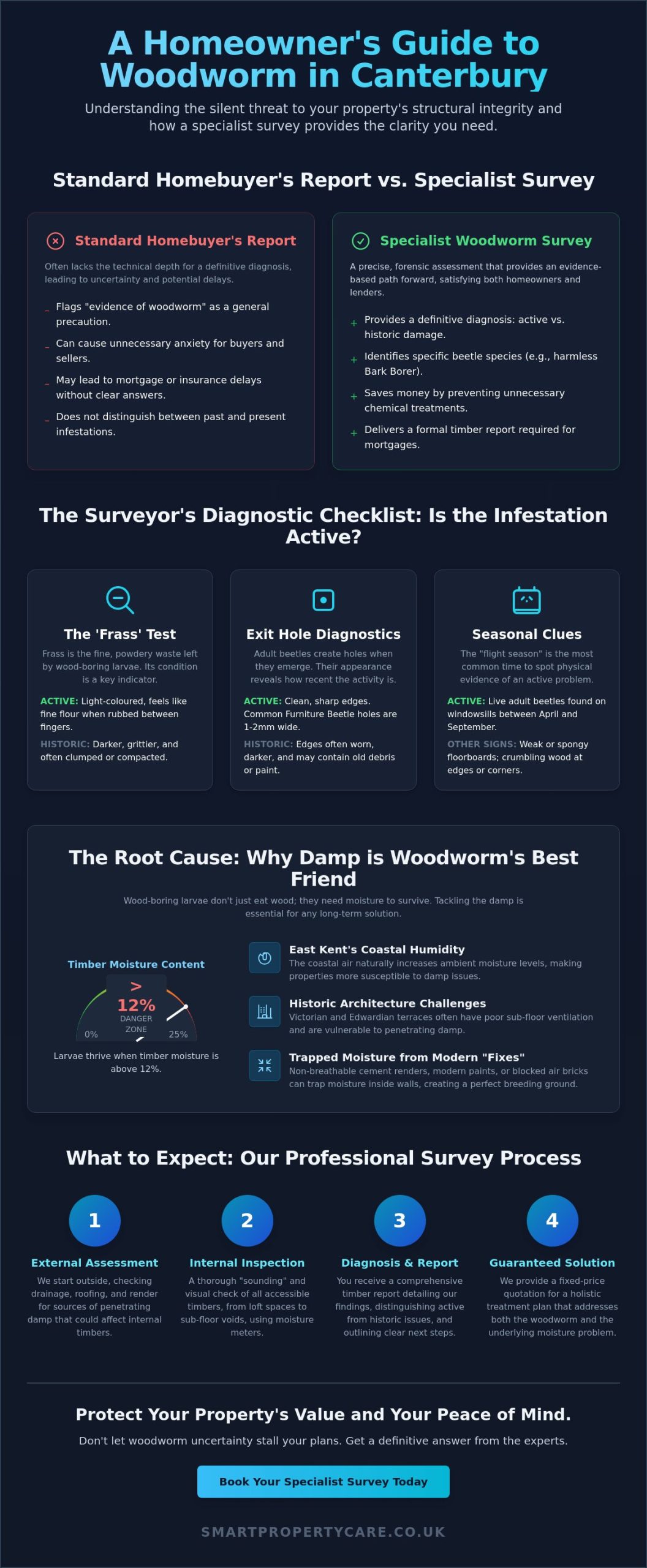
A standard RICS Homebuyer’s Report is a vital tool during a property purchase, but it often lacks the technical depth required to diagnose specific timber decay. General surveyors may flag “evidence of woodworm” as a precautionary measure, which often leads to unnecessary anxiety or mortgage delays. A dedicated woodworm survey canterbury provides a precise, forensic assessment that distinguishes between dormant, historic exit holes and an active, destructive infestation. This distinction is critical for property transactions in Kent, where building insurers and lenders often demand a formal timber report before releasing funds.
Misdiagnosis is a common pitfall in the property maintenance industry. Many homeowners are surprised to learn that not every hole in a beam signifies a structural threat. Some species, such as the Bark Borer, are entirely harmless once the bark is removed and require no chemical intervention. A specialist ensures you don’t pay for treatments that your property doesn’t actually need, providing a clear, evidence-based path forward that protects both your timber and your budget.
Canterbury’s Architectural Heritage and Timber Risks
The historic terraces of CT1 and CT2, particularly those from the Victorian and Edwardian eras, present unique challenges. These buildings often feature original softwood floorboards and joists that are highly attractive to the Common Furniture Beetle. In Canterbury’s city centre, many timber-framed buildings have undergone “modern” renovations over the decades. Unfortunately, the use of non-breathable cement renders or modern paints often traps moisture within the walls. This creates the humid micro-climate that wood-boring larvae need to thrive, turning a sturdy joist into a compromised structure over time.
When to Book a Specialist Timber Inspection
Early detection is the most effective way to limit repair costs and maintain structural safety. You should look for “frass”, which is the fine, light-coloured bore dust pushed out of exit holes by emerging beetles. If you see fresh, sharp-edged holes approximately 1mm to 2mm in diameter, it’s a sign of recent activity. Understanding What is woodworm? helps homeowners realize that the damage is actually caused by the larvae eating through the wood over several years, not just the adult beetles seen during the summer months.
The “flight season” between April and September is the most common time to spot adult beetles on windowsills as they emerge to mate. However, the larvae remain active deep inside the wood year-round, hidden from view. A specialist survey is essential because structural timber remains at risk of active infestation whenever its moisture content exceeds 12%.
Identifying Active Infestations: The Surveyor’s Diagnostic Checklist
A professional woodworm survey canterbury involves more than a quick visual check. It’s a forensic investigation into the health of your home’s skeleton. Our surveyors follow a rigorous diagnostic checklist to determine if wood-boring insects are currently consuming your floorboards or if the damage is a relic from decades ago. We look for fresh “frass”, which is the fine, powdery waste left by larvae. Fresh frass is light in colour and feels like fine flour; old debris is typically darker, grittier, and more compacted.
We also examine exit holes with precision. The Common Furniture Beetle leaves distinct 1mm to 2mm round holes, but their presence alone doesn’t prove an active threat. We don’t stop at visual cues. We use “sounding” techniques, tapping load-bearing beams with specialized tools to detect internal hollows. This helps us identify where the timber’s core may be compromised even if the surface looks intact. During late spring, we look for live sightings, as adult beetles are often found on windowsills. For a deeper technical understanding of these signs, Identifying Active Infestations provides an excellent overview of beetle life cycles and damage patterns.
Active vs. Historic Woodworm: Saving on Unnecessary Costs
Distinguishing between active and historic infestations is the most effective way to save on repair costs. We often use the “Tape Test”, where masking tape is applied over suspected exit holes. If new beetles emerge and pierce the tape during the next flight season, the infestation is live. Historic exit holes are often just cosmetic scars that require no chemical intervention. However, we must assess whether that historic damage has already weakened a structural beam to the point of failure. If you’ve spotted suspicious holes in your joists, booking a professional timber assessment can prevent minor issues from becoming major expenses.
Species Identification: Beyond the Common Furniture Beetle
Species identification dictates the specific treatment required. The Death Watch Beetle, for instance, prefers damp oak beams found in older Canterbury properties. It creates larger, more irregular holes and can cause significant structural decay. Conversely, the Wood Boring Weevil is usually a secondary sign of damp. It only attacks timber already softened by moisture or rot. By identifying the exact beetle, we ensure the treatment targets the specific pest and the environmental conditions that allowed it to thrive. This precision protects your property’s value and your peace of mind.
The Link Between Damp and Woodworm in East Kent
Wood-boring larvae don’t survive in dry, well-ventilated environments. To thrive and digest cellulose effectively, these pests require a specific minimum moisture content within the timber. When wood becomes damp, it softens, making it significantly easier for larvae to tunnel through the fibres. This is why a woodworm survey canterbury is essentially a moisture audit of your property. We look beyond the surface damage to understand why the timber has become a viable habitat in the first place. Without addressing the underlying dampness, even the most aggressive chemical treatments may only offer a temporary reprieve.
Canterbury’s unique geography plays a major role in local timber decay. The city’s proximity to the River Stour and the persistent coastal humidity of East Kent create an environment where atmospheric moisture levels are consistently high. In historic properties, this moisture often settles in unheated areas like lofts and cellars. Over time, the timber absorbs this humidity, pushing the moisture content above the critical threshold for beetle activity. Our surveyors pay close attention to properties near the river, where high water tables often contribute to rising damp in ground-floor joists.
When rising damp affects the base of your walls, it quickly migrates into the ends of floor joists embedded in the masonry. This creates a hidden, high-moisture ‘perfect’ environment for infestations to take hold. Integrating professional damp surveys with your timber inspection allows us to identify these moisture bridges. We provide a dual-focus solution that protects your structural integrity while eliminating the water source that sustains the pests.
Sub-Floor Ventilation and Beetle Habitat
Many older Canterbury properties suffer from blocked or insufficient air bricks. When sub-floor ventilation is restricted, moisture becomes trapped in the voids beneath your feet. This stagnant, humid air softens the timber, inviting the Common Furniture Beetle to colonise the joists. It’s a common pattern in Victorian terraces across the CT1 and CT2 postcodes. You must recognise that woodworm is often a symptom of underlying condensation or damp issues rather than an isolated pest problem.
Managing Timber Moisture Content
Precision is the hallmark of our service. We use calibrated Protimeters to map moisture ‘hotspots’ throughout your home, ensuring we don’t rely on guesswork. By identifying exactly where the timber is at risk, we can recommend targeted interventions. Reducing internal humidity through effective condensation control is the most reliable long-term preventative measure you can take. When your home is dry and well-ventilated, it ceases to be an attractive target for wood-boring insects, providing you with lasting peace of mind.
What to Expect During Your Professional Timber Survey
A professional woodworm survey canterbury follows a methodical, five-step process designed to provide total clarity on your property’s health. We begin with a thorough external inspection. Our surveyors examine air bricks, roof lines, and ground levels to identify moisture bridges or blocked ventilation points that could lead to timber decay. We then transition indoors to assess all accessible timbers. This includes a deep dive into loft spaces and floor voids, where the Common Furniture Beetle is most likely to hide.
During the internal phase, we use moisture mapping to identify high-risk zones where humidity levels exceed safe thresholds. We don’t just look for holes; we perform structural integrity testing on load-bearing beams to ensure the timber remains safe. Once the physical inspection is complete, we provide a species identification and a detailed specification for any necessary remedial works. This culminates in a comprehensive, costed technical report that serves as a definitive record for your property files.
Access Requirements and Preparation
To provide an accurate assessment, our surveyors require access to the “skeleton” of your home. You may need to move stored items from attic spaces or clear furniture from specific areas of a room. In some instances, we may need to lift a small number of floorboards to inspect the sub-floor joists. We understand that your home is a living space, not just a site. Our team takes immense pride in minimising disruption, ensuring that any lifted boards are replaced securely and the work area is left tidy. If you are preparing for a property transaction, you can book your professional timber survey today to ensure every corner of your home is verified.
The Survey Report: Your Legal and Financial Safeguard
The final report is more than just a summary; it’s a vital financial document. Unlike a ‘free’ visual check offered by general contractors, our specialist property survey provides a formal ‘specification for remedial works’. This document is essential if you’re navigating a mortgage application or making an insurance claim. Banks and building societies require this level of technical detail to release funds, as it proves that any infestation has been professionally diagnosed and the treatment plan is backed by expertise. Having a clear, costed report allows you to negotiate property prices or secure your lending with absolute confidence.
Why Choose Smart Property Care for Canterbury Timber Preservation
Choosing the right partner for your woodworm survey canterbury is about more than just finding a technician with a moisture meter. It’s about securing the future of your home with a team that understands the local landscape. With over 20 years of experience as a family-run specialist in East Kent, Smart Property Care Ltd brings a level of discipline and local knowledge that general contractors simply can’t match. We don’t just treat the beetles; we address the environmental root causes. Our holistic expertise ensures we eliminate the woodworm and the damp that allowed the infestation to take hold in the first place.
Peace of mind is our primary deliverable. We stand behind our craftsmanship with long-term guarantees, offering 20-year or 30-year protection depending on the scope of the work. This level of commitment is why Canterbury homeowners trust us with their most valuable assets. We navigate the complexities of local building regulations and heritage concerns with ease, ensuring your property remains compliant while staying structurally sound. A professional woodworm survey canterbury residents rely on provides the technical evidence needed to satisfy both lenders and insurers.
Expertise in Traditional Kent Building Techniques
Period properties require a delicate touch. Our background in professional woodworm treatment for historic buildings means we understand the nuances of Kentish timber frames. We know how 19th-century oak behaves compared to modern softwoods. Our qualified surveyors use this insight to recommend the most effective, least invasive solutions. We’re committed to using modern, low-odour, water-based preservation chemicals. These treatments are highly effective against larvae but allow you to return to your home quickly and safely, without the lingering chemical smells of older methods.
Local Reliability from Herne Bay to Canterbury
We’ve built our reputation on being a punctual, professional team that respects your home environment. From Herne Bay to the heart of Canterbury, we provide a reliable presence that property owners can count on. Our capability extends beyond simple spraying; we offer a comprehensive suite of services, including structural timber repair and specialist plastering. This one-stop approach removes the stress of managing multiple contractors and ensures a consistent standard of quality across the entire project. If you’re ready to protect your investment and resolve your timber concerns, contact us today for a damp and timber report that sets the professional standard in East Kent.
Secure Your Canterbury Home’s Structural Future
Protecting your property requires more than just reactive treatment; it demands a technical understanding of the moisture levels that invite timber decay. You now understand how a specialist woodworm survey canterbury separates historic damage from active threats, saving you from unnecessary repair costs. By identifying the root cause of dampness and providing a mortgage-approved report, you ensure your home remains both structurally sound and financially secure.
Smart Property Care combines over 20 years of local experience with the rigorous PCA-aligned standards expected by lenders and insurers. As a family-run Kent business, we take immense pride in preserving the unique architectural heritage of our city. We provide the clarity and precision needed to resolve your timber concerns permanently. Take the first step toward total peace of mind and protect your investment with an expert assessment.
Book Your Specialist Woodworm Survey in Canterbury Today
Your property deserves the highest standard of craftsmanship, and we’re ready to help you restore its integrity.
Frequently Asked Questions
How much does a woodworm survey cost in Canterbury?
A professional woodworm survey and report for properties in the Canterbury area typically costs £90. This fee is often refundable if you hire the company to perform the necessary treatment work. It’s a precise investment that prevents the much higher costs associated with undetected structural timber decay.
Is woodworm common in Canterbury’s Victorian houses?
Victorian and Edwardian terraces in the CT1 and CT2 postcodes are particularly susceptible due to their original softwood joists and floorboards. Canterbury’s high humidity levels and proximity to the River Stour often push timber moisture content above the 12% threshold required for larvae to thrive. This makes regular inspections vital for older homes in the city.
Will a woodworm survey flag show up on my mortgage valuation?
General surveyors often flag “suspected timber infestation” as a precautionary measure, which can delay mortgage approvals. A specialist woodworm survey canterbury provides the formal technical report that banks and building societies require. This document proves whether an infestation is active or historic, allowing your property transaction to proceed with confidence.
Can I stay in the property during a woodworm survey?
You can remain in your home throughout the entire inspection process. The survey is a non-destructive diagnostic audit that involves visual checks, moisture mapping, and timber sounding. Unlike the treatment phase, no chemicals are used during the survey, so there’s no risk to residents or pets while we work.
How long does a professional woodworm survey take to complete?
A standard residential inspection usually takes between one and two hours. The exact duration depends on the size of the property and the accessibility of the loft and sub-floor voids. We work efficiently to ensure a thorough audit of all structural timbers without causing unnecessary disruption to your daily routine.
Is the Common Furniture Beetle the most dangerous type of woodworm?
The Common Furniture Beetle is responsible for 80% of UK infestations, but the Death Watch Beetle is far more destructive to structural integrity. It prefers the damp, heavy oak beams found in many of Canterbury’s historic buildings. Because it tunnels deep into the core of the wood, it requires specialized detection and treatment methods.
What is the difference between a damp survey and a woodworm survey?
A damp survey identifies the source of moisture ingress, such as rising damp or condensation, whereas a woodworm survey focuses on the insect infestation itself. Since wood-boring beetles need moisture to survive, we often look at both issues simultaneously. Identifying the damp source is the only way to ensure a permanent solution for timber decay.
Do you provide guarantees for woodworm treatment in Canterbury?
We provide long-term peace of mind with treatment guarantees that typically last for 20 to 30 years. These documents are essential for property owners as they are fully transferable to future buyers. This protection adds significant value to your home and ensures your structural integrity is backed by professional accountability.