
What if the very sea air that makes Margate so desirable is silently compromising your home’s structural integrity? For many homeowners in East Kent, the discovery of brittle, crumbling timber or a distinct musty odor brings an immediate sense of dread. You know that ignoring the issue only invites further damage, yet the uncertainty surrounding the dry rot treatment cost margate specialists charge can make it difficult to take the first step. It is natural to worry about escalating expenses and the challenge of finding a craftsman who understands the unique demands of our coastal climate.
We understand that your home is your most significant asset, and protecting it requires more than a superficial fix. This guide provides a transparent look at the factors driving remediation prices and how professional treatment secures your property’s long term value. You will discover the critical differences between dry and wet rot, learn the essential steps of a successful repair plan, and gain the confidence that comes with a permanent solution. We move beyond technical jargon to provide a clear, logical path toward a restored and fungus free environment.
Key Takeaways
- Coastal humidity in Margate significantly accelerates fungal germination, making prompt identification essential for protecting your property’s structural integrity.
- Several variables influence the dry rot treatment cost margate homeowners face, including the depth of the fungal spread and whether load bearing joists require replacement.
- Effective remediation begins with eliminating the root cause of moisture, such as rising damp or leaks, before any chemical treatment or timber replacement occurs.
- Professional restoration involves removing infected materials at least one metre beyond the visible rot to ensure the fungus does not return.
- Engaging a specialist with deep roots in East Kent ensures your repair plan respects the unique architectural needs of local coastal homes.
Understanding Dry Rot and Why It Aggressively Affects Margate Properties
Margate’s architectural landscape is defined by its stunning Victorian and Edwardian terraces, but these historic structures face a persistent biological threat. Dry rot, scientifically known as Serpula lacrymans, is a wood-destroying fungus that acts with startling efficiency. Unlike other forms of decay, it doesn’t just sit in one damp corner; it seeks out new sources of nutrition, effectively “hunting” for timber throughout a building’s framework. Determining the dry rot treatment cost margate residents can expect starts with a precise diagnosis of this specific fungal strain and an understanding of why our coastal environment fuels its growth.
The Science of Coastal Fungal Decay
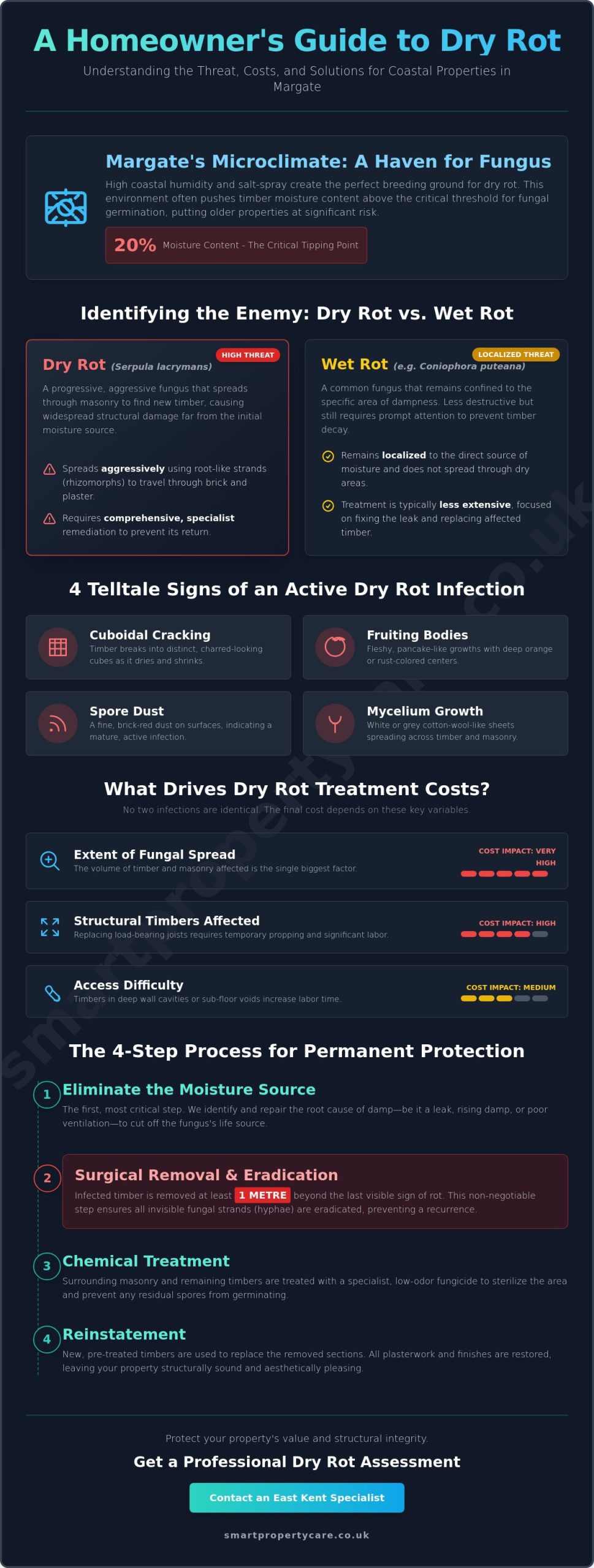
Our proximity to the sea creates a unique microclimate that is particularly hospitable to fungal spores. The high relative humidity common in East Kent often pushes the moisture content of internal timbers above the critical 20% threshold required for germination. Salt-spray from the North Sea can also settle on masonry, attracting further moisture through hygroscopic action. This creates a perpetual damp cycle that allows dry rot to thrive in unventilated sub-floor voids and behind the lath and plaster walls typical of Margate’s older building stock. Understanding Dry Rot involves recognizing its ability to transport moisture through specialized root-like structures called rhizomorphs. These strands can penetrate brickwork and mortar, allowing the infection to jump from a damp cellar to a dry first-floor joist with ease.
Dry Rot vs. Wet Rot: Identifying the Enemy
Homeowners often confuse dry rot with its less aggressive cousin, wet rot. This is a costly mistake. While wet rot remains localized to the source of moisture, dry rot is a progressive disease of the building. Identifying the specific visual cues is vital for an accurate repair plan:
- Cuboidal Cracking: Advanced dry rot causes timber to break into distinct, charred-looking cubes.
- Fruiting Bodies: Look for fleshy, pancake-like growths with deep orange or rust-colored centers.
- Spore Dust: A fine, brick-red dust settling on surfaces is a sign of an active, mature infection.
- Mycelium: White or grey cotton-wool-like growth that can spread across masonry and timber alike.
Misidentifying these signs can lead to a significant waste of resources. If you treat dry rot as if it were a simple case of wet rot, the fungus will continue to spread behind your new plasterwork. This oversight inevitably inflates the eventual dry rot treatment cost margate property owners must pay when the structural damage becomes undeniable. We focus on identifying the exact “hotspots,” such as sea-facing window frames and embedded wall plates, to ensure the remediation is surgical and permanent. Precision at this stage prevents the need for repetitive, expensive interventions later.
Key Factors That Influence Dry Rot Treatment Cost in Margate
Calculating the dry rot treatment cost margate homeowners face requires a detailed assessment of several variables. No two infections are identical. While a small patch of decay on a skirting board is manageable, a systemic outbreak affecting structural floor joists demands a more complex, multi stage intervention. The primary goal is always to protect the building’s structural integrity while ensuring the fungus cannot return. This involves a disciplined approach to both removal and reinstatement.
Primary Cost Drivers in Fungal Remediation
The most significant factor is the volume of timber requiring surgical removal. Standard industry practice dictates that we remove infected wood at least one metre beyond the last visible sign of rot. This ensures that invisible hyphae, which can travel through masonry, are fully eradicated. In many of Margate’s traditional terraces, timbers are often “landlocked” within deep wall cavities, making access difficult and increasing labour time. If the rot has compromised load bearing joists, we must use temporary structural support or “propping” to keep the building safe while we work. Additionally, disposing of fungus infected timber and masonry is a specialized task. These materials are hazardous and require controlled removal to prevent spores from contaminating other areas of the property.
Eliminating the moisture source is equally critical to the final budget. Dry rot cannot survive without a water supply. Whether the cause is a leaking gutter, a failed damp proof course, or poor sub floor ventilation, the underlying defect must be rectified. Failing to fix the leak before treating the wood is a wasted investment. We prioritize identifying these root causes during our initial survey to provide a comprehensive, all in one solution.
Secondary Expenses: Reinstatement and Protection
Removing the rot is only half the battle. To guarantee a permanent solution, we must address the environmental conditions that allowed the fungus to germinate. This often involves specialist plastering to manage hygroscopic salt migration, which is a common issue in our salt laden coastal air. We also apply fungicidal masonry sterilization to create a chemical barrier within the brickwork, preventing any dormant spores from re-emerging. Improving sub floor ventilation is another critical step; stagnant air is a primary catalyst for decay. Upgrading air bricks and clearing ventilation paths ensures a constant flow of dry air, which is the most effective natural defense against fungal growth.
Every step of this process is designed to offer long term peace of mind rather than a temporary patch. If you are concerned about the spread of decay in your home, seeking a professional survey from Smart Property Care Ltd can help you identify these cost drivers early, potentially saving thousands in structural repairs.
Typical Dry Rot Treatment Cost Ranges: Minor vs. Major Repairs
Every property in Margate presents a unique set of challenges, from the salt-exposed facades of Cliftonville to the historic timber frames in the Old Town. While a bespoke assessment is always necessary, understanding the general tiers of investment helps you plan effectively. The dry rot treatment cost margate homeowners encounter usually falls into one of three categories based on the severity of the fungal spread and the structural impact on the building.
- Minor Localised Treatment (Under £1,500): This tier typically addresses small areas of non-structural timber. It often involves replacing infected skirting boards, door frames, or decorative trim. The focus is on surgical removal and localized chemical application to prevent further germination.
- Moderate Structural Repair (£2,000–£5,000): This is the most common scenario for Margate’s Victorian terraces. It involves replacing several load-bearing floor joists in a single room, along with extensive masonry sterilization. We often find these issues in sub-floor voids where ventilation has been restricted for years.
- Extensive Property Remediation (£10,000+): In cases of long-term neglect, the fungus can travel across multiple floors and through party walls. These projects require structural engineering, significant timber replacement, and a comprehensive moisture-control strategy to save the property from condemnation.
Why DIY Dry Rot Treatment is a Costly Mistake
Attempting a DIY fix is often a false economy. Many off-the-shelf fungicides only treat the surface, leaving the deep-seated mycelium alive within the masonry. Dry rot is aggressive; if you don’t remove the infection at least one metre beyond the visible damage, it will return. Improper handling of infected timber can also release millions of spores into the air, inadvertently spreading the rot to other rooms. Perhaps most importantly, DIY work lacks the professional guarantees required for property resale in Kent. Mortgage lenders and insurers specifically look for certified remediation to ensure the building is a safe investment.
The Value of a Specialist Survey
A “free estimate” from a general builder rarely provides the technical depth needed for fungal decay. A professional damp survey is the only way to secure an accurate, fixed-price quote. We utilize advanced tools like thermal imaging and high-frequency moisture meters to see through Margate’s thick brickwork. These technologies identify hidden moisture reservoirs that aren’t visible to the naked eye. This detailed approach allows us to provide a costed specification that satisfies both your budget and your mortgage lender’s requirements. By identifying the exact extent of the dry rot treatment cost margate specialists will charge, you avoid the “hidden surprises” that often plague less thorough repair projects.
The Professional Remediation Process: Ensuring Long-Term Protection
A disciplined, step by step approach is the only way to guarantee that fungal decay is permanently eradicated. We don’t just treat the symptoms; we eliminate the biological threat at its core through a rigorous engineering process. This systematic methodology ensures that every penny of the dry rot treatment cost margate homeowners invest translates into long term structural security. Our process follows five critical stages:
- Step 1: We identify and stop the primary moisture source, whether it’s a leaking coastal roof, rising damp, or poor sub floor ventilation.
- Step 2: Our team strips back infected plaster and removes all compromised timber, extending the cut zone into healthy wood.
- Step 3: We sterilize the masonry and oversite using specialist fungicidal fluids to kill any dormant spores within the brickwork.
- Step 4: We install high grade, pre treated timber replacements, protected by physical damp proof barriers at all contact points.
- Step 5: We finish the project with specialist reinstatement using salt retardant plaster to protect your interior from coastal humidity.
Surgical Timber Removal and Masonry Sterilisation
Removing the “feeding” source is the most labor intensive phase of the project. Because Serpula lacrymans can travel through mortar joints, we use chemical irrigation to saturate the brickwork, creating a sterile zone that the fungus cannot penetrate. This prevents the infection from re emerging from deep within the walls. Timber must be removed one metre past the visible infection to ensure that microscopic fungal strands, which can hide deep within the grain, are fully eradicated. This surgical precision is why the dry rot treatment cost margate specialists provide is a vital investment in your home’s future.
Specialist Plastering: The Final Barrier
Standard gypsum plaster is a common failure point in coastal properties. It’s highly hygroscopic, meaning it attracts moisture and salts from the air, which can reactivate dormant fungal spores. We utilize salt neutralizing additives and specialized renders to create a dense, protective finish that resists dampness. Our property renovation services ensure that your home isn’t just safe, but restored to its original aesthetic standard. If you’ve discovered signs of decay, it’s time to act. Contact Smart Property Care Ltd today to secure a professional remediation plan that protects your home for decades to come.
Choosing Smart Property Care Ltd for Dry Rot Treatment in Margate
Selecting a partner to safeguard your home’s structural integrity is a decision that requires confidence in both technical skill and local reliability. With over 20 years of dedicated property preservation experience in East Kent, Smart Property Care Ltd has refined a methodology that balances high-end craftsmanship with approachable service. We don’t just treat the fungus; we restore the environment. Our team manages every aspect of the project, from the initial surgical timber removal to the final specialist plastering and rendering. This comprehensive approach eliminates the stress of coordinating multiple trades and ensures a seamless, high-quality finish that stands up to coastal conditions.
Homeowners often find that the dry rot treatment cost margate specialists quote can vary wildly depending on the thoroughness of the survey. We pride ourselves on transparency and precision. Every project begins with a detailed technical report that outlines the exact extent of the infection and the necessary remedial steps. You’ll receive a clear, costed specification that provides total clarity before any work starts. This level of detail is essential for protecting your property’s value and providing the peace of mind you deserve when investing in your home’s future.
Local Expertise You Can Trust
We are a family-run business based in Herne Bay, serving Margate, Ramsgate, and the surrounding coastal towns. This local focus means we possess a deep understanding of traditional Kentish construction methods and the specific challenges posed by our salt-laden air. Unlike national franchises, we don’t operate through anonymous call centres or hide behind corporate layers. You’ll have direct access to the owners, ensuring a personal and disciplined service from start to finish. We take immense pride in our reputation as a dependable urban partner for homeowners who value quality, punctuality, and a polished final result.
Request Your Specialist Survey Today
If you suspect dry rot is compromising your timbers, taking swift action is the most effective way to control costs. Booking an inspection for your Margate property is straightforward. Our expert surveyor will conduct a non-invasive assessment, utilizing advanced moisture detection tools to map the spread of the fungus as discussed in our remediation guide. You’ll then receive a comprehensive report that serves as a roadmap for your home’s restoration. This document is often a vital requirement for mortgage lenders or insurers when dealing with historic coastal buildings. Don’t let fungal decay diminish your property’s worth. Protect your home and book your dry rot survey today to secure a permanent solution for your property.
Securing Your Property’s Future with Professional Remediation
Protecting a coastal home from the aggressive spread of Serpula lacrymans requires a disciplined approach and a commitment to quality. You now understand that while the dry rot treatment cost margate homeowners face depends on the infection’s extent, the true value lies in a permanent, structural solution. By addressing the root cause of moisture and employing surgical timber removal, you ensure the fungus cannot return to compromise your investment.
Smart Property Care brings over 20 years of Kent property preservation experience to every project. We specialize in Victorian coastal property restoration, offering a comprehensive “survey to plastering” service that handles everything from structural carpentry to salt retardant finishes. You don’t have to manage multiple trades or worry about hidden defects; we provide the precision and reliability your home deserves. Take the first step toward total peace of mind and Get a Professional Dry Rot Assessment in Margate today. Your home’s structural integrity is our priority, and we are ready to help you restore it to its full potential.
Frequently Asked Questions
How much does a dry rot survey cost in Margate?
The cost of a professional dry rot survey varies based on the size and complexity of the property. While some general contractors offer visual estimates, a specialist technical report involves advanced moisture mapping and thermal imaging to identify hidden fungal growth. This detailed assessment ensures that the eventual dry rot treatment cost margate residents pay is based on accurate data rather than guesswork.
Is dry rot covered by standard home insurance in the UK?
Standard home insurance policies in the UK typically exclude dry rot because it is classified as a maintenance issue resulting from gradual dampness. Most insurers view fungal decay as preventable through proper property upkeep, such as fixing leaks or clearing gutters. If the rot is a direct result of a sudden event like a burst pipe, you might have a valid claim. It’s essential to review your specific policy wording.
Can I stay in my house during dry rot treatment?
You can usually remain in your property during the remediation process, though localized access to affected rooms will be restricted. Our team works with surgical precision to contain the work area, using dust sheets and protective barriers to minimize disruption to your daily life. If the treatment involves extensive floor joist replacement in multiple main living areas, we will discuss a phased approach to ensure your comfort.
How long does professional dry rot remediation typically take?
A standard dry rot treatment project often takes between three to seven working days to complete. The duration depends heavily on the extent of the timber removal required and the drying time for masonry sterilization fluids. Larger projects involving structural engineering or multi room reinstatement will naturally take longer. We provide a clear timeline during the initial survey so you can plan your schedule with confidence.
What happens if dry rot is left untreated in a coastal property?
Leaving dry rot untreated in a coastal environment like Margate leads to rapid structural failure. The high humidity levels accelerate the fungus’s ability to extract moisture from the air, allowing it to move through masonry and destroy load bearing timbers at an alarming rate. Over time, this compromises the safety of floors and roofs, potentially leading to a total loss of property value or even condemnation.
Are dry rot spores harmful to health, especially for children or the elderly?
Dry rot primarily targets timber, but the high levels of moisture and spores associated with an active infection can exacerbate respiratory issues. Vulnerable individuals, such as children, the elderly, or those with asthma, may experience heightened sensitivity to the musty environment created by the fungus. Eliminating the rot and correcting the underlying dampness is the most effective way to restore a healthy, clean living environment for your family.
How can I tell the difference between dry rot and woodworm damage?
Dry rot is characterized by cuboidal cracking and fleshy fruiting bodies, whereas woodworm damage presents as small, circular exit holes in the timber. Woodworm involves larvae boring through the wood, often leaving behind a fine, powdery frass. In contrast, dry rot chemically breaks down the wood’s cellulose, making it brittle and lightweight. Both issues require professional intervention, but the remediation techniques for fungal decay and insect infestation are distinctly different.
Does dry rot always mean the house is structurally unsafe?
Dry rot does not always mean a house is immediately unsafe, but it does signify that the structural integrity of specific timbers is declining. While an infection in a skirting board is a cosmetic concern, rot in a load bearing joist requires urgent attention to prevent floor collapse. We assess the depth of the decay to determine if the building remains stable during the remediation process.