
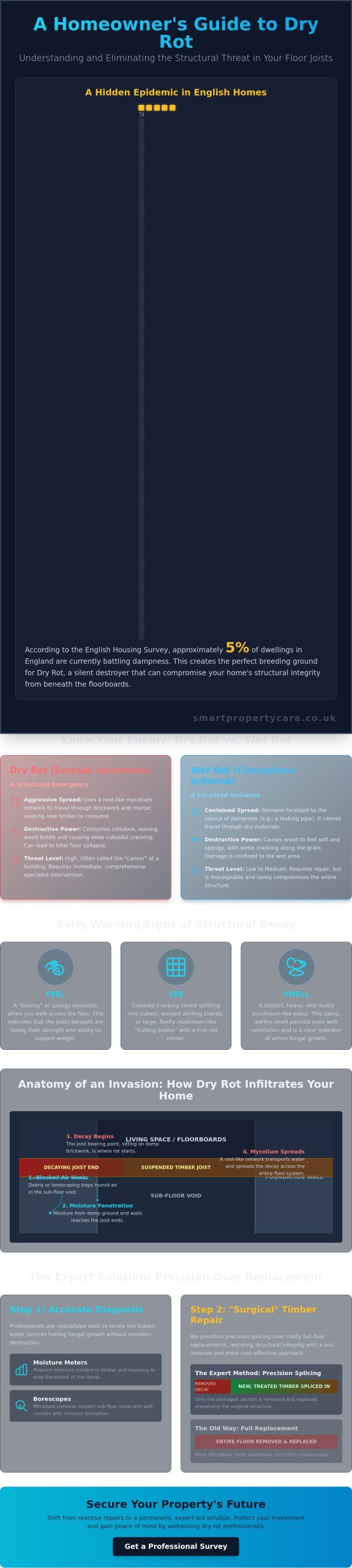
What if the ground beneath your feet is slowly losing its strength? For many homeowners, the first sign of trouble isn’t a visible fungus but a subtle, unsettling bounce in the floorboards that signals a deep-seated structural crisis. Securing a professional dry rot in floor joists repair Kent service is the most effective way to prevent a localized damp issue from evolving into a total floor collapse. With approximately 5 percent of all dwellings in England currently battling dampness according to the latest English Housing Survey, the anxiety surrounding timber decay is a significant concern for those who value the safety and longevity of their property.
It’s natural to feel stressed about the potential for expensive timber replacement or the disruption of a messy repair process. We believe that structural restoration should be a precise, surgical procedure that restores your peace of mind without upending your life. This guide provides a clear roadmap to identify, treat, and permanently resolve dry rot using the most current 2026 industry standards. You’ll learn how we combine advanced environmental controls with specialist timber treatments to ensure your floors remain stable, secure, and entirely rot-free for the long term.
Key Takeaways
- Learn to spot early warning signs of structural decay, including “bouncy” floorboards and the distinct cuboidal cracking of Serpula lacrymans.
- Understand why a specialized dry rot in floor joists repair Kent service is vital for preserving the structural integrity of local homes with sub-floor ventilation issues.
- Discover the “surgical” approach to timber restoration, where we prioritize precision splicing over unnecessary and costly full floor replacements.
- Identify how professional surveys use moisture meters and borescopes to locate the hidden water sources fueling fungal growth.
- Gain peace of mind by shifting from reactive repairs to a permanent, expert-led solution that secures your property’s value.
Understanding Dry Rot in Floor Joists: The Kent Property Context
Dry rot, or Serpula lacrymans, is a wood-destroying fungus that thrives in the dark, damp environments found beneath your home. While the name suggests a lack of water, the fungus actually requires moisture to survive; it simply has a unique ability to transport that moisture to dry areas of timber. In the Garden of England, this is particularly problematic. Coastal humidity in towns like Herne Bay and Margate creates a persistent atmospheric dampness that settles in poorly ventilated sub-floor voids. This makes professional dry rot in floor joists repair kent a critical necessity for preserving the structural safety of your property. To understand the biology behind this threat, it helps to look at What is Dry Rot? and how it differs from more common fungal issues.
It’s vital to distinguish this from wet rot. Wet rot usually stays localized to the immediate source of water, such as a leaking pipe. Dry rot is far more predatory. It uses a root-like network to colonize entire floor systems, often moving through mortar joints and behind plaster to find fresh timber. While wet rot is a localized nuisance, dry rot is a structural emergency that demands a comprehensive, expert-led response.
Why Floor Joists are Vulnerable
Most Kent period properties use suspended timber floors that rely on air bricks to maintain a dry environment. If these vents are blocked by garden debris or modern landscaping, the sub-floor void becomes a stagnant humidity trap. Moisture often creeps through the masonry to reach the joist ends, where the timber sits directly on damp brickwork. This “bearing point” is usually where the decay begins. Dry rot can travel through brickwork and mortar to find new timber sources, effectively bypassing structural barriers that would stop other types of decay.
The Aggressive Nature of Serpula Lacrymans
The fungus spreads via a “mycelium” network, a series of grey, felt-like strands that act as a plumbing system for the rot. This network allows it to transport water to previously dry wood, spreading the infection rapidly across your floor joists. Experts often describe dry rot as the “cancer” of a building because of this invasive, self-sustaining growth. Kent’s seasonal climate, with its wet winters and humid summers, provides the perfect cycle for fungal spore germination. Left unchecked, the fungus will consume the cellulose that gives timber its strength, leaving your floorboards brittle, cracked, and prone to sudden failure. Our approach focuses on stopping this network in its tracks, ensuring the structural integrity of your home is restored and protected.
Identifying the Signs: Is Your Floor Structurally Compromised?
Walking across your living room shouldn’t feel like navigating a trampoline. If your floors feel “bouncy” or uneven, the timber beneath is likely losing its structural integrity. Unlike surface-level damage, the decay of floor joists happens out of sight, making the physical sensation of the floor your first line of defense. When homeowners seek a specialist for dry rot in floor joists repair kent, we begin by analyzing these subtle shifts in stability as primary indicators of a deep-seated issue. Identifying these signs early is the only way to ensure your dry rot in floor joists repair kent is focused on restoration rather than total reconstruction.
Visual indicators are equally telling once you know what to look for. You should check for “cuboidal cracking,” where the wood splits into small, brittle cubes as the fungus extracts all moisture and strength. You might also spot “fruiting bodies,” which are large, fleshy, mushroom-like growths with a rust-red center. These are the reproductive organs of the fungus. Their presence indicates an advanced infection that is actively releasing millions of spores into your home environment, ready to colonize adjacent timbers.
Trust your nose when your eyes can’t see the damage. Dry rot carries a distinctive, heavy, mushroomy odour that smells like damp woodland. It’s an earthy, oppressive scent that persists even with the windows open. The fragrance is often strongest in the evening or in rooms that have been closed off for several days. If you notice this smell alongside warped skirting boards or darkened floorboards, it’s a clear signal that the sub-floor environment has become a breeding ground for decay.
Visual Indicators Beneath the Floorboards
Once we lift the boards, the true extent of the damage becomes clear. We look for specific biological markers that confirm the presence of Serpula lacrymans:
- Mycelium: This looks like thick, white cotton-wool or greyish, skin-like sheets spreading across the timber and masonry.
- Red Spore Dust: A fine, rust-colored powder that settles on surfaces near the floor, often mistaken for simple dust.
- Shrunken Timber: Wood that appears darkened and shrunken, which crumbles easily under light finger pressure.
Structural Red Flags for Kent Homeowners
The architectural heritage of East Kent presents specific vulnerabilities. In the Victorian terraces of Ramsgate or the seaside villas of Margate, you might notice new gaps appearing between the floorboards and the skirting boards as the joists begin to sag. The most dangerous scenario involves the “wall pockets” found in the older masonry of Dover or Sandwich, where joist ends are embedded directly into damp brickwork. If these pockets are damp, the joist ends can rot away entirely, leaving the floor held up by little more than habit. Whether it’s a springy floor in a Canterbury cottage or a sagging room in a coastal property, these signs demand immediate action. Our team can provide a detailed dry rot treatment plan to stabilize your home before the damage spreads further.
Professional Repair vs. Replacement: The Expert Craftsman Approach
When faced with structural decay, many contractors default to a “total rip-out” strategy. This brute-force method is often unnecessarily destructive and creates significant disruption for the homeowner. We advocate for a surgical approach instead. By removing only the compromised wood and preserving sound original timber, we maintain the building’s character while restoring its strength. Choosing a specialist for dry rot in floor joists repair kent ensures that your home’s structural integrity is restored through precision engineering rather than mass demolition. This method balances high-end craftsmanship with modern structural requirements, providing a stable, rot-free floor without the need for a complete reconstruction.
Restoring a floor system requires a deep understanding of load-bearing mechanics. We often utilize high-strength resin-bonded repairs or “bitchu” techniques to reinforce timbers where they meet masonry. These resin systems create a bond that is frequently stronger than the original wood, effectively “fusing” the repair to the healthy structure. To prevent the return of fungal strands, we integrate chemical barriers directly into the surrounding masonry and timber. This proactive defense system creates a sterile zone that stops the Serpula lacrymans mycelium from migrating back into the restored floor.
The Joist Splicing Technique
Precision is the hallmark of our splicing process. Our craftsmen use bolted plates or specialized timber connectors to secure new, pre-treated sections to the existing sound joists. Every piece of replacement timber is selected to meet BS 8417 preservation standards, ensuring it has the durability required for a long service life. We take extra care to isolate these new timber ends from damp masonry using physical damp-proof membranes. This prevents the “wicking” of moisture that caused the original decay. While splicing is our preferred method for its efficiency, we’ll always advise when a full joist replacement is the only safe option to meet BS EN 1995 (Eurocode 5) structural load requirements.
Chemical Treatment and Environmental Control
Chemicals are a vital second line of defense, but they aren’t a standalone cure. We apply fungicidal masonry creams to “sterilise” the brickwork, but our primary focus is always on environmental control. Improving sub-floor ventilation by clearing air bricks or installing high-flow vents is the only way to permanently lower humidity. During our inspection, if we discover that damp conditions have attracted timber-boring insects, we may recommend a professional woodworm treatment alongside our rot remediation. This comprehensive strategy ensures that every threat to your floor’s stability is addressed simultaneously, giving you total peace of mind in a restored, secure home.
The Remediation Process: What to Expect from a Kent Survey
Effective restoration begins with an uncompromising assessment. We don’t rely on guesswork or surface-level observations. Our surveyors use deep-probe moisture meters and high-definition borescopes to inspect the dark, inaccessible voids beneath your floorboards. This technology allows us to visualize the extent of the decay without needing to lift every board in the initial phase. When you book a specialist for dry rot in floor joists repair kent, you are investing in a diagnostic process that maps the exact footprint of the fungus through your building’s fabric. We track the mycelium as it travels through mortar joints and behind plaster, ensuring no hidden pockets of infection are left to restart the cycle.
Finding the rot is only half the battle. We must identify the moisture source feeding the outbreak. This could be anything from a pinhole leak in a radiator pipe to a failing damp-proof course. Dry rot cannot survive without a moisture content of around 20 percent in the timber. Without resolving this underlying cause, any timber treatment is merely a temporary fix. We trace the moisture path through masonry and timber to ensure the environment is permanently altered to prevent fungal regrowth. This problem-solution approach is what distinguishes a professional restoration from a simple patch repair.
Locating the Root Cause in East Kent Properties
Coastal and market towns like Faversham and Dover present unique challenges for timber preservation. High ground levels or failing external rendering often lead to rising damp, which provides the consistent hydration dry rot needs to thrive. A professional damp survey is the only way to avoid a costly misdiagnosis. We evaluate the external ground levels and the condition of the masonry to ensure your home remains dry from the outside in, protecting your joists from future moisture ingress.
The Detailed Technical Report
Our findings are presented in a comprehensive technical report. This document is vital for insurance claims or property transactions in the competitive Kent market. It includes a costed specification for the necessary carpentry, specialist replastering, and chemical treatments required. We provide clear timelines for the dry rot in floor joists repair kent, ensuring that work is scheduled to minimize disruption to your daily routine. Every step is designed to restore order and safety to your home as efficiently as possible.
If you suspect your floor joists are under threat from fungal decay, contact our team to arrange a specialist dry rot survey today and secure the future of your property.
Why Specialist Joist Repair is Essential for Kent Homeowners
Attempting a DIY fix or hiring a general builder for structural timber decay is a significant gamble that often leads to catastrophic floor failure. While previous sections detailed the technical aspects of splicing and resin bonding, the success of these methods relies entirely on the discipline of the practitioner. Professional dry rot in floor joists repair kent ensures that the restoration follows strict Property Care Association (PCA) codes of practice. We combine traditional carpentry skills with modern preservation technology to create a solution that lasts. By choosing an expert craftsman, you’re not just fixing a floor; you’re securing the skeletal integrity of your home for the next generation.
Kent is home to a vast array of historic building stock, from the medieval timber frames in Faversham to the grand Victorian terraces of Ramsgate. These properties require a sensitive, expert touch to maintain their market value and structural health. A botched repair is easily identified during a future homebuyer’s survey, potentially devaluing your investment or stalling a sale. We provide the peace of mind that comes with a long-term guarantee on our structural work. This assurance is a cornerstone of our service, positioning us as a reliable partner for clients who value quality and reliability in a busy metropolitan environment.
Protecting Your Property Investment
In the property preservation industry, “cheap” repairs are often the most expensive choice in the long run. We frequently see cases where rot returns within 12 to 24 months because the previous contractor failed to address the environmental root cause or didn’t follow COSHH regulations for chemical application. As a family-run Kent business with over 20 years of local experience, Smart Property Care Ltd understands the specific challenges posed by the region’s climate. Our repairs are designed to be permanent. When you eventually decide to sell your home, our documented, professional dry rot in floor joists repair kent will act as a trust signal to surveyors and prospective buyers alike.
Comprehensive Restoration Services
One of the primary benefits of working with our team is our ability to manage the entire project from start to finish. We don’t just repair the timber and leave you with a hole in the wall. Our expertise extends to specialist plastering, ensuring that salt-contaminated surfaces are replaced with high-quality, damp-resistant finishes. This end-to-end service eliminates the need for multiple contractors and minimizes the disruption to your household. Smart Property Care Ltd provides a single point of accountability and a consistent standard of excellence across every phase of the restoration.
Don’t leave your home’s safety to chance. Book your specialist timber survey in Kent today and let our expert team restore the stability and value of your property.
Secure the Structural Integrity of Your Kent Home
Restoring a floor system compromised by fungal decay requires more than just a quick fix. It demands a surgical approach that combines traditional craftsmanship with the latest preservation technology. By focusing on identifying moisture sources and utilizing precision timber splicing, you can ensure your floorboards remain stable and secure for decades. Choosing a specialist for dry rot in floor joists repair kent is the most reliable way to protect your home’s structural health and long-term market value.
With over 20 years of property preservation experience across Kent, our team of expert local carpenters provides the technical precision your property deserves. We deliver comprehensive damp and timber reports that offer the absolute peace of mind you need when dealing with structural issues. Don’t let a hidden damp problem escalate into a costly collapse. Take the first step toward a stable, rot-free environment by contacting our disciplined professionals today.
Request Your Professional Dry Rot Survey in Kent
Your home is your most significant investment. We’re here to help you protect it with quality, reliability, and expert care.
Frequently Asked Questions
How much does it cost to repair dry rot in floor joists in Kent?
The total investment for restoration depends entirely on the scale of the fungal outbreak and the structural requirements of your floor. Factors like the number of joists requiring splicing and the depth of masonry sterilization needed will determine the final specification. We provide a detailed, costed report following a professional survey to ensure you have a clear, transparent understanding of the necessary works for your property.
Can I stay in my house while the floor joists are being repaired?
Homeowners can typically remain in the property during the restoration process, though the specific work area will be cordoned off for safety and dust control. We prioritize a clean and organized workspace to minimize the impact on your daily routine. Our team works with precision and efficiency to restore structural stability, ensuring that the rest of your home remains functional throughout the project.
Is dry rot in floor joists covered by standard home insurance?
Standard home insurance policies generally don’t cover dry rot because it’s usually classified as a gradual maintenance issue rather than a sudden, accidental event. However, it’s always advisable to check your specific policy for any “latent defect” or “accidental damage” clauses. Some providers may consider a claim if the rot is a direct result of a covered peril, such as a sudden burst pipe.
How do I know if it is dry rot or just wet rot in my floor?
Dry rot is distinguished by its ability to spread through masonry and its characteristic rust-red spore dust. You’ll often see deep, cuboidal cracking where the wood splits into brittle chunks. Wet rot stays localized to the moisture source and doesn’t produce the thick, cotton-wool-like mycelium associated with Serpula lacrymans. A specialist survey is the only definitive way to distinguish between these types of decay.
What is the most common cause of dry rot in Kent homes?
Inadequate sub-floor ventilation is the most frequent cause of decay in Kent’s older properties. When air bricks are blocked by modern landscaping or debris, moisture levels in the floor void rise, creating an ideal habitat for spores. This trapped humidity allows the moisture content in the joists to exceed 20 percent, triggering the aggressive growth of the fungus and compromising the timber’s integrity.
How long does a professional dry rot treatment take to complete?
A standard dry rot in floor joists repair kent project is typically completed within three to seven working days. This timeframe covers the removal of compromised materials, the application of fungicidal treatments to the masonry, and the installation of new structural timbers. We provide a clear schedule of works before we begin, allowing you to plan your week with total confidence in our delivery.
Will the dry rot return after the joists have been repaired?
Fungal regrowth is impossible if the moisture source is permanently eliminated and the timber is kept dry. Our comprehensive approach combines chemical barriers with vital environmental controls to ensure the fungus cannot survive. By lowering the moisture content of the timber and masonry below the critical 20 percent threshold, we create a hostile environment that prevents spores from ever germinating again.
Do I need to replace all the floorboards if the joists have dry rot?
Replacement is only necessary for timbers that have lost their structural strength or are actively hosting the fungus. Our surgical approach to dry rot in floor joists repair kent focuses on preserving as much original material as possible. We use precision joinery to integrate new, treated sections only where the integrity has been compromised, which helps to maintain the character of your property while ensuring total safety.