
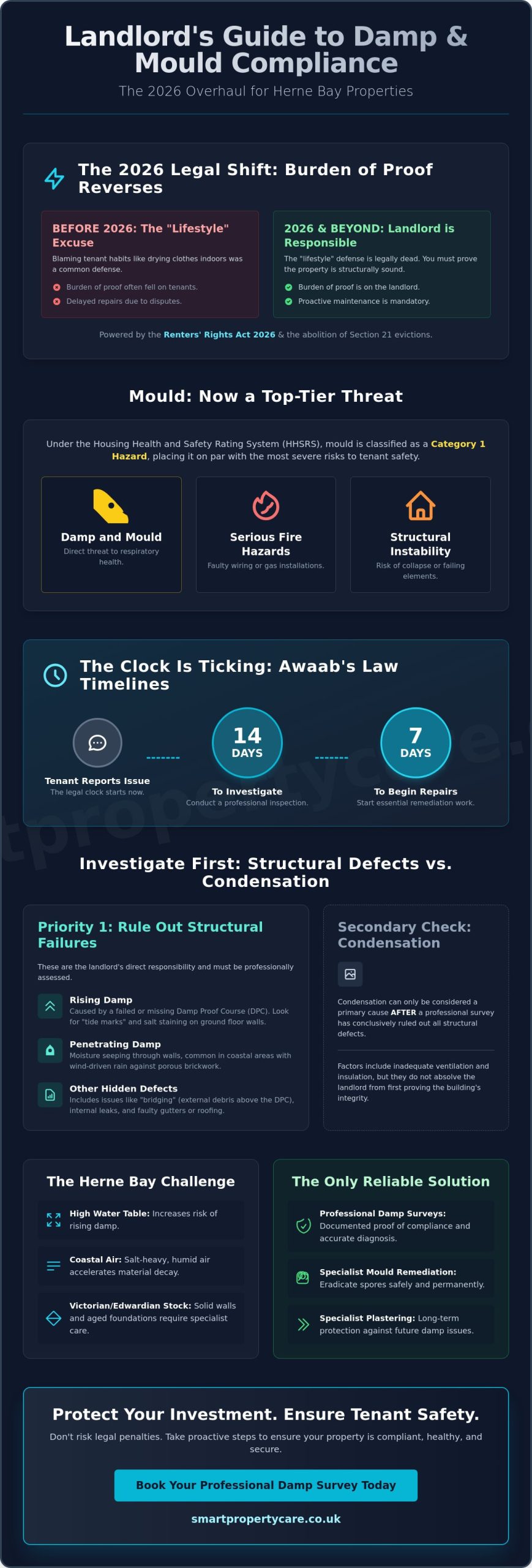
In 2026, the long-standing “lifestyle” excuse for property damp is legally dead. With the Renters’ Rights Act 2026 now in full effect, the burden of proof has shifted. You must now demonstrate that your property’s structure and ventilation systems are beyond reproach before attributing issues to tenant habits. Understanding landlord responsibility for mould herne bay is no longer just about property maintenance; it’s about protecting yourself from severe legal penalties and the implications of the May 2026 abolition of Section 21 evictions.
We understand the stress of managing these evolving standards while trying to maintain a high-quality rental portfolio. You want peace of mind that your buildings are healthy and your legal standing is secure. This guide provides a clear roadmap through the latest regulatory requirements, including the strict investigation timelines inspired by Awaab’s Law. You’ll learn how to distinguish between structural failures and condensation control issues, ensuring you take the precise actions needed to achieve permanent compliance and total tenant safety.
Key Takeaways
- Learn why mould is now classified as a Category 1 hazard and how to meet the 2026 “Fitness for Human Habitation” standards for your rental property.
- Clarify your landlord responsibility for mould herne bay by identifying structural defects like rising damp before they lead to legal penalties.
- Stay ahead of Awaab’s Law with a clear breakdown of the 14-day inspection window and the 7-day limit for starting essential repairs.
- Identify why professional mould remediation and specialist plastering provide the only reliable, long-term solution for coastal properties.
- Understand the unique impact of Herne Bay’s high water table on your building’s integrity and how to protect your investment.
Understanding Landlord Obligations for Mould in Herne Bay
Legal standards for rental properties in Kent have reached a new level of rigor. As of 2026, the definition of “Fitness for Human Habitation” hinges on a property’s ability to remain free from significant damp and mould hazards throughout a tenancy. For those managing the local housing stock, landlord responsibility for mould herne bay often involves navigating the unique challenges of Victorian and Edwardian architecture. These period homes are iconic to our coastal town, but their solid brick walls and aged foundations require specialized care to meet modern standards. You cannot simply paint over a problem; you must address the root cause to stay compliant.
Mould is now firmly classified as a Category 1 hazard under the Housing Health and Safety Rating System (HHSRS). This classification places dampness in the same risk bracket as serious fire hazards or structural instability. When Understanding Indoor Mould, it’s vital to recognize that these spores aren’t just aesthetic issues. They represent a direct threat to respiratory health, especially in the humid, salt-heavy air of the Herne Bay seafront. Landlords are legally responsible for the external fabric of the building, including roofs, gutters, and walls, as well as the internal installations that provide heating and ventilation.
The Landlord and Tenant Act 1985 vs. 2026 Regulations
Section 11 of the 1985 Act established the duty to keep the structure and exterior in repair, but the 2026 regulatory framework shifts the focus toward proactive property preservation. You’re no longer just expected to react to a visible leak. You must ensure that heating and ventilation systems are fully functional and capable of maintaining a healthy environment. This proactive stance helps avoid the “lifestyle” disputes that previously delayed essential damp proofing or condensation control measures.
Tenant Rights and Reporting Procedures
Tenants have a duty to report damp or mould as soon as it appears. Once they’ve notified you, the clock starts ticking for a formal investigation. In Herne Bay, if a landlord fails to act, tenants can contact Canterbury City Council’s Environmental Health department. The Renters’ Rights Act 2026 provides robust protection against retaliatory evictions, ensuring tenants can seek a healthy home without fear of losing their residency. This makes immediate, professional intervention the only viable path for landlords who value their investment and their reputation.
Structural Defects vs. Lifestyle: Identifying the Cause
Determining the root cause of dampness is the most critical step in meeting your legal obligations. In the past, many property owners defaulted to blaming tenant habits, such as drying clothes on radiators or keeping windows closed. However, under the 2026 standards, the burden of proof rests with you. To fulfill your landlord responsibility for mould herne bay, you must first rule out structural failures. Distinguishing between rising damp, penetrating damp, and condensation requires a methodical approach and professional diagnostic tools. Without a definitive cause, any remediation work is merely a temporary mask for a deeper problem.
Rising and Penetrating Damp in East Kent
Herne Bay properties often suffer from rising damp due to failed or non-existent damp proof courses (DPC). You’ll typically spot this as salt staining or “tide marks” on ground-floor walls. Penetrating damp is equally common here. Our coastal winds drive heavy rain against porous Victorian brickwork, allowing moisture to seep through the building’s envelope. Relying on visual cues alone isn’t enough for a legal defense. Securing professional damp surveys is the only way to confirm structural failure and provide a documented trail of compliance.
The Government Guidance on Damp and Mould explicitly states that landlords must investigate the building’s condition before attributing mould to tenant behavior. At Smart Property Care Ltd, we often find “hidden” causes that go unnoticed by the untrained eye. This includes “bridging,” where external ground levels or debris sit above the DPC, or internal leaks within wall cavities. Identifying these specific defects is essential for long-term property preservation.
The Condensation Trap: Ventilation and Insulation
Modern upgrades can sometimes create unexpected issues in older Herne Bay homes. Installing double glazing and thick insulation without upgrading ventilation often turns a house into a sealed box. This traps moisture-laden air, leading to rapid mould growth on cold surfaces. It’s your duty to provide adequate extraction in “wet rooms” like kitchens and bathrooms. While tenant lifestyle remains a secondary factor, you must ensure the property’s infrastructure can handle the moisture of everyday living. If you suspect your property’s ventilation is insufficient, a professional condensation control assessment from Smart Property Care Ltd can provide the clarity you need to protect your investment.
Compliance Timelines: Awaab’s Law in the Private Sector
In 2026, the era of vague timelines is over. The Renters’ Rights Act has replaced the old “reasonable period” standard with rigid, legally binding deadlines. For those managing coastal properties, landlord responsibility for mould herne bay now includes a strict clock that begins the moment a tenant reports a concern. Failing to meet these milestones isn’t just poor service; it’s a breach of statutory duty. This can lead to Rent Repayment Orders and significant financial penalties. You must treat every report with the urgency it deserves to maintain compliance and protect your reputation.
The 14-Day Inspection Rule
You must acknowledge any report of damp or mould within 48 hours. Following this, the 2026 regulations mandate a formal inspection within 14 days. This assessment cannot be a simple visual check by a general handyman. It requires a competent person; someone with the technical expertise to identify the moisture source and distinguish between structural failure and condensation. Documenting this visit is your primary defense against litigation. You are required to provide the tenant with a written summary of the surveyor’s findings within a week of the visit. This ensures transparency and professional accountability from the outset. Precise record-keeping is no longer optional; it’s a core component of your risk management strategy.
Remediation Deadlines and Health Risks
If the inspection identifies a significant hazard or the tenant is deemed vulnerable, the timeline accelerates. You have a 7-day window to begin remedial works. In the 2026 landscape, “starting” a repair means more than just booking a contractor. It involves active site preparation or the commencement of specialist treatments like damp proofing or condensation control. Defining “urgent” mould issues is critical. High spore counts or visible black mould in bedrooms often trigger these shorter windows.
The 2026 standard emphasizes the importance of continuous progress. While complex structural work takes time, you must demonstrate you’re moving toward a permanent solution. If a tenant refuses entry for repairs, document every attempt at communication. Send letters via recorded delivery and keep a log of all phone calls. This evidence is vital if you need to prove you’ve taken all reasonable steps to comply with the law. Non-compliance carries heavy consequences. Local authorities now have enhanced powers to issue fines, and tenants can pursue Rent Repayment Orders (RROs) for up to 12 months of rent. These financial hits often exceed the cost of professional remediation. By acting within the mandatory windows, you avoid these risks and ensure your property remains a high-value, compliant asset.
Professional Mould Remediation and Long-Term Prevention
Effective mould management requires moving beyond superficial cleaning. Many property owners attempt to resolve issues with off-the-shelf anti-mould paint; however, this often acts as a temporary mask rather than a cure. In the context of landlord responsibility for mould herne bay, relying on cosmetic fixes leads to recurring failures and potential legal disputes under the 2026 standards. True mould remediation involves identifying the moisture source and applying technical solutions that prevent regrowth. For a comprehensive approach, we recommend following a permanent guide for mould removal tailored for the specific conditions of East Kent properties.
Specialist Plastering and Rendering
Standard gypsum plaster is highly porous and frequently fails in damp-affected Herne Bay rentals. Once moisture enters the wall, it often leaves behind hygroscopic salts. These salts continue to draw damp from the atmosphere even after the initial leak or structural defect is fixed. We utilize specialist plastering techniques involving salt-neutralising renders to break this cycle. This process creates a robust barrier that prevents salt migration and protects the internal finish of your building. By choosing high-quality rendering and plastering, you restore the aesthetic value of your property while ensuring long-term structural protection. It’s a high-end solution that provides immediate relief and lasting reliability.
Condensation Control Technology
Mechanical ventilation is the most reliable way to remove “human error” from property maintenance. Positive Input Ventilation (PIV) systems are particularly effective for multi-occupancy rentals where moisture levels can fluctuate rapidly. These units circulate filtered, fresh air throughout the home, diluting moisture levels and preventing condensation from settling on cold surfaces. This proactive approach stops mould before it has a chance to take root.
For kitchens and bathrooms, we install smart humidistat fans that activate automatically based on detected moisture levels. This ensures your property stays dry regardless of tenant habits. Our team at Smart Property Care Ltd designs and installs these bespoke condensation control systems to provide you with total peace of mind. If you’re ready to secure your property’s future and meet your 2026 legal obligations, contact Smart Property Care Ltd for a professional mould remediation assessment today. We focus on delivering a transformed environment where quality and safety are the primary standards.
Why Local Expertise Matters for Herne Bay Landlords
Managing a property in a coastal town like Herne Bay presents unique environmental hurdles that standard property maintenance guides often overlook. The combination of a high water table and constant coastal humidity puts immense pressure on local brickwork and foundations. Meeting your landlord responsibility for mould herne bay requires more than a generic understanding of housing law; it demands a deep familiarity with how sea air and damp ground interact with East Kent’s traditional building materials. We’ve spent over 20 years refining our property preservation techniques to address these exact conditions, providing landlords with the technical certainty they need to remain compliant in 2026.
Our approach is rooted in the discipline of the expert craftsman. We understand that a Victorian terrace near the pier requires a different preservation strategy than a modern apartment block in the town centre. As a family-run business, Smart Property Care Ltd provides the approachable, local reliability that corporate entities lack. We don’t just offer services; we offer a stress-relieving partnership that secures your property’s value and your tenants’ health.
Coastal Property Preservation Challenges
Herne Bay’s seafront properties face relentless salt spray, which can rapidly degrade external rendering and mortar. Once the external barrier is compromised, penetrating damp takes hold, often leading to more severe issues like wet rot or dry rot in timber-framed coastal extensions. These aren’t just aesthetic problems; they’re structural failures that can trigger a Category 1 hazard rating under current health and safety standards. “Off-the-shelf” solutions fail in this unique microclimate because they don’t account for the hygroscopic nature of salt-contaminated masonry. Smart Property Care Ltd provides comprehensive damp and timber reports that serve as vital evidence for insurance claims and legal compliance, ensuring your remedial strategy is based on hard data rather than guesswork.
Smart Property Care Ltd: Your Compliance Partner
Our process delivers fully costed specifications for all remedial works, giving you a clear financial and technical roadmap. Our specialized damp proofing Kent services are designed specifically to help landlords meet the 2026 regulatory requirements with precision and efficiency. We don’t just treat the symptoms; we restore the integrity of your property to provide a safe, healthy environment for your tenants. This commitment to quality ensures that your building remains a high-performing asset for years to come.
Don’t leave your investment to chance in an increasingly strict legal landscape. The 2026 regulations require proactive action and professional documentation. Protect your investment, your reputation, and your tenants by choosing a partner who understands the practicalities of urban property maintenance in East Kent. Contact Smart Property Care Ltd today to secure a professional survey and ensure your property meets the highest standards of safety and reliability.
Securing Your Property and Legal Standing in 2026
The 2026 regulatory landscape has fundamentally changed the nature of property management in East Kent. You must now prioritize proactive structural assessments and adhere to strict remediation windows to avoid severe legal penalties. Navigating landlord responsibility for mould herne bay is the first step toward maintaining a safe, profitable rental portfolio. By distinguishing between structural defects and condensation issues with technical precision, you protect both your building’s integrity and your professional reputation.
Our team brings over 20 years of experience as family-run local specialists in property preservation. We provide the comprehensive technical reports you need for insurance and legal compliance, ensuring every intervention is precise, effective, and permanent. Don’t leave your assets vulnerable to changing legislation or the unique challenges of coastal dampness. Book Your Specialist Damp Survey in Herne Bay Today to achieve total peace of mind. We’re ready to help you restore and protect your property to the highest professional standards, ensuring a healthy environment for your tenants and a secure future for your investment.
Frequently Asked Questions
Is a landlord always responsible for mould in a rental property?
Landlords aren’t always responsible, but the Renters’ Rights Act 2026 requires you to prove the property is fit for habitation. If the mould results from a failed damp proof course or penetrating damp through Herne Bay’s coastal brickwork, the liability is yours. You must demonstrate that the building’s infrastructure, including ventilation and heating, is sufficient for modern living before attributing the issue to tenant habits.
Can a tenant withhold rent if there is mould in their Herne Bay home?
Tenants are generally advised against withholding rent, as this can lead to mandatory grounds for possession. Instead, the 2026 legal framework allows tenants to apply for Rent Repayment Orders if the property is found to be a Category 1 hazard. This ensures landlord responsibility for mould herne bay is enforced through the courts or local authorities rather than through unilateral rent strikes which jeopardize the tenancy.
How quickly must a landlord respond to a mould report in 2026?
In 2026, you must acknowledge a report within 48 hours and conduct a formal inspection within 14 days. If the mould is deemed a significant health risk, remedial works must begin within 7 days of that inspection. These mandatory timeframes ensure that dampness is addressed before it escalates into a major structural or health crisis, protecting both the tenant and the property value.
What is Awaab’s Law and does it apply to private landlords in Kent?
Awaab’s Law is a piece of legislation that mandates specific, legally binding timelines for landlords to investigate and repair damp and mould. While it began in social housing, the Renters’ Rights Act 2026 has extended these protections to the private rented sector. This means every private landlord in Kent must now follow the same strict standards for property preservation and tenant safety.
Is mould considered ‘normal wear and tear’ at the end of a tenancy?
Mould is never classified as normal wear and tear because it is a biological hazard. Under the Housing Health and Safety Rating System, mould is often a Category 1 hazard that makes a home unfit for human habitation. It represents either a structural failure or a failure in ventilation, neither of which falls under the category of expected decorative aging during a tenancy.
Can a landlord deduct from a deposit for mould damage?
You can only deduct from a deposit if you can provide documented evidence that the tenant’s specific actions directly caused the damage. This is difficult to prove if the property lacks adequate condensation control or has an aging damp proof course. Deposit schemes often rule in favor of the tenant unless the landlord has a professional damp survey proving the building is structurally sound.
What should I do if my landlord ignores my report of black mould?
If a report is ignored, tenants should contact the Environmental Health department at Canterbury City Council. They have the power to inspect the property and issue an Improvement Notice. Under the 2026 rules, ignoring these notices can lead to heavy fines and Rent Repayment Orders. Professional mould remediation is always more cost-effective than facing local authority enforcement action.
Does a landlord have to provide a dehumidifier for damp properties?
There is no specific legal requirement to provide a dehumidifier, but landlords must ensure the property has adequate, working ventilation. If condensation is a recurring issue, installing a Positive Input Ventilation (PIV) system or smart humidistat fans is a more effective way to fulfill your landlord responsibility for mould herne bay than relying on temporary appliances. Permanent solutions provide lasting property preservation.