
Did you know that 10% of private rented homes in the UK are currently struggling with damp, the highest level recorded in years? Living on the Kent coast means dealing with persistent high humidity, making professional mould remediation herne bay a necessity for any property owner who values structural integrity and health. If you’ve spent months scrubbing away black spots only for them to reappear, you’re likely treating a cosmetic symptom while the root cause remains hidden deep within your masonry.
It’s exhausting to feel like you’re losing the battle against musty smells and spores, especially with the Renter’s Rights Act 2026 now mandating strict legal compliance for landlords. You deserve a permanent solution that goes beyond surface level wiping to ensure a healthy, clean living environment. This guide reveals the definitive professional approach to identifying, treating, and permanently preventing mould in coastal properties. We’ll walk through how expert condensation control and specialist plastering can finally restore your peace of mind and provide the professional certification your home requires.
Key Takeaways
- Master the relationship between coastal humidity and structural damp to protect your property’s long-term value.
- Move beyond surface scrubbing by identifying the hidden moisture sources that fuel recurring mould growth.
- Discover how professional mould remediation herne bay utilizes advanced thermal imaging to eliminate the 90% of mould colonies that remain invisible to the naked eye.
- Secure a permanent solution with specialist plastering techniques designed to resist moisture and salt in challenging marine environments.
Understanding Mould Remediation in Herne Bay’s Coastal Climate
Professional mould remediation herne bay is more than a rigorous cleaning process; it’s a technical intervention designed to restore the structural and environmental health of your property. In our coastal town, the proximity to the sea creates a unique microclimate where internal relative humidity frequently spikes. By 2026 property standards, effective remediation must address the underlying moisture source rather than merely scrubbing away visible spores. Without a damp-first approach, any treatment is temporary.
The relentless North Sea winds play a significant role in property degradation along the Kent coast. These winds drive rain directly into the porous masonry of coastal terraces, leading to penetrating damp that eventually manifests as internal mould. We treat remediation as a structural cure, ensuring that the building envelope is secure before we begin the precision task of spore removal and air purification.
The “Coastal Trap”: Why Herne Bay Homes Are Vulnerable
Herne Bay’s architecture faces a specific set of environmental challenges that we often refer to as the “Coastal Trap.” Salt spray isn’t just a nuisance for your windows; it’s a significant factor in masonry decay. When salt deposits settle on external rendering, they act as a desiccant, drawing moisture into the walls. This hygroscopic action keeps the building fabric damp long after the rain has stopped.
Victorian seaside properties are particularly susceptible due to thermal bridging. These solid-walled structures often have cold spots where internal warmth meets the chilled external shell, creating the perfect conditions for condensation. Because our external humidity levels are naturally high, traditional methods like opening windows often fail to provide the necessary ventilation, effectively trapping moist air inside the home.
Mould vs. Mildew: Identifying Your Property Issue
Distinguishing between surface mildew and structural black mould is the first step in our diagnostic process. Mildew is typically a grey or white powdery growth that sits on the surface and is easily wiped away. In contrast, structural black mould roots itself deep into porous materials like plaster, timber, and wallpaper. If you’ve cleaned a spot repeatedly only for it to return in the exact same shape, you’re dealing with a rooted mould colony.
A persistent musty smell is often the most reliable indicator of a deeper problem. In Herne Bay’s lower ground floors and basements, these odors frequently signal that moisture has triggered dry rot or wet rot within the floor joists. We don’t guess with your property’s health. A professional damp survey is the only way to accurately diagnose whether you’re facing a simple condensation issue or a complex structural failure that requires specialist remediation.
Identifying the Root Cause: Condensation, Penetrating Damp, and Rising Damp
Mould is never the primary issue. It’s the visible manifestation of a deeper moisture imbalance within your home’s ecosystem. To achieve permanent results, we must look beyond the black spots and identify the specific source of water ingress. In Herne Bay, this usually falls into one of three categories: condensation, penetrating damp, or rising damp. Successful mould remediation herne bay starts with a technical assessment of these environmental factors to ensure the spores don’t simply return next season.
Many homeowners overlook the impact of modern improvements. High-quality double glazing and thick loft insulation are excellent for thermal efficiency, but they often turn Kentish properties into airtight boxes. Without sufficient air exchange, the moisture produced by daily living has nowhere to go. It lingers in the air until it hits a cold surface, transforming into the liquid water that feeds fungal growth. Our approach prioritises the restoration of this balance.
Condensation: The #1 Cause of Mould in Herne Bay
Lifestyle damp is a common challenge in modernised seaside homes. Activities like cooking, showering, and drying laundry can release up to 15 litres of water vapour into your indoor air every day. When this warm, moist air meets a cold external wall, it reaches its dew point and condenses. This is why you’ll often find mould colonising the upper corners of bedrooms or the hidden spaces behind wardrobes. Managing these moisture levels is a core component of professional remediation standards, as cleaning alone cannot fix an atmospheric imbalance.
Structural Damp: When the Building Fails
While condensation is internal, structural damp comes from the building’s failure to repel external water. Herne Bay’s coastal storms can be brutal, often highlighting defects in a property’s exterior. Blocked guttering or hairline cracks in your render allow rainwater to soak into the masonry. Once the wall is saturated, mould begins to bloom on the internal plasterwork. This penetrating damp requires a structural fix before any internal cleaning can be considered successful.
On lower ground floors, the issue is often more fundamental. If your property’s original damp proof course has failed or been bridged, moisture will rise from the earth through capillary action. This persistent dampness provides a constant food source for mould at the base of your walls. In these cases, consulting rising damp specialists is essential to stop the cycle of growth. If you’re concerned about the health of your walls, you can book a professional moisture assessment to find the definitive cause and regain your peace of mind.
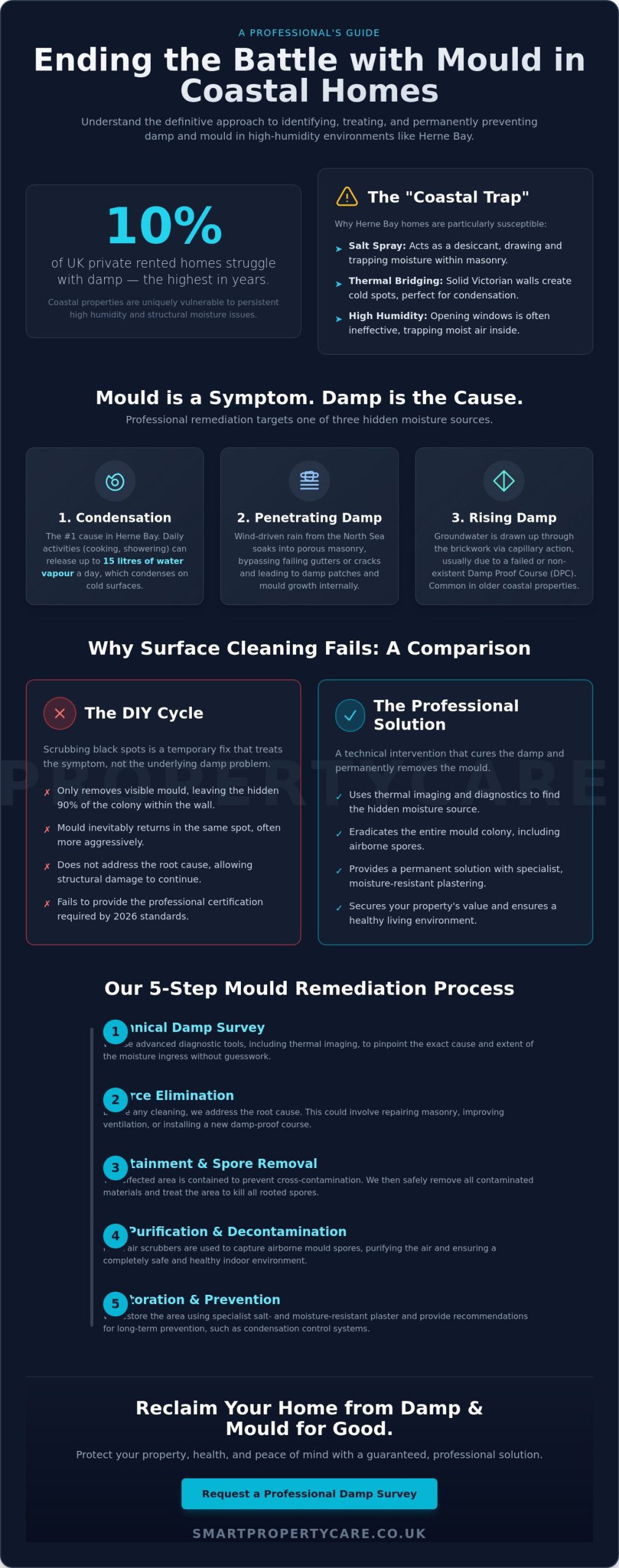
Why Surface Cleaning Fails: The Professional Remediation Standard
Scrubbing a patch of black mould with a supermarket spray might feel productive, but it’s often the start of a much larger problem. This reactive approach ignores the “Iceberg Effect,” where the visible spots on your wallpaper represent only a fraction of the actual colony. In the porous substrates common in Herne Bay properties, such as traditional lime plaster or timber, 90% of the mould network lives deep within the material. Professional mould remediation herne bay focuses on extracting these roots rather than just polishing the surface.
DIY cleaning frequently does more harm than good. When you scrub a dry mould patch, you inadvertently release millions of microscopic spores into the air. These spores travel on internal draughts to colonise other cold spots in your home, effectively spreading the infection. We use a holistic system that treats your building as a single environment, ensuring that air quality is managed alongside the physical removal of fungal growth. Bleach is particularly ineffective here; it’s mostly water, which can actually feed the mould once the surface chlorine has evaporated.
The Limitations of Anti-Mould Paint
Painting over a damp patch is a temporary cosmetic fix that often leads to structural damage. Anti-mould paint creates a non-breathable seal that traps moisture behind the decorative finish. This trapped water eventually causes the plaster to “blow” or lose its bond with the masonry. More dangerously, concealing these wet spots can hide the early signs of dry rot, a wood-destroying fungus that can compromise your floor joists and skirting boards while hidden behind a fresh coat of paint.
Professional Accreditations and Safety Standards
In 2026, the standards for healthy housing are higher than ever. Under the Renter’s Rights Act 2026, private and social landlords in Herne Bay are now legally mandated to address the root causes of damp. For social housing, Awaab’s Law requires an investigation within 10 working days of a report. Following UK government guidance on damp and mould is no longer optional; it’s a compliance necessity. Our remediation process includes the use of industrial HEPA filtration and air scrubbing to ensure your home is safe for occupancy. We provide the professional certification required for insurance purposes and property sales, giving you the documented proof that your home is truly mould-free.
Our Step-by-Step Mould Remediation Process for Herne Bay Properties
Professional mould remediation herne bay requires a disciplined, multi-stage protocol to ensure your environment is truly restored. We follow a rigorous five-phase process that addresses both the visible fungus and the microscopic ecosystem supporting it. This systematic approach distinguishes a permanent structural cure from a temporary cleaning service. Our standard procedure includes:
- Phase 1: The Specialist Survey using thermal imaging and moisture meters
- Phase 2: Containment and Air Filtration to protect the rest of the home
- Phase 3: Physical Removal and Antimicrobial Treatment of affected areas
- Phase 4: Structural Repair, including damp proofing or specialist rendering
- Phase 5: Post-Remediation Testing and Prevention Advice
Specialist Surveying: Finding the Invisible
We begin with a technical audit of your property’s moisture profile. Using high-precision hygrometers, we measure the relative humidity and dew point within your specific coastal environment. This isn’t just about finding wet spots; it’s about salt analysis. We determine if the moisture is “rising” from the ground or “hygroscopic,” where sea salts in the masonry are pulling moisture from the air. By mapping the moisture profile of your walls, we pinpoint the exact entry point of the damp before any work commences. This precision ensures we treat the cause, not just the symptom.
Removal and Neutralisation Techniques
Once the survey is complete, we establish a containment zone using industrial-grade HEPA air filtration. This prevents spores from migrating to unaffected rooms during the removal phase. We safely dispose of contaminated materials including saturated plaster, wallpaper, and insulation. Our craftsmen then apply industry-approved biocides designed to penetrate deep-seated mycelium that standard cleaners cannot reach. Fogging or ULV misting technology is used to deploy a fine antimicrobial cloud that neutralises airborne spores throughout the entire volume of the room.
The remediation isn’t finished until the building is fortified against future ingress. This phase often involves specialist damp proofing or plastering to seal the property’s envelope against the North Sea’s humidity. We don’t just clear the room; we provide comprehensive post-remediation testing to verify the air quality has returned to safe levels. If you’re ready to secure your property’s future, you can request a specialist mould survey today to begin your restoration journey and regain your peace of mind.
Protecting Your Property: Long-Term Prevention and Specialist Plastering
Successful mould remediation herne bay doesn’t end when the visible spores are gone. The final, and perhaps most critical, phase involves fortifying the building fabric against future moisture. Many property owners make the mistake of using standard gypsum plaster for repairs. Gypsum is highly absorbent and contains organic components that act as a primary food source for recurring mould. In a coastal environment where humidity is a constant factor, using the wrong substrate practically guarantees the return of the problem.
We take a different approach. By utilizing salt-retardant and inorganic materials, we eliminate the biological conditions mould needs to survive. Our strategy integrates high-end craftsmanship with technical moisture management. We often recommend mechanical ventilation solutions to complement structural repairs. While standard extractor fans provide localized relief, Positive Input Ventilation (PIV) systems are far more effective for Kentish homes. These systems replace damp, stagnant air with filtered, dry air, creating a pressurized environment that prevents condensation from forming on cold surfaces. Smart Property Care Ltd backs every project with 20 years of local expertise, providing a level of reliability that only a dedicated regional specialist can offer.
Specialist Plastering: The Final Barrier
In the Victorian architecture frequently found across Herne Bay, breathability is essential. We use lime-based or specialist renovation plasters that allow moisture to migrate through the wall without becoming trapped. This prevents the “blown” plaster and salt damp issues that plague modern, non-breathable repairs. Specialist plastering is particularly effective at preventing “ghosting” mould, where dark patterns appear on walls following the lines of the building’s internal structure. Our team takes immense pride in restoring original aesthetic features, ensuring that your property’s historic character is preserved alongside its structural health.
Landlord Compliance and Peace of Mind
The regulatory landscape for landlords has shifted significantly. Meeting the 2026 Decent Homes Standard in East Kent is no longer just about basic maintenance; it’s about proving your property is a safe, healthy environment. Professional mould remediation herne bay is an investment in your asset’s longevity. By addressing the root cause and installing permanent preventative measures, you protect your rental yield and significantly reduce the risk of legal disputes or health-related complaints. We provide the technical documentation you need to demonstrate compliance and maintain your reputation as a responsible property owner. Don’t let recurring damp devalue your investment. Book your Herne Bay mould and damp survey today to secure a definitive, long-term solution for your property.
Restore Your Home’s Health and Structural Integrity
Coastal living shouldn’t mean compromising on your health or your property’s value. By shifting from reactive cleaning to structural solutions, you ensure your home remains a dry, healthy sanctuary. True success lies in moving beyond surface-level fixes to address the moisture imbalances that fuel fungal growth. Whether you’re a homeowner seeking peace of mind or a landlord needing to meet 2026 compliance standards, the path to a mould-free property starts with technical precision and expert diagnosis.
Our family-run team brings over 20 years of Kent property preservation experience to every project. We are specialists in Victorian and coastal restoration, providing the high-end craftsmanship required to protect your investment. When you choose our professional mould remediation herne bay, you’re not just hiring a service; you’re partnering with craftsmen who take immense pride in delivering permanent results. Secure your property with a specialist Herne Bay mould survey today and let us restore your environment to its best possible condition. You deserve a home that’s as resilient as it is beautiful.
Frequently Asked Questions
How much does professional mould remediation cost in Herne Bay?
The cost of your project depends entirely on the scale of the infestation and the complexity of the underlying moisture source. Every property is unique, so we provide a bespoke fixed-price quotation following a technical survey of your home. This ensures you only pay for the specific structural repairs and treatments required to achieve a permanent cure rather than a generic cleaning fee.
Can I stay in my house during the mould remediation process?
Yes, you can usually remain in your property while our craftsmen carry out the work. We use industrial-grade containment barriers and HEPA air filtration systems to isolate the affected zones from the rest of your living space. This precision approach ensures that spores and dust are captured at the source, keeping the air in your bedrooms and living areas clean and safe throughout the process.
How long does it take to permanently remove mould from a property?
A typical mould remediation herne bay project takes between two to five working days to complete. This timeframe allows us to establish containment, remove contaminated materials, and apply antimicrobial treatments. If your property requires specialist plastering or structural damp proofing, we factor in additional time for these materials to cure properly, ensuring a high-end finish that lasts for decades.
Is black mould in my Herne Bay home dangerous to my health?
Yes, black mould is officially classified as a Category 1 hazard under the Housing Health and Safety Rating System (HHSRS). It’s a significant health risk that contributes to respiratory infections and asthma. Government data shows that over 600,000 UK households living with damp include at least one person with a pre-existing health condition, making professional removal a priority for family wellbeing.
What is the difference between mould removal and mould remediation?
Mould removal is a surface-level cleaning task, while mould remediation herne bay is a technical structural cure. Removal only addresses the visible spots you can see. Remediation involves a specialist survey to identify the moisture source, followed by air purification and structural drying. It’s a comprehensive approach designed to return your indoor environment to a safe, healthy, and scientifically verified state.
Will the mould come back after professional treatment?
No, the mould won’t return if the root cause of the moisture is correctly identified and eliminated. Our process focuses on changing the environment that allowed the fungus to grow in the first place. By combining professional treatment with improved ventilation or damp proofing, we create a dry, hostile environment where spores simply cannot survive or colonise your walls again.
Do I need a damp survey if I only have mould in one room?
Yes, because mould in a single room is often an early warning sign of a systemic property issue. A professional survey determines if the problem is localized condensation or a structural failure like penetrating damp that hasn’t yet reached other areas. Identifying the cause early prevents a small patch of mould from turning into a costly structural repair project across your entire home.
Are landlords in Herne Bay legally required to fix mould problems?
Yes, the Renter’s Rights Act 2026 and Awaab’s Law mandate that all landlords must proactively investigate and resolve damp and mould issues. Social landlords are now legally required to begin investigations within 10 working days of a report. These strict regulations shift the responsibility to the landlord to fix the root cause, ensuring every tenant has a right to a clean, safe, and mould-free home.