
Why does your plaster keep bubbling and peeling just months after a professional decorator has finished? It’s a common frustration for homeowners in East Kent, where the coastal climate and historic architecture demand more than a standard quick fix. When you’re dealing with blown plaster or recurring damp patches, the issue usually isn’t the paint; it’s the substrate. Investing in specialist plastering canterbury ensures your walls don’t just look good today, but remain structurally sound for years to come.
You likely want a smooth, durable finish that won’t fail the moment the weather turns. We agree that your home deserves a solution that addresses the root cause of moisture rather than just hiding it behind a cosmetic layer. This article reveals how expert restoration techniques, from traditional breathable lime work to modern salt-retardant systems, protect Canterbury’s 2,888 listed buildings and unique modern properties. You’ll learn how the right materials prevent damp, preserve your property value, and finally provide the peace of mind that comes with an expert, long-term solution.
Key Takeaways
- Understand why standard finishes fail in East Kent’s high water table environment and how remedial plastering acts as a vital technical barrier.
- Learn the critical scientific differences between salt-retardant additives and breathable lime to ensure your walls stay dry and salt-free.
- Discover the specific legal requirements for Grade II listed properties and how specialist plastering canterbury protects architectural history through traditional materials.
- Identify the essential steps of a professional restoration, beginning with a diagnostic survey to address the root cause of moisture damage.
- Gain peace of mind by choosing a comprehensive solution that integrates damp proofing with high-end finishing for a permanent, durable result.
Why Specialist Plastering is Essential for Canterbury Properties
Specialist plastering is more than a finishing trade; it’s a technical building discipline focused on moisture management and structural preservation. In a city like Canterbury, where high water tables and coastal moisture are constant threats, walls require more than just a smooth surface. Investing in specialist plastering canterbury involves the application of advanced remedial materials designed to stop damp and salt contamination from destroying your interior decor. While a standard plasterer focuses on the aesthetics of a flat wall, a specialist focuses on the chemistry behind the surface to ensure that finish lasts for decades.
Canterbury’s unique geography in the Stour Valley creates a specific set of challenges. High ground-water levels often lead to rising damp, while the proximity to the East Kent coast introduces salt-laden air into the building fabric. Specialist finishes are essential because they act as a protective layer that manages these environmental pressures. Without this technical barrier, even the most expensive damp-proof course (DPC) can fail. The plaster itself must be able to resist the hygroscopic salts that migrate from the ground into your masonry. If you only apply a cosmetic skim over a damp wall, the underlying salts will eventually push the new plaster off the brickwork.
The Problem with Standard Gypsum Plaster
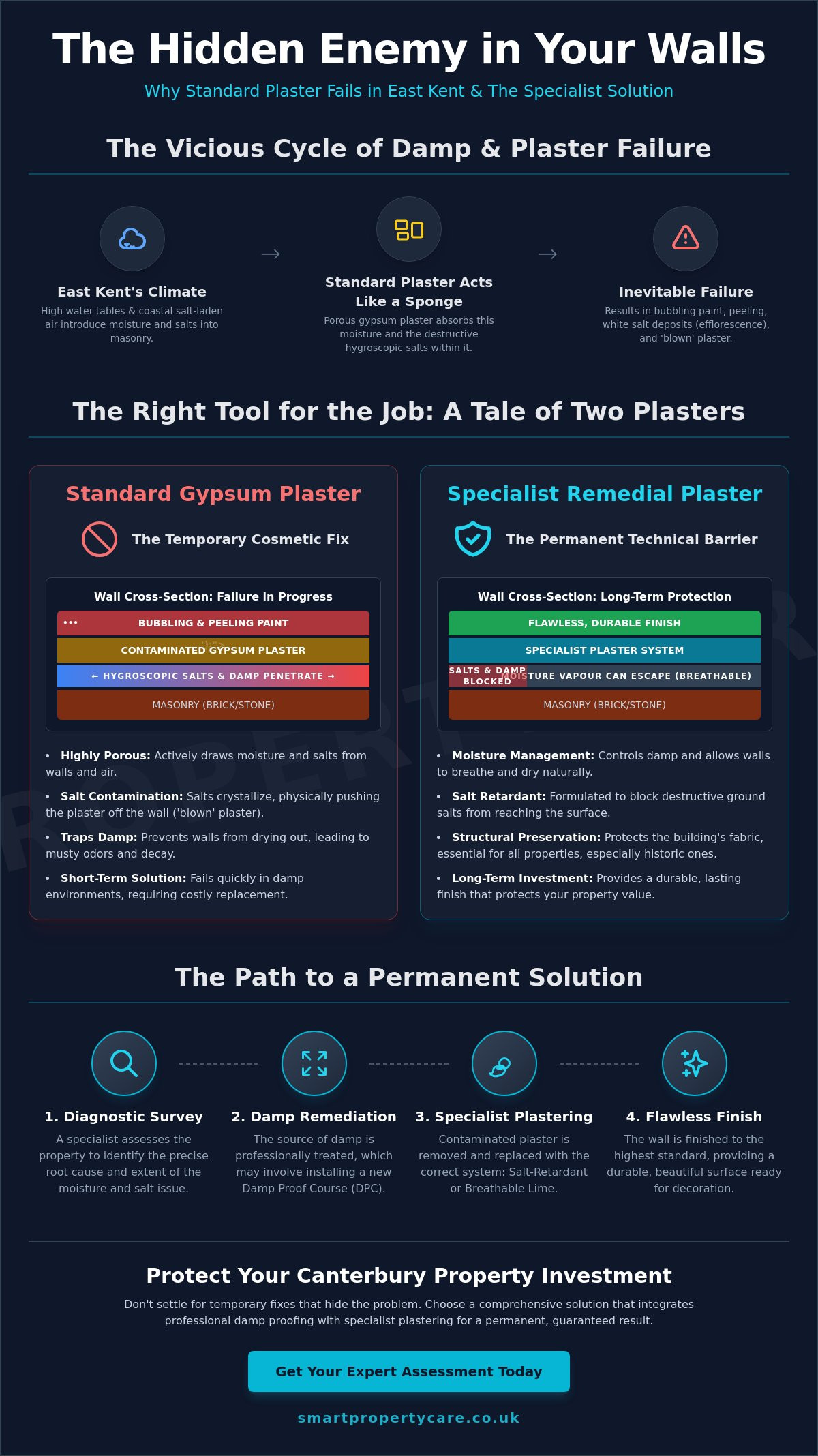
Standard gypsum plaster is the industry norm for modern construction, but it’s often the wrong choice for older Canterbury homes. Gypsum is highly porous and acts like a sponge; it actively draws moisture from the atmosphere. This becomes a significant issue when hygroscopic salts are present. These salts remain in the wall even after a damp problem is fixed, and they continue to pull water from the air. You’ll recognize this failure by the white, powdery efflorescence on your walls, bubbling paint, or a persistent musty odour that won’t go away. Once gypsum is contaminated by salts, it’s effectively ruined and must be replaced with a specialist alternative.
When to Call a Specialist Instead of a General Trade
Choosing the right professional is the difference between a temporary fix and a permanent solution. When you require specialist plastering canterbury, the focus shifts from simple decoration to long-term property protection. General tradesmen often suggest a quick skim to hide cracks or unevenness. However, if your wall sounds hollow when tapped, it’s likely “blown.” This means the plaster has detached from the substrate due to moisture damage. A specialist understands that these sections must be removed and replaced with salt-neutralising materials. For heritage properties, we often specify Breathable Lime Plaster to allow the building to regulate moisture naturally. An integrated approach that combines professional damp remediation with specialist finishing is the only way to guarantee a dry, durable home.
The Science of Materials: Salt-Retardant vs. Breathable Lime
Selecting the correct material for specialist plastering canterbury isn’t a matter of personal preference; it’s a technical requirement dictated by your home’s construction. Modern cavity-wall properties and historic solid-walled buildings interact with moisture in fundamentally different ways. If you use the wrong plaster, it can lead to trapped damp, structural decay, and a failed finish within months. Our specialist plastering canterbury services focus on the specific chemistry of your walls to ensure the new surface remains dry and salt-free.
Salt-retardant additives are crucial in the remediation process. Even after the source of damp is eliminated, residual ground salts like nitrates and chlorides remain embedded in the masonry. These salts are hygroscopic, meaning they absorb water from the air. Specialist salt-retardant plasters are engineered to block these salts from reaching the surface, preventing the reappearance of damp patches. Effective Professional Damp Remediation requires this careful balance between blocking contaminants and allowing the wall to function as intended. Matching the material to the substrate, whether it’s porous red brick or dense Kentish flint, is vital for a successful bond.
Lime Plastering: The Heritage Standard
Period properties in East Kent rely on the movement of air and moisture to stay healthy. Lime plastering allows these older buildings to breathe naturally, facilitating the evaporation of moisture rather than sealing it inside the brickwork. This material is naturally flexible, which is essential for managing the subtle shifts in older foundations without cracking. Lime plaster is the primary choice for pre-1919 properties to avoid moisture entrapment.
Modern Waterproof and Salt-Neutralising Plasters
While lime is ideal for heritage work, modern environments like basements or cellar conversions often require a different strategy. High-specification waterproof rendering systems and cementitious tanking create a robust internal barrier against high water tables. These systems are designed to withstand hydrostatic pressure, turning damp underground spaces into dry, habitable rooms. Salt-neutralising agents are used as a preparatory coat to chemically stabilize the substrate before the final finish is applied. If you’re planning a renovation, choosing the right specialist plastering system will ensure your investment is protected for the long term.
Heritage Restoration: Preserving Canterbury’s Architectural History
Canterbury’s architectural landscape is a tapestry of history, with 2,888 listed buildings across the district requiring specialized care. Grade II properties in the city centre demand a sensitive touch that respects original construction methods. Using modern, impermeable materials on these structures often leads to irreversible damage, as they trap moisture against ancient timber frames. Authentic specialist plastering canterbury focuses on using materials that complement the building’s age. Effective conservation relies on Controlling Unwanted Moisture in Historic Buildings, ensuring the fabric of the property remains dry and ventilated while maintaining its aesthetic charm.
There is a vital synergy between plaster restoration and professional woodworm treatment. Damp plaster creates an ideal environment for wood-boring insects to thrive within floor joists and wall plates. When moisture levels in the plaster remain high, the adjacent timber becomes vulnerable to infestation. By addressing the plaster and the timber as an integrated system, we ensure the structural integrity of the home is preserved. This comprehensive approach is essential for Canterbury’s timber-framed heritage, where a single “quick fix” can lead to long-term decay.
Lath and Plaster Repairs
Traditional lath and plaster systems utilize hand-split timber strips and lime mortar reinforced with horsehair. This setup is naturally flexible and breathable, allowing the building to move without the plaster cracking. Many general tradespeople mistakenly remove these systems to install modern plasterboard, which can stifle the building’s ability to breathe. We focus on identifying whether the original laths are sound. If the “keys” (the plaster squeezed between laths) have failed, we perform targeted repairs to save as much original fabric as possible. This preserves the acoustic and thermal properties unique to historic homes.
Restoring Period Mouldings and Coving
Victorian and Georgian townhouses in Canterbury often feature ornate plasterwork that has suffered from decades of damp or neglect. Replicating these details requires high-end craftsmanship and precision. We use matching materials to ensure the new sections expand and contract at the same rate as the original details. This prevents the differential expansion that causes cracking when modern gypsum is patched into historic lime coving. We recently restored a damp-damaged ceiling in a Canterbury townhouse, successfully replicating a complex cornice that had been partially lost to water ingress, returning the room to its former elegance.
The Specialist Process: From Survey to Flawless Finish
A flawless finish isn’t just about the skill of the craftsman; it’s about the technical integrity of the wall beneath. When commissioning specialist plastering canterbury, the process must follow a strict remedial sequence to ensure longevity. We don’t just cover up problems. We eliminate them. Every successful restoration project begins with a professional damp survey to map moisture levels and identify the exact nature of the ingress. This diagnostic approach ensures that the subsequent work, from DPC injection to remedial rendering, is targeted and effective.
Patience is a virtue in property preservation. Specialist materials require specific curing times to ensure the chemical bond is permanent and the salt-retardant properties are fully active. Rushing the drying phase is the most common cause of failure in standard trade work. Once the remedial layers have sufficiently cured, we apply the final skimming. This results in a high-end, aesthetic finish that’s ready for decoration, providing you with a room that’s both beautiful and structurally sound.
Diagnostic Phase: Identifying the Root Cause
We never plaster over a damp wall without finding the source. It’s a waste of your time and investment. Our surveys distinguish between condensation, rising damp, and penetrating damp. Each requires a different remedial strategy. By identifying the root cause, we provide a costed specification that addresses both the treatment and the plastering. This clarity gives you peace of mind that the damage won’t return once the decorators have left. It’s about solving the problem once, and solving it right.
Preparation and Application
Preparation is the most labor-intensive part of the process. We strip the wall back to the original masonry to remove all salt-laden contaminants. This is messy work, but the Smart Property Care Ltd standard ensures your home is protected throughout. We use heavy-duty floor protection and dust extraction to maintain a clean environment. After the DPC is injected, we apply a specialist scratch coat and floating coats with precision. These layers form the technical barrier discussed earlier in this article. If you’re ready to restore your home’s interior, you can book a specialist plastering consultation with our expert team today.
Choosing Smart Property Care Ltd for Your Canterbury Project
Smart Property Care Ltd represents over 20 years of dedicated service as a family-run business operating across Herne Bay and Canterbury. We understand that property preservation is a significant investment. You aren’t just looking for a decorator; you’re seeking a partner to safeguard your home’s structural health. Choosing our team for specialist plastering canterbury means you benefit from a “one-stop” solution. We bridge the gap between technical damp remediation and high-end finishing. This integrated approach removes the risk of miscommunication between separate trades, ensuring that every layer of your wall is applied to the same exacting standard.
Our “Expert Craftsman” ethos defines every project we undertake. We are punctual, disciplined, and meticulous. We take immense pride in delivering a workspace that is as clean as the finished result is beautiful. We don’t believe in temporary fixes or cosmetic cover-ups. Our focus is on long-term protection, providing you with the peace of mind that your property value is preserved and the root cause of wall damage is addressed. We act as a stress-reliever for clients who value quality and reliability in a busy metropolitan environment.
Integrated Property Preservation
Plastering services are backed by our deep expertise in damp proofing Kent. This allows our team to handle complex structural repairs alongside aesthetic finishing with total accountability. We possess an intimate knowledge of Canterbury’s specific building stock, from the medieval timber frames near the Cathedral to the Victorian terraces of South Canterbury. This local insight ensures we select the right materials for the specific moisture challenges of your neighborhood. By combining technical damp control with specialist plastering canterbury, we create a unified barrier that standard plastering simply cannot match.
Your Next Steps to a Damp-Free Home
Restoring your interior begins with a clear, evidence-based plan. You can book a specialist survey for your Canterbury property to receive a comprehensive assessment of your walls and any underlying moisture issues. Following our visit, you’ll receive a detailed technical report and a transparent, costed quote. This document outlines the exact remedial steps required to transform your environment and protect your investment. We provide the clarity you need to move forward with confidence. Contact Smart Property Care Ltd today to restore your home’s interior and secure its future.
Secure the Future of Your Canterbury Home
Protecting a property in East Kent requires a technical understanding of moisture dynamics and material science. You’ve seen how standard gypsum often fails in the face of Canterbury’s high water table and why breathable lime or salt-retardant systems are the only viable long-term solutions. By addressing the root cause of damp before the final skim is applied, you ensure a finish that is as durable as it is beautiful. Authentic specialist plastering canterbury is about more than just aesthetics; it’s about structural preservation.
Smart Property Care Ltd brings over 20 years of Kent property preservation experience to every project. As a family-run business with deep local expertise, we include comprehensive damp and timber reports to guide your restoration with precision. Our team treats your home with the respect it deserves, ensuring a clean, disciplined, and professional environment from the initial survey to the final coat of plaster.
Book Your Specialist Plastering Survey in Canterbury Now to receive a detailed technical assessment and start your journey toward a dry, healthy interior. We look forward to helping you restore your property with the expert craftsmanship it deserves.
Frequently Asked Questions
Is specialist plastering different from standard skimming?
Yes, specialist plastering is a technical remedial process designed to manage moisture, whereas standard skimming is purely cosmetic. While a general plasterer applies a thin layer of gypsum for a flat finish, specialist systems involve multiple layers of salt-neutralising or breathable materials. This approach is essential for properties in East Kent that face high water tables or salt contamination from the coast.
How long does it take for specialist damp-proof plaster to dry?
Drying times for specialist systems typically range from several days to a few weeks depending on the specific materials used and the ambient humidity. While standard gypsum might appear dry in 72 hours, specialist salt-retardant renders and lime finishes require a longer curing period to ensure the technical bond is permanent. Rushing the decoration phase can trap moisture and lead to premature paint failure.
Can I use normal paint on specialist breathable plaster?
No, you should avoid standard emulsion paints on breathable systems like lime. Normal paints often contain polymers that create a plastic-like film, which seals the surface and prevents moisture from escaping. To maintain the benefits of your specialist plastering canterbury, you must use mineral, silicate, or clay-based paints that allow the wall to continue breathing naturally.
Do I need to move out while specialist plastering is being done?
You don’t usually need to vacate your home, but you should prepare for some noise and dust. The removal of salt-contaminated plaster is a heavy-duty task. We use professional-grade floor protection and dust extraction systems to minimize the impact on your daily life. If we’re working in a primary bedroom or kitchen, you may find it more comfortable to limit access to those areas for a few days.
How much does specialist plastering cost in Canterbury?
Costs vary based on the extent of the damp damage, the height of the remedial work, and whether you require heritage lime or modern salt-retardant systems. Specialist work is more labor-intensive than standard plastering because it involves stripping walls back to the masonry and applying multiple technical coats. We recommend checking current Kent industry rates for a baseline or booking a survey for a detailed, costed specification.
What is the difference between lime plaster and modern gypsum?
The primary difference lies in how the materials handle moisture and structural movement. Gypsum is a rigid, non-porous material that can trap dampness within solid walls, leading to “blown” plaster. Lime is a traditional, flexible material that allows moisture to evaporate naturally. This breathability is vital for the health of pre-1919 buildings found throughout the Canterbury city centre.
Can you repair lath and plaster ceilings in Grade II listed buildings?
Yes, we specialize in the sympathetic restoration of original lath and plaster using traditional methods. This involves using hand-split timber laths and lime mortar reinforced with horsehair to match the existing historic fabric. These repairs ensure your property remains compliant with local heritage regulations while preserving the acoustic and thermal properties unique to Canterbury’s historic townhouses.
Will specialist plastering permanently stop my damp problems?
Investing in specialist plastering canterbury is a permanent solution when it is part of an integrated damp-proofing strategy. The plaster acts as a technical barrier against residual salts, but the root cause of the moisture must be addressed simultaneously. When we combine a professional damp-proof course with specialist finishing, it provides a robust, long-term defense that protects your interior for decades.