
Most damp repairs in Faversham fail within twenty four months because they address the surface symptom rather than the complex science of salt contamination. If you’ve noticed tide marks on your skirting boards or peeling wallpaper, you’re likely one of the two million homeowners in England currently battling moisture issues. It’s natural to feel anxious about structural rot or the disruption to your home’s historic plasterwork. You need a solution that doesn’t just mask the problem but eliminates it. Finding reliable rising damp treatment faversham specialists is about more than just a chemical injection; it’s about meticulous craftsmanship and long term security.
We understand that you want a dry, healthy home without the fear of cowboy tradesmen or recurring damp. This 2026 guide provides the clarity you need to protect your property’s value and comply with the latest regulations, including the extension of Awaab’s Law to private landlords. You’ll learn exactly how we use bespoke chemical barriers and specialist replastering to create a permanent solution. From understanding why a standard terraced house treatment typically costs between £1,400 and £2,400 to verifying 30 year insurance backed guarantees, we’ll show you how to achieve total peace of mind.
Key Takeaways
- Learn to identify the distinct “tide mark” indicators and understand how Faversham’s local geology accelerates moisture ingress.
- Discover why a professional rising damp treatment faversham creates a permanent hydrophobic barrier to halt the upward movement of groundwater.
- Understand the vital role of specialist replastering in removing hygroscopic salts that would otherwise continue to attract atmospheric moisture.
- Compare modern chemical injection systems against traditional methods to ensure a cost-effective and long-term structural solution.
- Secure your property’s value with expert techniques and meticulous craftsmanship backed by over 20 years of Kent-based experience.
Identifying Rising Damp in Faversham Properties
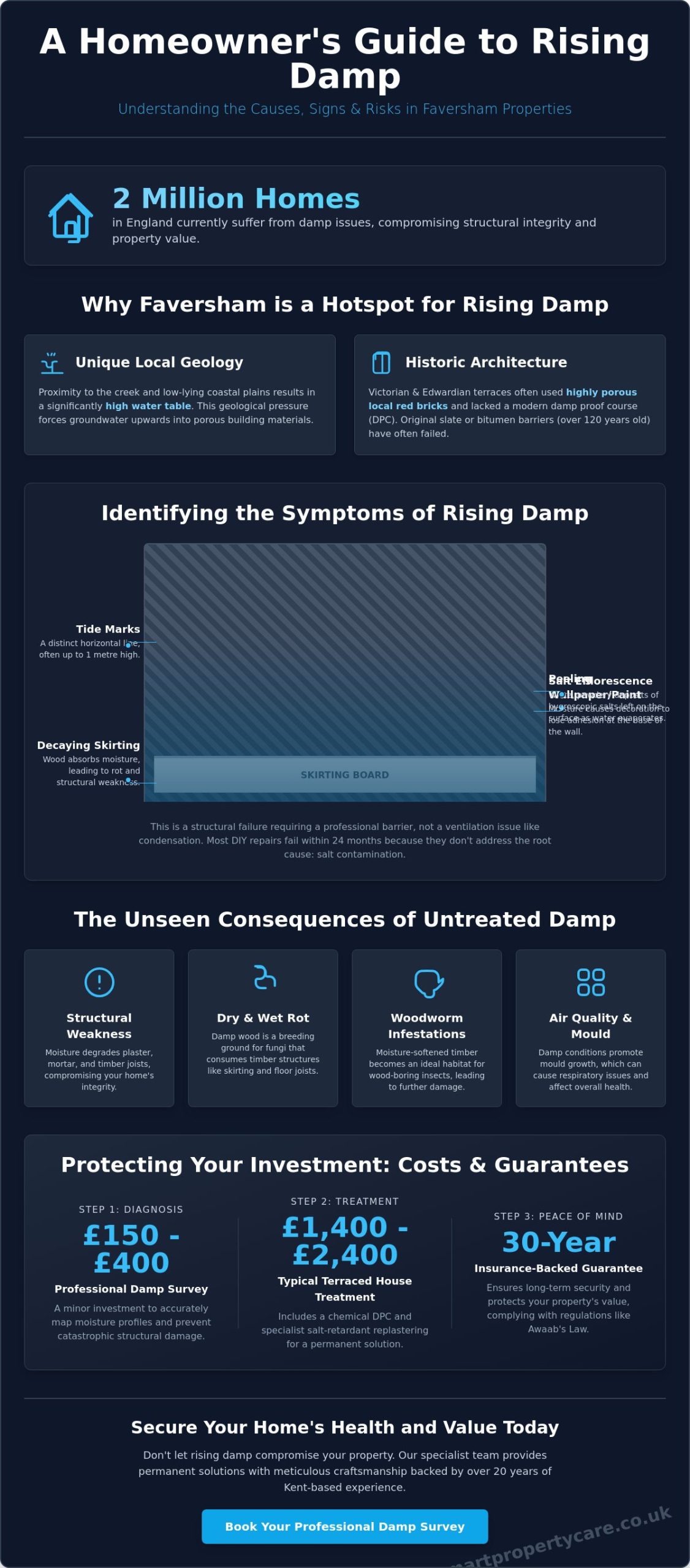
Faversham’s unique geography makes it a prime candidate for moisture issues. With its proximity to the creek and low-lying coastal plains, the local water table is often significantly higher than in other parts of Kent. This geological pressure forces groundwater into porous masonry. Identifying the need for rising damp treatment faversham starts with spotting the horizontal “tide mark” usually found up to one metre above the skirting board. Unlike penetrating damp, which appears in isolated patches after rain, rising damp is a consistent upward migration from the earth.
To understand why this happens, we must look at The Science of Rising Damp. It involves capillary action where moisture pulls ground salts into your walls. You’ll often see salt efflorescence, a white, powdery substance on the surface, or notice wallpaper peeling away from the base of the wall. These hygroscopic salts are particularly troublesome. They continue to attract moisture from the air, making the wall feel damp even during the height of summer. Differentiating this from simple condensation is vital; while condensation is a ventilation issue, rising damp is a structural failure that requires a professional hydrophobic barrier.
Faversham’s Architectural Heritage and Damp
Faversham is renowned for its Victorian and Edwardian terraces, particularly around the town centre and Preston Street. These properties were typically built with solid walls and lacked a modern physical damp proof course. The local red bricks used in many 19th-century builds are highly porous. This allows groundwater to travel through the masonry like a sponge. In a town where many buildings are over 120 years old, the original slate or bitumen barriers have often cracked or perished, leaving the property vulnerable to the high moisture levels found in the Kentish soil.
The Hidden Dangers of Untreated Damp
Ignoring these early warning signs leads to more than just aesthetic damage. Over 2 million homes in England currently suffer from damp issues that compromise structural integrity if left unaddressed. Excess moisture in floor joists creates the perfect environment for secondary infestations. We frequently find that untreated rising damp leads to serious complications. These include:
- Woodworm infestations in damp floor timbers and joists.
- Outbreaks of dry rot or wet rot in skirting boards and sub-floor structures.
- Significant degradation of indoor air quality and potential mould growth.
- Structural implications for internal specialist plasterwork.
The cost of a professional damp survey typically ranges between £150 and £400. This is a minor investment compared to the structural damage caused by prolonged moisture exposure. Taking action early ensures your home remains a healthy, dry environment while preserving its market value.
The Science of Professional Rising Damp Treatment
Rising damp is a physical process where groundwater moves vertically through masonry via capillary action. Think of your home’s walls as a series of microscopic tubes that pull moisture from the earth. Without a functional barrier, this water carries dissolved nitrates and chlorides into your living space. Effective rising damp treatment faversham relies on breaking this chain by creating a hydrophobic zone within the mortar bed. This chemical or physical shield prevents water molecules from climbing further, effectively drying the wall from the ground up.
Before any work begins, a professional damp survey is essential to map the moisture profile of your property. We often see homeowners attempt DIY fixes with off-the-shelf creams that fail to address the core issue. In historic Faversham properties, solid walls are frequently too thick or the mortar too degraded for basic retail products to work. A specialist approach ensures the treatment reaches the entire depth of the wall, providing a lasting seal rather than a temporary patch. It’s a technical task that requires specific equipment and high-grade materials to succeed.
Chemical DPC Injection Methods
Our primary method for modernising damp protection involves high-viscosity silane-based injections. We drill precise holes at the correct mortar course, typically 150mm above the external ground level to comply with UK Building Regulations. The cream then migrates through the masonry, lining the pores with a water-repellent resin. Accuracy is paramount here. Incorrect drill spacing or insufficient depth will leave gaps in the barrier, allowing moisture to bypass the treatment. It’s a meticulous process that demands an expert touch to ensure the barrier is seamless and effective.
Physical Damp Proofing Barriers
While chemical injections are highly effective, some scenarios require a physical intervention. If your external ground levels have been raised over the years by new driveways or patios, they might “bridge” the original damp course. In these cases, we may install physical membranes or lower the ground level to restore the property’s natural defence. We also look at external rendering. If your render extends too low, it can act as a bridge for moisture to climb over the DPC. Correcting these structural defects is part of our comprehensive approach to property care. If you’re concerned about your home’s integrity, request a specialist assessment to identify the right solution for your specific masonry type.
Comparing Treatment Solutions: What Works Best?
Selecting the correct rising damp treatment faversham homeowners can trust involves navigating a variety of technical options. The industry gold standard remains chemical DPC injection, which uses silane-based creams to create a molecular-level barrier. In contrast, electro-osmotic systems use small electrical charges to repel moisture. While these systems exist, they are rarely the first choice for traditional Kentish brickwork due to their complexity and maintenance requirements. Most professional surveyors recommend chemical barriers because they’re passive, permanent, and proven to work in the dense, solid-wall properties common in our local area.
Investing in a professional solution is ultimately a financial safeguard. While a standard terraced house treatment can cost between £1,400 and £2,400, this price includes the expertise required to avoid “bridging” and the secondary damage caused by hygroscopic salts. We also look beyond the wall itself. Blocked air bricks are a frequent culprit in Faversham, where higher ground levels or new driveways often obstruct essential sub-floor ventilation. Addressing these external factors ensures that your property preservation strategy is comprehensive and built to last.
Diagnostic Tools for Faversham Surveyors
Accuracy during the survey phase prevents expensive misdiagnosis. We use electronic protimeters to detect surface moisture, but these can be fooled by salt contamination from old chimney breasts or previous leaks. For a definitive answer, we employ carbide meters. This involves taking a small sample of masonry from within the wall to measure the actual moisture content. This level of detail allows us to provide a costed specification report that distinguishes between true rising damp and “false” damp caused by condensation or salts.
Guarantee and Insurance Considerations
Peace of mind comes from knowing your investment is protected. Reputable damp proofing typically comes with a 20 year guarantee, but it’s vital that this is insurance-backed. This means the protection remains valid even if the original contractor ceases trading. Mortgage lenders and insurance providers in the UK strictly require professional certification for any damp remediation work. Without this paperwork, selling or refinancing your home becomes significantly more difficult. Our meticulous approach provides the certified evidence you need to satisfy lenders while ensuring your home remains dry and healthy for decades.
Specialist Plastering: The Essential Final Step
Many homeowners assume that injecting a new barrier is the end of the journey. In reality, successful rising damp treatment faversham requires a secondary phase: the removal of salt-contaminated plaster. Standard gypsum plaster is highly porous and acts like a magnet for moisture. Even after the source of rising water is blocked, the hygroscopic salts left in the masonry will continue to pull water from the air. This is why you often see damp patches reappearing on newly painted walls if the original plaster wasn’t replaced. We typically remove old plaster to a height of at least one metre to ensure every trace of salt is gone.
Applying salt-neutralising additives to the new render coat is a non-negotiable part of our process. These additives react with any remaining nitrates and chlorides, preventing them from reaching the surface of your new decorations. It’s a technical safeguard that standard builders often overlook. By using high-specification materials, we achieve a seamless finish that matches your existing property renovation. This meticulous attention to detail is what separates a temporary fix from a permanent structural solution that protects your home for decades.
The Remedial Plastering Process
We strip the walls back to the original brickwork to remove all contaminated material. This reveals the raw masonry, allowing us to apply a specialist waterproof rendering system. In historic Faversham properties, we often use breathable renovation plasters. These materials allow the structure to “breathe” while blocking salt migration, which is vital for the longevity of solid wall constructions. The typical cost for internal replastering is between £450 and £800 per room, an investment that ensures the damp never returns to ruin your aesthetic finish.
Preventing Secondary Issues
While the walls dry, it’s vital to monitor indoor air quality. High humidity can lead to condensation on windows and walls, which might be mistaken for a failed DPC. We also use this phase to inspect floor timbers for signs of wet or dry rot. Moisture trapped behind old skirting boards often migrates into the grain of the wood, creating a breeding ground for fungi. Finally, patience is key for redecoration. You shouldn’t apply permanent paint or wallpaper until the new render has fully cured and dried. If you want to ensure your home’s interior is restored to the highest standard, book a specialist plastering assessment with our expert team today.
Why Smart Property Care Ltd is Faversham’s Damp Specialist
For over 20 years, Smart Property Care Ltd has provided the professional rising damp treatment faversham homeowners rely on to protect their most valuable assets. We operate as a family-run business, which means our reputation is built on every brick we treat and every wall we restore. We don’t believe in quick fixes or “one size fits all” solutions. Instead, we apply a level of meticulous attention to detail that only an expert craftsman can provide. Our team understands that a damp wall is often just the start of the problem, which is why we offer a comprehensive “Survey to Finish” service.
Because moisture creates the perfect environment for timber decay, our expertise extends to professional woodworm treatment and rot remediation. We’ve seen how untreated rising damp can compromise floor joists and historic skirting boards across Kent. By choosing a specialist who manages both the damp proofing and the secondary timber protection, you ensure your home’s structural integrity is handled by a single, accountable partner. Smart Property Care Ltd takes immense pride in its work, moving swiftly from a technical diagnosis to a high-standard execution that leaves your home dry, safe, and fully restored.
Our Local Commitment to Faversham
Faversham is home to numerous conservation areas and listed buildings that require a sensitive, informed approach to maintenance. We possess a deep knowledge of local building regulations and the specific requirements of the Swale Borough Council’s conservation guidelines. Our team doesn’t just inject chemicals; we ensure every intervention respects the original fabric of your property. We provide transparent pricing and no-obligation professional surveys, ensuring you have all the facts before making a decision. This commitment to honesty and quality has made Smart Property Care Ltd a trusted partner for both private homeowners and local property managers since the early 2000s.
Start Your Property Restoration Today
Taking the first step toward a dry home is straightforward. When you book a specialist damp survey in Faversham, one of our senior surveyors will conduct a thorough on-site assessment. You’ll receive a detailed technical report and a costed specification that outlines exactly what’s needed to resolve your damp issues permanently. We don’t use high-pressure sales tactics; we provide expert evidence and clear solutions. With the 2026 updates to Awaab’s Law placing even greater emphasis on property health, there’s never been a more important time to secure your home’s future. Contact Smart Property Care Ltd for your Faversham damp survey and regain your peace of mind today.
Secure Your Home’s Structural Integrity
Protecting your property from groundwater ingress requires a combination of modern chemical science and traditional craftsmanship. Successful rising damp treatment faversham relies on the precise diagnosis and meticulous salt removal we have detailed in this guide. Failing to address these underlying issues leads to secondary rot or structural degradation that compromises your home’s market value. By choosing a solution that includes a 20-year insurance-backed guarantee, you ensure that your investment is protected for the long term.
Smart Property Care Ltd brings over 20 years of experience as a family-run local business to every project we undertake. We don’t just provide a service; we offer the peace of mind that comes from knowing your home is in the hands of expert craftsmen. Our comprehensive approach ensures that every trace of moisture is managed from the initial survey to the final specialist plastering coat. Take the first step toward a dry, healthy living environment by booking your professional assessment today.
Book Your Specialist Damp Survey in Faversham Today
You don’t have to live with the anxiety of damp walls or peeling wallpaper. With the right specialist support from Smart Property Care Ltd, your home can be transformed into the dry, comfortable sanctuary you deserve.
Frequently Asked Questions
How much does rising damp treatment cost in Faversham in 2026?
Typical costs for a chemical DPC injection in 2026 range between £70 and £120 per linear metre. For a standard terraced house in Faversham, this often totals between £1,400 and £2,400 depending on the wall thickness. You must also factor in specialist replastering, which typically costs between £450 and £800 per room to ensure all hygroscopic salts are removed from the masonry.
Can I sell my house in Faversham if it has rising damp?
You can sell a property with damp, but it significantly complicates the process because most UK mortgage lenders require a professional rising damp treatment faversham certificate before approving a loan. Active damp issues often lead to price renegotiations or buyers pulling out. Providing a 20 year insurance backed guarantee to potential buyers is the most effective way to protect your property’s market value.
How long does the damp proofing process take to complete?
A standard treatment for a single internal wall usually takes one to two days to complete. If we’re treating the entire ground floor of a property, the process typically spans three to five working days. This timeframe includes stripping the contaminated plaster, injecting the new hydrophobic barrier, and applying the specialist salt neutralising render. We provide a specific schedule during the survey phase to minimise disruption.
Is rising damp treatment messy for a lived in home?
Remedial work involves removing old plaster, which inevitably creates dust and debris within the property. We take meticulous care to protect your home by using industrial grade extraction equipment and heavy duty dust sheets. Our team operates with the discipline of expert craftsmen, ensuring the workspace is kept as clean as possible and all contaminated materials are removed from the site daily.
Do I really need to replaster after a damp proof course injection?
Replastering is a non negotiable step because groundwater carries nitrates and chlorides into the wall. These hygroscopic salts remain in the old plaster even after the moisture source is blocked, continuing to attract water from the air. Removing the contaminated material and replacing it with a specialist salt neutralising render is the only way to prevent damp patches from reappearing on your new decorations.
What is the difference between rising damp and penetrating damp?
The primary difference is the direction and source of the moisture. Rising damp travels vertically from the ground through capillary action, typically affecting only the first metre of the ground floor. Penetrating damp moves horizontally through the walls, often caused by external defects like leaking gutters or porous bricks. Our rising damp treatment faversham specifically targets the upward migration of groundwater to ensure a dry interior.
Are your damp proofing treatments guaranteed?
All our professional damp proofing installations are backed by long term guarantees of 20 to 30 years. Crucially, these guarantees are insurance backed, which means they remain valid even if the original contractor ceases trading. This level of security is a standard requirement for UK mortgage lenders and provides homeowners with the peace of mind that their structural repairs are fully protected.
How can I tell if my existing damp proof course has failed?
Signs of a failed DPC include visible tide marks, white salt powder on the walls, and decaying skirting boards. If your property was built before 1900, the original slate or bitumen barrier may have perished or been “bridged” by higher external ground levels. A professional survey using a carbide meter is the most accurate way to confirm if your existing barrier is no longer functional.