
Did you know that damp-related illnesses cost the NHS an estimated £38 million every year? It’s a sobering figure that highlights why a wet basement is far more than just a storage headache. For homeowners in the Garden of England, investigating the damp proofing basement walls cost kent is the first step toward reclaiming a lost room and protecting your family’s health. You’ve likely felt that familiar sense of dread when spotting a dark patch on the masonry or smelling that unmistakable musty scent in your lower ground floor.
We understand the anxiety that comes with below-ground water ingress. It’s frustrating to choose between complex technical terms like Type A tanking and Type C cavity drainage while worrying if a contractor will actually solve the problem or just mask it. This guide promises to strip away the jargon and provide a clear, 2026 perspective on what you should expect when investing in professional-grade protection. We’ll examine the latest British Standards, compare modern waterproofing methods, and show you how to secure a dry, habitable space that adds genuine value to your Kent home.
Key Takeaways
- Understand why Kent’s specific clay soil and high water tables demand a more robust waterproofing approach than standard damp proofing.
- Learn how the damp proofing basement walls cost kent is influenced by more than just square footage, including regional logistics and structural complexity.
- Discover the critical differences between Type A tanking and Type C cavity drainage systems to determine which method offers the most reliable protection.
- Identify the essential finishing touches, such as specialist plastering, that prevent standard materials from failing in a treated basement environment.
- Find out why local architectural expertise is vital for a successful installation that adds lasting value and security to your home.
Understanding Basement Damp in Kent Properties
Effective moisture management in a below-ground space is a complex engineering challenge, particularly across the diverse landscape of the South East. For many homeowners, investigating the damp proofing basement walls cost kent reveals that standard solutions often fall short. Professional basement waterproofing is far more than just blocking water; it’s an integrated structural strategy designed to manage ground pressure and moisture vapor simultaneously. While a standard damp proof course might suffice for a ground-floor extension, a basement exists in a state of constant battle with the surrounding earth.
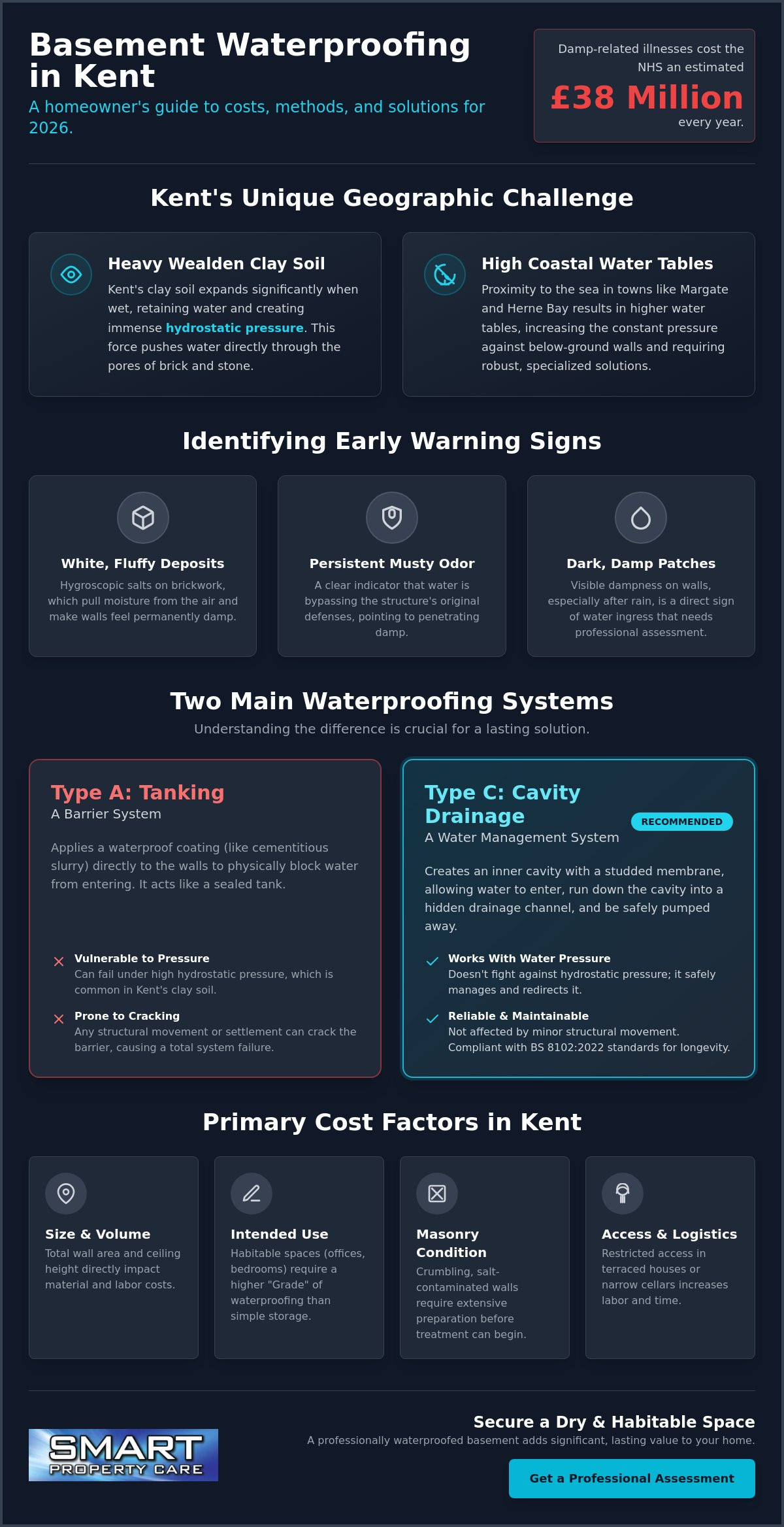
Kent’s unique geography dictates the intensity of this struggle. Much of the county sits on heavy Wealden clay, a soil type that expands significantly when wet and retains water for long periods. This creates high levels of hydrostatic pressure, literally pushing liquid water through the microscopic pores of your masonry. In 2026, all reputable installations must adhere to the BS 8102:2022 standard. This code of practice emphasizes a dual-protection approach and requires a documented risk assessment. It ensures that any system we install is not only robust but also maintainable over its lifetime. Understanding the various damp proofing methods is the first step in deciding whether your property requires a simple barrier or a comprehensive drainage system.
Common Signs of Basement Wall Damp
Identifying the problem early saves significant repair costs. Look for hygroscopic salts, which appear as white, fluffy deposits on the brickwork. These salts actually pull moisture from the air, making the wall feel permanently damp even in dry weather. It’s also vital to distinguish between simple condensation and true penetrating damp. If you notice a persistent musty odor in your Kent cellar, it usually indicates that water is bypassing the structure’s original defenses. This isn’t just an aesthetic issue; it’s a structural warning sign that demands professional attention.
Why Local Kent Architecture Matters
The age and material of your home play a massive role in treatment selection. Canterbury is famous for its Victorian and Edwardian terraces, which often feature solid brick foundations that lack any modern moisture barriers. These porous structures act like a wick, drawing ground water upward. In coastal towns like Herne Bay and Margate, the proximity to the sea often results in higher water tables, increasing the pressure against basement walls. We also frequently encounter Kentish ragstone. While beautiful, this irregular masonry is notoriously difficult to seal, requiring specialized mortars and flexible membranes that a “one-size-fits-all” builder simply won’t have in their toolkit.
Cost Factors for Damp Proofing Basement Walls in Kent
Estimating the damp proofing basement walls cost kent involves more than a simple square-footage calculation. While national averages provide a baseline, they often fail to account for the logistical realities of the South East in 2026. A professional quote considers the volume of the space, the height of the ceilings, and the intended use of the room. If you’re converting a cellar into a high-end home office, the technical requirements for vapor control are far more stringent than for a basic dry storage area. We categorize these as “Grades” of waterproofing, with habitable spaces requiring the highest level of protection against moisture and humidity.
The condition of your existing masonry is a significant variable. Years of water ingress often leave walls saturated with hygroscopic salts. These minerals must be completely removed before any new system is applied. If the substrate is crumbling or unstable, the preparation phase will naturally take longer and require more specialized materials to ensure a permanent bond. Choosing a contractor who belongs to the Property Care Association ensures that these technical nuances are addressed correctly from the start. Our team at Smart Property Care Ltd prioritizes this meticulous preparation to guarantee the longevity of every installation.
Primary Cost Drivers in 2026
Logistics play a massive role in Kent. If your property is a Victorian terrace in Canterbury with restricted street access, the manual effort required to transport heavy membranes and remove salt-contaminated debris increases. Accessibility isn’t just about the front door; it’s about the narrowness of the cellar stairs and the ease of installing drainage channels. Higher ceilings also mean more wall area to treat, which impacts both material volume and labor hours. We also account for the cost of safe waste disposal, which has become more complex due to updated environmental regulations regarding contaminated building materials.
Specialist Surveys vs. General Quotes
A “free” quote from a general builder often leads to expensive surprises. These estimates frequently miss the underlying causes of damp or fail to account for hydrostatic pressure. A specialist damp survey is a diagnostic tool that uses calibrated equipment to map moisture patterns and salt concentrations. This data allows us to provide a fixed-price proposal based on facts rather than guesswork. It’s the only way to ensure your budget is respected and the solution is permanent. To get a clear, professional overview of your property’s needs, Book your specialist damp survey in Kent today. This report becomes the blueprint for a dry, healthy home, saving you from the high cost of remedial repairs in the future.
Tanking vs. Cavity Drainage: Which System Fits Your Budget?
Choosing the right method is the most critical decision in your project. It dictates both the upfront investment and the long-term reliability of the space. In Kent, where heavy clay soils are common, the choice between Type A and Type C waterproofing often depends on the level of hydrostatic pressure your walls face. This selection directly impacts the overall damp proofing basement walls cost kent, as each system requires different materials and preparation times. We don’t just look at the walls; we evaluate the entire structural environment to recommend the most cost-effective, durable solution.
The Reality of Basement Tanking
Type A waterproofing, commonly known as tanking, involves applying a rigid, waterproof barrier directly to the internal masonry. We often use cementitious slurries that bond to the brickwork to create an impermeable seal. While the material costs for tanking are often lower than other methods, the labor involved in substrate preparation is significant. The walls must be stripped to the original masonry and repaired to ensure a perfect bond. You can learn more about this process here: What does tanking a cellar mean?. The main risk in Kent is that the rigid nature of tanking cannot always withstand the expansion and contraction of our local clay soils, which may lead to hairline cracks over time.
Cavity Drainage Systems (CDS) Explained
Type C waterproofing, or Cavity Drainage Systems, takes a different approach by managing water ingress rather than trying to stop it. We install a studded plastic membrane over the walls and floor, which directs water into hidden perimeter channels and toward a sump pump system. This method is often the professional choice for habitable conversions because it’s more forgiving of structural movement. It also aligns perfectly with UK building regulations for damp-proofing, which prioritize maintainable systems. This approach is particularly effective for larger Kent basements where the volume of water ingress might overwhelm a simple barrier.
While a CDS involves a higher initial outlay for the pump and membranes, it offers superior long-term security. You’ll need to factor in the cost of an annual service for the sump pump to ensure it remains operational. However, for properties in areas with high water tables, like Herne Bay or Margate, the peace of mind provided by a managed system often outweighs the lower entry cost of traditional tanking. We help you weigh these options based on your specific property’s architecture and your vision for the finished room, ensuring your investment is protected for decades.
Hidden Costs and ROI of Basement Waterproofing
Understanding the damp proofing basement walls cost kent requires a view of the total project lifecycle rather than just the initial installation. Many homeowners focus solely on the cost of membranes or slurries, but the true investment includes the specialized finishes and structural adjustments required to make a space habitable. Electrical and plumbing systems in a below-ground environment must meet specific safety standards to resist moisture. Standard components often corrode or fail in high-humidity zones. We integrate moisture-resistant fixtures and waterproof conduits as part of our comprehensive approach to ensure your systems remain safe and functional for decades.
Precision is the hallmark of a professional installation. When we transform a cellar, we don’t just hide the problem; we engineer a solution that adds tangible value to your home. This involves coordinating various trades who understand the unique constraints of a waterproofed environment. The result is a seamless transition from a damp, neglected storage area to a premium living space that feels like a natural extension of your property.
Specialist Plastering and Rendering
One of the most common mistakes in basement renovation is using standard gypsum plaster. Gypsum is highly porous. It acts like a sponge, drawing moisture and residual hygroscopic salts through the wall, which eventually causes the finish to bubble and peel. We employ salt-neutralizing renders that act as a final, robust defense. This ensures your walls stay crisp and dry regardless of external conditions. This is a critical stage detailed in The Ultimate Guide to Damp Proofing in Kent. While specialist rendering carries a higher price point than general decorating, it’s the only way to protect your long-term investment from surface failure.
Calculating Your Return on Investment
A dry, professionally treated basement offers a significant boost to your property’s market value. In high-demand areas like Canterbury or the revitalized coastal stretches of Margate and Ramsgate, adding usable square footage is often more cost-effective than moving home or building an extension. Beyond the increased floor space, professional waterproofing prevents the onset of dry rot and structural timber decay. These issues are expensive to fix and can be devastating to a building’s integrity if left unchecked. A well-sealed basement also improves the thermal performance of the entire house. It eliminates the rising damp and cold air that often permeates from the foundations, leading to a more energy-efficient home.
Insurance-backed guarantees are another essential consideration when evaluating the damp proofing basement walls cost kent. While they add a small premium to the quote, they offer an emotional and financial safety net that standard builder warranties cannot match. These documents are frequently requested by solicitors during the conveyancing process. They act as a trust signal for future buyers, proving that the work was completed to a high professional standard. To ensure your home is protected by an expert team, book a specialist damp assessment with Smart Property Care Ltd today and secure your property’s future.
Choosing a Local Kent Damp Specialist
Selecting the right partner for your project is the final step in securing your home’s structural future. In Kent, this choice involves more than just comparing bottom-line figures. You need a specialist who understands the specific architectural challenges of the region, from the timber-framed heritage of Canterbury to the salt-spray environments of Herne Bay. A general contractor might underestimate the damp proofing basement walls cost kent by failing to account for the hydrostatic pressure unique to our local clay soils. We focus on providing technical clarity from the first interaction.
Our approach centers on the Expert Craftsman philosophy. This means we prioritize discipline, punctuality, and an obsession with detail. We don’t just do the job; we engineer a dry environment that lasts for decades. A professional installation should leave your home cleaner than we found it, with every membrane sealed and every drainage channel tested for absolute precision. This level of care transforms a stressful renovation into a reassuring investment in your property’s longevity.
Questions to Ask Your Waterproofing Contractor
Transparency is the most reliable trust signal in the property preservation industry. Before you sign any contract, ensure your specialist can provide clear answers to these vital questions:
- Are you accredited by the Property Care Association (PCA)? Membership in the PCA is the industry gold standard. It proves the contractor has undergone rigorous vetting and adheres to strict professional standards.
- Do you provide a costed specification after the survey? A vague estimate is a red flag. You deserve a line-by-line breakdown of materials, labor, and preparation costs.
- What specific guarantees do you offer for Kent properties? Look for insurance-backed guarantees that remain valid even if the company ceases to trade. This is the ultimate peace of mind for any homeowner.
The Smart Property Care Difference
Smart Property Care Ltd brings over 20 years of experience to every cellar and basement we treat across Herne Bay, Canterbury, and East Kent. As a family-run business, we understand that we aren’t just working on a building; we’re protecting your family’s home. We treat every project with the same level of care and precision we would apply to our own property. Our team provides a comprehensive service that manages every stage of the process. We take you from the initial diagnostic survey through to the final coat of specialist plastering, ensuring a seamless and stress-free experience. By choosing a local specialist with deep roots in the community, you ensure that your damp proofing basement walls cost kent results in a permanent, high-value solution.
Secure Your Kent Property’s Future Today
Transforming a damp cellar into a dry, valuable asset requires a blend of local insight and technical precision. You now understand that Kent’s unique clay soils and high water tables demand more than a superficial fix. By choosing between Type A and Type C systems based on your property’s specific needs, you ensure a permanent solution rather than a temporary patch. This strategic approach protects your structural integrity while adding genuine square footage to your home.
Managing the damp proofing basement walls cost kent is about prioritizing quality and professional diagnostics from the start. As a family-run local business with over 20 years of industry experience, we specialize in both modern and traditional techniques to preserve your home’s character. We provide the expertise needed to navigate complex structural challenges with absolute confidence, ensuring every membrane and pump system is installed to the highest standard.
Ready to reclaim your lower ground floor and enjoy total peace of mind? Contact Smart Property Care for a professional damp survey in Kent today. Our expert team is ready to help you create a dry, healthy environment that lasts for generations.
Frequently Asked Questions
How much does it cost to damp proof a small basement in Kent?
The damp proofing basement walls cost kent for a smaller space depends heavily on the chosen waterproofing method and the depth of the structure. A simple tanking application involves different material expenses than a full cavity drainage system with a sump pump. We provide a tailored specification after a detailed survey to ensure you only pay for the protection your specific property requires.
Is basement tanking a permanent solution for damp walls?
Tanking provides a robust, impermeable barrier that can last for many years if the substrate remains stable. However, it isn’t always the best choice for Kent’s heavy clay soils, which can shift and cause hairline cracks in rigid slurries. For long-term peace of mind in high-pressure environments, a managed drainage system is often the more reliable professional recommendation.
How long does professional basement waterproofing take to complete?
Most professional installations are completed within five to ten working days. This timeline includes the labor-intensive process of removing old plaster, preparing the masonry, and installing the chosen waterproofing system. If your project includes specialist plastering, you’ll need to allow extra time for the materials to cure properly before final decorating begins.
Can I damp proof my basement walls myself to save on costs?
We don’t recommend DIY for below-ground damp proofing because moisture management requires specialized engineering knowledge. Small errors in membrane sealing or slurry application can lead to catastrophic failures that are expensive to rectify. Professional installation also provides the insurance-backed guarantees required by mortgage lenders and future property buyers during the conveyancing process.
Does damp proofing a basement increase my house value in Kent?
Converting a damp cellar into a dry, habitable room is one of the most effective ways to boost the damp proofing basement walls cost kent return on investment. It transforms neglected storage into premium living space, such as a home office or gym. Having a certified, dry basement also makes your home much more attractive to buyers who are wary of structural damp.
What is the difference between a damp survey and a general building survey?
A specialist damp survey uses calibrated diagnostic tools to map moisture and identify salt contamination, which a general building survey often misses. While a general surveyor provides a broad overview of a property’s condition, our specialists focus purely on the science of moisture ingress. This forensic approach ensures the root cause is identified before any work starts.
Why do my basement walls still feel damp after treatment?
It’s common for walls to feel cool or slightly damp during the initial drying phase, which can take several weeks depending on the wall’s thickness. If the feeling persists, it might be due to residual hygroscopic salts on the surface or inadequate ventilation causing condensation. Our specialist renders are designed to manage this transition and keep the surface dry.
Do I need a sump pump if I only have damp walls and no flooding?
If you choose a Cavity Drainage System, a sump pump is a non-negotiable component. Even if you don’t experience flooding, the pump’s job is to safely remove the small amounts of water that naturally collect behind the membrane. Without a pump, this water would stagnate, eventually creating hydrostatic pressure that could compromise the entire waterproofing system.