
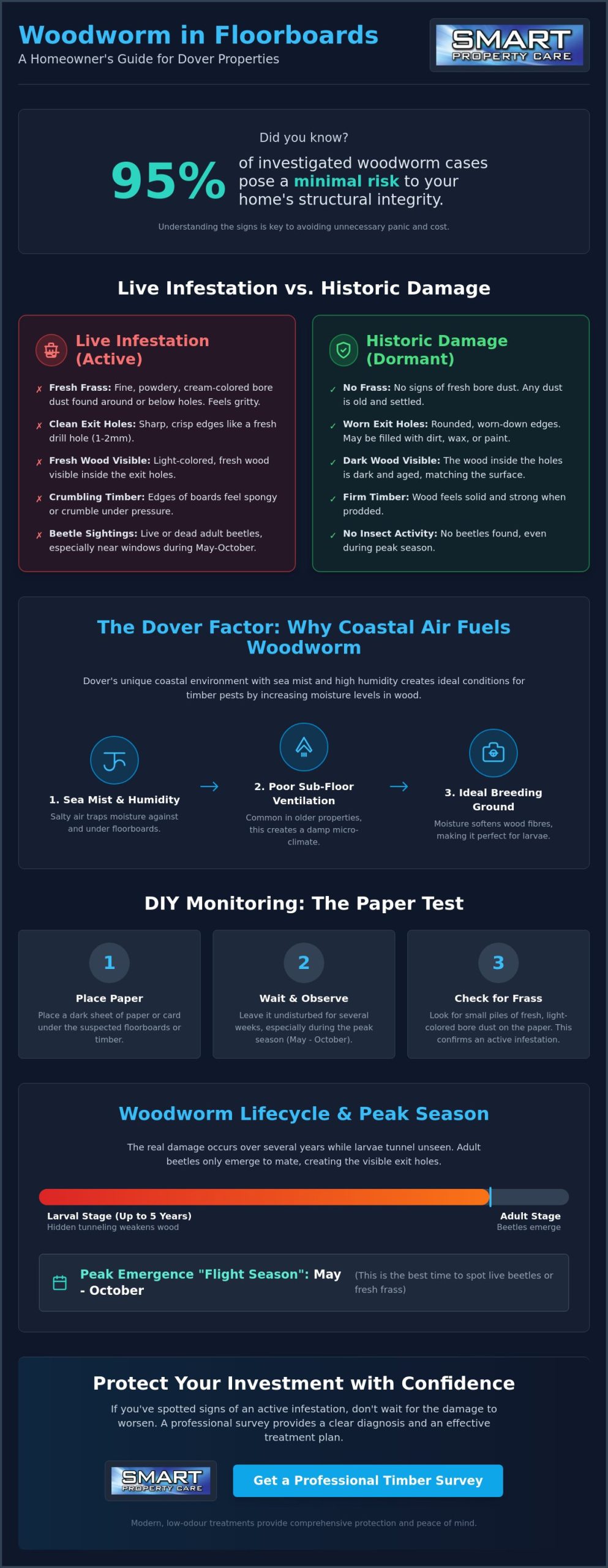
Did you know that in as many as 95% of investigated cases, woodworm poses a minimal risk to the structural integrity of your home? It’s natural to feel a surge of anxiety when you spot tiny holes in your timber, especially in Dover’s damp coastal environment where salt air can trap moisture against your floorboards. You likely worry about the floor giving way or the treatment costs spiraling out of control before you even start. Identifying the specific signs of active woodworm in floorboards dover is the first step toward regaining control over your property’s health.
We understand that your home is your most valuable asset, and uncertainty is the enemy of effective maintenance. This guide will help you distinguish between harmless historic damage and a live infestation that requires professional attention. You’ll learn exactly what to look for during the peak emergence season between May and October, including how to spot fresh frass and exit holes. We will provide a clear 2026 checklist to help you protect your structural timbers, secure your furniture, and create a precise plan for any necessary remedial work. By the end of this article, you’ll have the certainty needed to protect your investment with confidence.
Key Takeaways
- Learn how to distinguish between dormant damage and live infestations by identifying fresh, powdery frass and clean exit holes.
- Use our 2026 checklist to identify specific signs of active woodworm in floorboards dover, especially in older homes where coastal dampness accelerates timber decay.
- Discover how the simple “Paper Test” can help you monitor activity levels in your home before committing to professional remediation.
- Understand why Dover’s unique sea-mist and high humidity create the perfect environment for timber pests and how to mitigate these moisture risks.
- Explore the benefits of modern, low-odour aqueous treatments that provide comprehensive protection for your structural timbers and peace of mind for your family.
Identifying Active Woodworm in Dover Floorboards
Active woodworm isn’t just a cosmetic flaw; it’s a current, ongoing larval infestation deep within your property’s structural timber. While many residents use the term “woodworm” generically, it actually refers to the larvae of several different wood-boring beetles. The most frequent culprit in East Kent is the Common Furniture Beetle, which accounts for approximately 75 to 80% of all UK infestations. Spotting the signs of active woodworm in floorboards dover often happens during renovations when you lift a carpet and find a network of tiny holes that were previously hidden from view.
To accurately assess the health of your home, you must change how you view those holes. From an expert craftsman’s perspective, a hole isn’t an entry point; it’s an exit. By the time you see a hole, the adult beetle has already completed its life cycle and flown away. The real danger lies in the larvae still tunneling through the wood, often for up to five years, before they ever emerge. Identifying whether these tunnels are still being actively extended is the key to protecting your floorboards from structural failure.
The Discovery: Why Floorboards are the Primary Target
Floorboards are particularly vulnerable because they are often constructed from softwoods like pine or spruce, which are the preferred diet for wood-boring larvae. In older Dover properties, the lack of adequate sub-floor ventilation creates a damp micro-climate under carpets. This trapped moisture softens the wood fibers, making it easier for larvae to navigate. You’ll most likely find these signs of active woodworm in floorboards dover in less-disturbed areas like under-stairs cupboards, the perimeters of bedrooms, or beneath heavy, long-standing furniture where air circulation is minimal.
Old Damage vs. Live Infestation
Distinguishing between historic damage and a live threat requires a disciplined eye. You can use the “Sharpness Test” as a reliable first step. Active exit holes have sharp, crisp edges that look like they were recently drilled, whereas old holes appear rounded and may be filled with floor wax or dust. Similarly, the “Colour Test” provides immediate clues; a live hole will show fresh, light-coloured wood inside that contrasts with the aged, darker surface of the board. If you find fresh, cream-coloured bore dust, known as frass, spilling from the holes or collecting in small piles, the infestation is undeniably active and requires immediate professional intervention.
The 4 Primary Indicators of a Live Infestation
Identifying a live infestation is a matter of forensic observation. While the previous section established the exit-hole concept, we must now look for the physical evidence left behind by wood-destroying insects. There are four primary markers that confirm an active colony is currently feeding on your timber:
- Fresh Frass: Fine, powdery bore dust found around or beneath holes.
- Clean Exit Holes: Round openings measuring approximately 1mm to 2mm in diameter with sharp, un-weathered edges.
- Beetle Sightings: Live or dead insects found near timber or on windowsills.
- Crumbling Timber: Structural weakness at the edges of floorboards where multiple internal tunnels have merged.
Spotting these signs of active woodworm in floorboards dover is critical for preventing structural collapse. If the timber feels “spongy” or gives way under pressure, the internal damage is likely extensive.
Understanding Frass: More Than Just Sawdust
Frass is often mistaken for ordinary household dust, but its characteristics are distinct. When produced by the Common Furniture Beetle, frass has a gritty, sandy texture. You can test this by rubbing a small amount between your thumb and forefinger. Unlike soft, fluffy house dust, genuine bore dust feels abrasive. This material is actually the waste product of the larvae, which is pushed out of the exit holes by the adult beetle as it emerges. If you find small, cream-coloured piles of this grit on top of your carpets or beneath your joists, it’s one of the most reliable signs of active woodworm in floorboards dover.
Emergence Patterns and Timing
Timing is everything. In Kent, the “flight season” generally occurs between May and September. This is the period when adult beetles emerge from the wood to mate. Because they are naturally attracted to light, you’ll often find them dead on windowsills or congregating near glass doors. It’s a common misconception that the presence of beetles means the problem is new. In reality, those larvae may have been tunneling through your floorboards for up to five years before they reached the surface.
Don’t ignore these indicators. A specialist woodworm treatment survey provides the technical diagnosis needed to stop the cycle of decay. Catching the infestation during the emergence phase allows for targeted remedial work that protects the rest of your home’s timbers from cross-contamination.
The Dover Factor: Why Coastal Damp Fuels Woodworm
Dover’s unique geography creates a specific set of challenges for timber preservation. The town’s proximity to the English Channel means homes are constantly exposed to high relative humidity and salt-laden air. This isn’t just a matter of external weathering; it directly impacts the internal health of your property. Wood-boring beetles require a specific moisture threshold to thrive. When timber moisture levels exceed 12%, it becomes significantly more attractive to larvae. In coastal East Kent, sea-mist frequently penetrates older, porous brickwork, leading to elevated moisture levels in the very floorboards you walk on every day.
Understanding the biology of Wood-Boring Beetles in Homes reveals that they are moisture-dependent pests. Without sufficient dampness, the larvae struggle to survive or may enter a dormant state. However, Dover’s atmospheric conditions provide a consistent “fuel” for these infestations. If you notice the signs of active woodworm in floorboards dover, it’s rarely a standalone issue. It is almost always a symptom of a larger moisture problem that requires a comprehensive professional woodworm treatment strategy to resolve permanently.
Sub-Floor Ventilation in Coastal Properties
Air bricks are the primary defense against timber decay in traditional Dover homes. Their job is to facilitate a constant flow of air beneath the floorboards, sweeping away dampness before it can settle. We frequently find that these vital vents are blocked by modern additions like raised flower beds, new driveways, or even decorative gravel. When air circulation stops, the void beneath your feet becomes a stagnant, humid breeding ground. This micro-climate allows woodworm to spread rapidly from one joist to the next, often remaining undetected until the structural integrity is compromised.
Hygroscopic Salts and Timber Moisture
The sea air in Dover contains microscopic salt particles that are “hygroscopic,” meaning they naturally attract and hold water. Over decades, these salts can accumulate within the brickwork and eventually migrate into the ends of your floorboards. This process keeps the timber damp even during dry spells. You might notice “soft” spots in the wood near external walls where moisture has concentrated. These localized damp zones are often where the first signs of active woodworm in floorboards dover appear. By addressing the underlying dampness alongside the infestation, we ensure the environment is no longer hospitable to future generations of beetles.
DIY Monitoring vs. Professional Timber Surveys
If you’ve spotted potential signs of active woodworm in floorboards dover, your next move is crucial. While it’s tempting to rush into a DIY solution, a misdiagnosis can be costly. You need to verify if the infestation is currently active or merely a ghost from the past. For homeowners who want immediate clarity, the “Paper Test” is a reliable, low-cost monitoring technique that you can perform yourself before calling in the experts. It’s a simple way to gain a baseline understanding of what’s happening beneath your carpets.
However, visual inspection alone often misses the full story. In many Dover properties, the most severe damage isn’t on the surface of the floorboard; it’s on the underside or within the supporting joists. These hidden areas are where the larvae feed undisturbed for years. If you only treat what you can see, you leave the structural heart of your floor at risk. Identifying the signs of active woodworm in floorboards dover is just the start of a proper diagnostic process that must account for structural stability and moisture levels.
How to Perform the Paper Test
This test is most effective during the flight season when beetles are likely to emerge. It creates a physical barrier that any emerging adult must break through, leaving clear evidence of recent activity. Follow these three steps for the best results:
- Step 1: Thoroughly clean the suspected area. Remove all old dust, wax, and debris so the surface is pristine.
- Step 2: Securely tape pieces of white paper or masking tape over the specific exit holes you’ve found.
- Step 3: Wait for 7 to 14 days. If you find new holes punctured through the paper, you have confirmed a live infestation.
What a Professional Survey Reveals
While the paper test confirms activity, it doesn’t reveal the extent of the damage hidden beneath the surface. Professional surveys go beyond the visible holes. We use high-precision moisture meters to map “at-risk” zones where humidity is highest. This is particularly important because woodworm activity often signals an underlying moisture issue. If your property is suffering from coastal humidity, you may also require a damp survey to identify the root cause of the infestation.
Our experts inspect the underside of floorboards and the supporting joists, which are often the most heavily damaged areas. We assess the structural integrity of every timber to determine if a board can be treated or if it must be replaced. This process provides you with a costed, detailed specification for remedial work that meets insurance and mortgage standards. To ensure your home is structurally sound, it’s best to book a professional timber survey with a qualified specialist today.
Professional Woodworm Treatment & Long-Term Prevention
Once you have confirmed the signs of active woodworm in floorboards dover, the focus must shift from observation to eradication. Smart Property Care Ltd provides a sophisticated, Expert Craftsman approach to timber preservation. We don’t just spray surfaces; we engineer a long-term solution that protects your home’s structural integrity. Using modern, low-odour aqueous treatments, we ensure the active infestation is neutralized without leaving your living space uninhabitable due to harsh chemical smells. Our methods are designed for efficiency and safety, meeting the highest professional standards.
Treating only the visible exit holes is a common mistake that leads to recurring issues. Because larvae can remain hidden deep within the timber for years, we treat the entire floor area as a single unit. This comprehensive coverage ensures that any emerging beetles are stopped before they can mate and re-infest other parts of your property. By addressing every square inch of the timber, we provide the certainty that your floorboards are truly safe. We lead with the outcome you desire: a restored, secure environment where you no longer have to worry about the floor beneath your feet.
The Smart Property Care Treatment Process
Our methodology is disciplined and thorough. We begin with meticulous timber preparation, clearing away decades of dust and debris that would otherwise block chemical absorption. This step is vital for ensuring deep penetration into the wood fibers. Our targeted application process is designed to break the beetle’s life cycle at every stage, from egg to adult. With over 20 years of experience in East Kent, our team understands the nuances of local property construction. We take pride in doing the job right the first time, giving you the peace of mind that your structural timbers are restored to a professional standard.
Preventing Re-infestation
Treating the wood is only half the battle in a coastal town like Dover. To prevent the return of wood-boring pests, you must address the moisture levels that attracted them in the first place. We advise homeowners on sealing their properties against penetrating damp, which is a common byproduct of sea-mist and salt-laden air. In many cases, our specialist plastering services are required to maintain dry internal environments and protect walls from hygroscopic salt damage. By balancing moisture and improving sub-floor ventilation, we transform your home into an environment that is no longer hospitable to timber pests.
Don’t let a hidden infestation compromise your property’s value or safety. Contact Smart Property Care Ltd for a specialist woodworm survey in Dover today to secure your home’s future with a precision-led solution.
Securing Your Home’s Structural Future
Protecting your property starts with an accurate diagnosis. You now know how to distinguish between dormant damage and the signs of active woodworm in floorboards dover, from the presence of gritty frass to the seasonal emergence of beetles. In our unique coastal environment, moisture is the constant catalyst for timber decay. Ignoring these signals can lead to compromised joists and expensive structural repairs that are entirely preventable with the right professional intervention.
Smart Property Care Ltd brings over 20 years of local experience to every project. As a family-run business, we maintain the highest Expert Craftsman standards, providing you with comprehensive damp and timber reports that offer total transparency. We don’t just treat symptoms; we deliver permanent solutions that restore your peace of mind. It’s time to stop the cycle of decay and protect your investment for the long term. Our team provides the precision and reliability your property deserves.
Take the first step toward a safer home and Book Your Professional Woodworm Survey in Dover today. We look forward to helping you restore and protect your property with confidence.
Frequently Asked Questions
How can I tell if woodworm is active in my floorboards?
Activity is confirmed by the presence of fresh, light-coloured “frass” and holes with sharp, crisp edges. If the holes appear dark or rounded, they are likely historic. Using the “Paper Test” by taping white paper over the holes for two weeks is a reliable way to detect emerging beetles. Identifying these specific signs of active woodworm in floorboards dover allows you to act before the larvae cause deeper structural damage.
Does woodworm in floorboards mean the house is structurally unsafe?
In approximately 95% of cases, woodworm poses a minimal risk to the overall structural integrity of a property. However, localized “sponginess” in floorboards suggests that internal tunneling has compromised the wood’s load-bearing capacity. While the house itself is usually safe, individual boards or joists may require replacement. A professional survey provides the technical assessment needed to determine if your floors meet current safety standards.
Can I treat active woodworm myself with DIY sprays?
DIY sprays are suitable for small, non-structural items like picture frames but often fail on floorboards. These products rarely penetrate deep enough to reach the larvae tunneling in the heart of the timber. Professional treatments use specialized equipment to ensure deep chemical saturation. Furthermore, professional remediation provides the transferable guarantees often required by mortgage lenders and insurers during property transactions in East Kent.
Why is woodworm so common in Dover and coastal Kent?
Dover’s coastal climate features high relative humidity and salt-laden air, which are primary drivers for timber decay. The salt particles are hygroscopic, meaning they naturally attract moisture into your floorboards and keep it above the 12% threshold beetles need to survive. This constant supply of moisture, combined with poor sub-floor ventilation in older properties, creates an ideal breeding ground for wood-boring infestations.
What does woodworm frass actually look like?
Frass looks like fine, cream-coloured sawdust but feels distinctively gritty when rubbed between your fingers. This texture, similar to fine sand, is a key indicator of the Common Furniture Beetle. Finding these small, gritty piles on top of your carpets or beneath your floorboards is one of the most reliable signs of active woodworm in floorboards dover. It confirms that larvae are currently active and boring through the timber.
Will woodworm from my floorboards spread to my furniture?
Yes, adult beetles can fly and will seek out other untreated timber surfaces to lay their eggs. This includes antique furniture, skirting boards, and even structural roof timbers. Because beetles are mobile during the flight season, an untreated floorboard infestation acts as a reservoir for the rest of your home. Treating the entire floor area is the most effective way to prevent cross-contamination and protect your valuable interior assets.
How long does a professional woodworm treatment take to work?
Modern aqueous treatments begin neutralizing the infestation as soon as they are applied to the timber surface. The chemical creates a protective barrier that kills emerging adults and prevents new eggs from hatching. While larvae already deep inside the wood may take time to reach the treated layer, the life cycle is effectively broken. This process ensures your floorboards are protected through subsequent emergence seasons until the infestation is fully eradicated.
Is woodworm treatment safe for pets and children?
We use advanced, low-odour aqueous treatments that are specifically formulated for use in busy residential environments. Once the treated area has dried, which usually takes between two and four hours, the room is perfectly safe for re-entry. Our team provides clear safety instructions and disciplined timelines, allowing you to enjoy a restored, pest-free home with complete peace of mind and minimal disruption to your daily routine.