
What if the most expensive part of your home repair isn’t the damp treatment itself, but the specific bag of plaster your builder chooses? It’s a frustrating reality for many homeowners who see bubbling paint and salty tide marks return just months after a project ends. When you’re arranging replastering after damp treatment faversham, you aren’t just looking for a smooth finish. You’re installing a functional barrier against residual minerals. With an estimated 4.5 million homes in the UK currently affected by damp or mould, getting this final stage right is essential for your property’s structural integrity.
We know the stress of receiving conflicting advice from general contractors while worrying if your investment will actually last. You deserve a home that stays dry and safe. This guide explains why specialist replastering is the most critical step in protecting your Faversham home from recurring damp and salt damage. We will walk you through the science of hygroscopic salts, the requirements of British Standard BS 6576, and the exact process needed to achieve a salt-free, dry wall that you can decorate with total confidence and long-term peace of mind.
Key Takeaways
- Discover why specialist replastering acts as a critical technical barrier against residual ground salts that remain in your walls after treatment.
- Learn how hygroscopic salts create a “sponge effect” by pulling moisture from the air, making standard plastering methods ineffective.
- Follow the industry-standard process for replastering after damp treatment faversham to ensure your masonry is correctly prepared and treated.
- Understand the performance differences between salt-retardant renders and gypsum-based plasters to avoid recurring damage to your interior decor.
- Secure long-term peace of mind by applying professional preservation techniques that protect your property’s value and structural health.
Why Specialist Replastering is Essential After Damp Treatment in Faversham
Specialist replastering is a technical application of salt-retardant renders specifically engineered to prevent residual moisture and minerals from reaching your wall surface. It’s the most misunderstood phase of property restoration. Many homeowners assume that once a damp-proof course is installed, the job is done. However, successful replastering after damp treatment faversham requires more than just a smooth aesthetic finish. It involves creating a functional barrier that accounts for the decades of moisture your masonry has already absorbed.
When a property suffers from structural dampness, the water carries nitrates and chlorides from the ground into the brickwork. Even after the source of rising damp is cut off, these “contaminated” salts remain trapped within the walls. If you use standard plastering materials, these salts will continue to pull moisture from the air, creating a phenomenon known as “phantom damp.” Your walls will appear wet and the paint will bubble, even though your new damp-proof course is working perfectly. Neglecting this specialist stage often results in the need to strip the walls back and start again, doubling your costs and disruption.
The Role of the Damp-Proof Course vs. Plastering
A damp-proof course (DPC) is designed to stop new moisture from rising through the capillary action of the bricks. It doesn’t, however, evaporate the water or remove the salts already present in the masonry. Specialist plastering acts as the final shield against the “history” of the damp in your home. We often see projects where general builders use standard gypsum plaster to save time. This is a critical error; gypsum is highly porous and effectively acts as a wick for residual salts, leading to inevitable failure within months of completion.
Faversham Property Types and Their Specific Needs
Faversham is home to a beautiful array of Victorian and Edwardian terraces, many of which feature solid wall construction. These historic bricks require a specific level of breathability that modern, waterproof materials often lack. In East Kent, our coastal proximity and local humidity levels mean that drying times are typically longer than in inland regions. We match our techniques to the specific age and material of your property. This ensures that replastering after damp treatment faversham provides lasting protection without compromising the building’s original character. Our approach prioritizes structural health alongside a polished, high-end finish.
Understanding Hygroscopic Salts: The Hidden Threat to Your Walls
Hygroscopic salts are the primary reason why standard decorating fails following a damp proofing project. These salts, specifically nitrates and chlorides, are carried into your masonry by moisture rising from the ground. Even after the water source is eliminated, these minerals remain embedded within the brickwork. They are naturally “hygroscopic,” meaning they actively attract and hold water molecules from the surrounding atmosphere. This creates a persistent “sponge effect” that keeps your walls feeling cold and clammy regardless of whether your damp-proof course is functioning correctly.
Identifying salt contamination is usually straightforward for a trained eye. You might notice white, fluffy deposits known as efflorescence on the surface, or persistent tide marks that refuse to dry out. Paint often peels away in large flakes, and standard wallpaper will frequently lift at the seams. Simply washing the wall surface provides no relief. Because these salts are deep within the pores of the brick, they will simply reappear as soon as the wall begins to breathe. For those seeking expert advice on rising damp, it’s clear that addressing these salts is just as important as stopping the initial water ingress.
How Salts “Mimic” Rising Damp
A common frustration for homeowners is seeing their walls look darker and feel damper on rainy or humid days. This often leads to the mistaken belief that the new damp-proof course has failed. In reality, the salts are simply reacting to the increased moisture in the air. As the room dries, the salts crystallize and expand. This physical growth is powerful enough to “blow” standard gypsum plaster off the wall, causing cracks and crumbling. Distinguishing between a failed DPC and residual salt contamination requires technical expertise and precise measurement.
The Importance of a Professional Damp Survey
Before beginning the process of replastering after damp treatment faversham, an accurate diagnosis is vital. A professional damp survey goes beyond a simple visual check. While basic moisture meters can indicate the presence of damp, they cannot distinguish between water and salt. Specialists often use laboratory analysis or carbide pressure tests to identify the specific concentration of nitrates and chlorides. This data determines the exact specification of the salt-retardant render required. If you suspect your walls are contaminated, our team at Smart Property Care Ltd can provide the clarity and technical solutions needed to restore your home permanently.
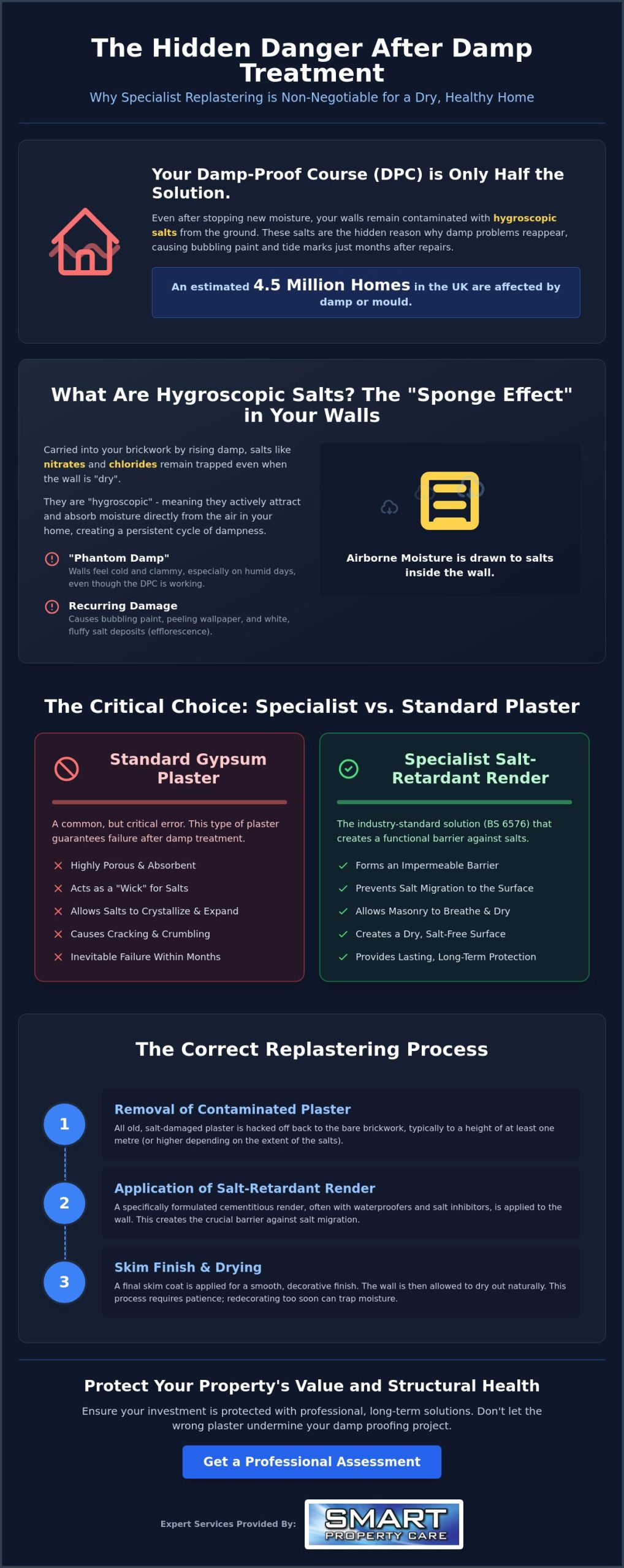
Specialist Plaster vs. Standard Gypsum: Why One Fails and the Other Protects
Choosing the correct material for replastering after damp treatment faversham is the difference between a permanent restoration and a recurring nightmare. Many property owners view plastering as a purely cosmetic trade, yet in the context of damp remediation, it is a functional engineering choice. The core conflict lies in the microscopic pore structure of the materials used. While standard gypsum is excellent for dry, modern builds, it is fundamentally incompatible with masonry that has a history of rising damp.
Specialist renovation plasters are engineered with a specific open-pore structure. This design allows the wall to “breathe,” letting residual moisture evaporate naturally without building up pressure behind the surface. These mixes also contain sophisticated salt-blocking additives. These chemicals react with and neutralise the movement of chlorides and nitrates, ensuring they stay trapped within the masonry rather than migrating to your new paintwork. This technical approach provides the structural integrity needed to bond effectively to older, damp-affected bricks found throughout Kent.
Why Standard Gypsum Fails
Standard pink gypsum plaster is a disaster for any wall previously affected by damp. It is highly dense and non-breathable, which means it effectively acts as a wick. If any residual moisture remains in the brickwork, gypsum will pull it through to the surface. Because it has no resistance to salt migration, the plaster quickly becomes contaminated. You cannot simply paint over this; the salts will continue to react with the humidity in the air, causing the plaster to lose its bond, crumble, and eventually “blow” off the wall entirely. It’s a costly mistake that often requires the entire room to be stripped back a second time.
The Benefits of Specialist Renovation Plaster
Specialist renovation plaster represents the gold standard for replastering after damp treatment faversham. It offers a unique combination of high-value protection and a premium finish. By allowing for enhanced breathability, it supports the natural drying out process of the building. The built-in salt inhibitors are your primary defense against the return of unsightly tide marks. Once applied by an expert craftsman, the result is a smooth, high-quality surface that is ready for breathable decoration. Investing in the correct technical render now prevents the need for future repairs, preserving both your home’s aesthetic and its structural value for years to come.
The Professional Replastering Process: What to Expect
Executing replastering after damp treatment faversham requires a disciplined, multi-stage approach. We don’t simply cover up the problem; we engineer a solution. The process begins with the rigorous removal of all salt-contaminated plaster. Our craftsmen strip the walls to a minimum height of 1 metre, or at least 500mm above the highest visible damp line. This ensures no residual minerals remain to compromise your new finish.
Once the masonry is exposed, we clean the brickwork thoroughly using stiff wire brushes to remove loose debris. If our initial survey identified high mineral levels, we apply specialist anti-sulphate washes to neutralise the surface. The restoration continues with a high-performance rendering coat. We use either a technical salt-retardant sand and cement mix or a pre-bagged renovation plaster, depending on your building’s specific needs. This is often applied in two passes to ensure a dense, uniform barrier. Finally, we apply a breathable skim coat. This provides the smooth, high-end surface you expect while allowing the wall to function as a breathable system.
Preparation and Raking Out Joints
Successful bonding depends on the quality of the substrate. We strip old plaster back to the original brick or stone to reveal the true condition of your walls. Our team then rakes out the mortar joints to a depth of approximately 10mm to 15mm. This creates a mechanical “key” that allows the new render to grip the masonry securely, which is a hallmark of professional replastering after damp treatment faversham. It is a laborious but essential step that prevents the render from debonding over time. We understand that property work is disruptive. We use professional dust extraction and protective floor coverings to maintain a clean environment in your Faversham home throughout the process.
Decorating After Replastering
Patience is the final ingredient in a successful damp remediation project. The “Golden Rule” of property preservation is to never use wallpaper or vinyl paints immediately after treatment. These materials trap moisture and will cause the system to fail. We recommend using breathable clay-based paints or specialist trade emulsions that allow water vapour to escape. In the Kent climate, typical drying times are usually 4 to 6 weeks per 25mm of plaster thickness. Rushing this curing period often leads to aesthetic issues later. If you’re ready to begin your restoration with a team that values precision, our experts at Smart Property Care Ltd are ready to assist.
Expert Property Restoration with Smart Property Care Ltd in Faversham
At Smart Property Care Ltd, we bring 20 years of experience in property preservation directly to your doorstep in East Kent. We understand that your home represents your most significant investment. Our family-run approach ensures that every project receives a personal, high-end finish that larger franchises simply cannot replicate. We don’t just treat the symptoms; we manage the entire lifecycle of restoration. This includes everything from the initial diagnostic survey to the final, precise application of specialist renders.
Integrating technical damp proofing kent solutions with aesthetic restoration is our core competency. We recognise that replastering after damp treatment faversham is a precise science that requires both technical knowledge and manual skill. Our craftsmen are trained to handle the complexities of salt migration and breathable finishes, ensuring your interior decor remains pristine for years to come. We take immense pride in delivering a dry, salt-free environment that restores your peace of mind and your home’s structural health.
A Local Team You Can Trust
Our reputation is built on a foundation of cleanliness, discipline, and punctuality. Whether you reside in Faversham, Herne Bay, or Canterbury, we respect your property as if it were our own. We have extensive, review-backed expertise in period property renovation, specifically tailored to the unique challenges of Kentish building materials like historic brick and flint. You gain direct access to local specialists who understand the regional climate and its specific impact on drying times and material performance. We provide the reliability of a large firm with the personal touch of a local partner.
Start Your Property Restoration Today
Early intervention is the key to preventing structural decay and the health risks associated with persistent mould growth. Don’t wait for salt damage to compromise your masonry or ruin your recent decorating efforts. Our comprehensive surveys cover damp, timber health, and specific replastering after damp treatment faversham requirements in a single, professional visit. We provide a clear, logical path toward a restored and protected home. Contact Smart Property Care Ltd for a specialist survey in Faversham today to secure your property’s future and enjoy the comfort of a dry, healthy environment.
Secure Your Property’s Future with Professional Restoration
Successful property preservation doesn’t end with a damp-proof course; it concludes with a technical barrier that addresses the building’s history. By choosing specialist renovation renders over standard gypsum, you effectively neutralise the sponge effect of hygroscopic salts. This ensures your interior walls remain dry, stable, and safe for decoration. Arranging replastering after damp treatment faversham is a strategic investment in your home’s longevity and structural health.
Smart Property Care brings over 20 years of property preservation experience to every project. As a family-run business based in Herne Bay, we take immense pride in our reputation as specialists in period property restoration across East Kent. We provide the technical precision needed to handle historic masonry while delivering the high-end finish your property deserves. Don’t leave your home to the risks of recurring damp or failing plasterwork.
Book Your Specialist Damp & Plastering Survey in Faversham
Our team is ready to help you achieve a dry, beautiful home that stands the test of time.
Frequently Asked Questions
How long must I wait to replaster after a damp-proof course is installed?
You can usually begin the replastering process within 24 to 48 hours of a chemical damp-proof course injection. While the masonry itself will take several months to dry out completely, the specialist salt-retardant render is designed to manage this residual moisture. This allows you to restore your living space much faster than if you were waiting for the bricks to be bone dry.
Can I use a standard builder to replaster my walls after damp treatment?
Using a general builder for replastering after damp treatment faversham often leads to premature failure. Most general contractors use standard gypsum plaster, which lacks the salt-blocking additives required for damp-affected walls. Specialist plastering is a technical trade that uses specific ratios of sand, cement, and lime-free renders to ensure the salts stay trapped within the masonry rather than ruining your new paintwork.
What is the white powder appearing on my newly plastered walls?
This white powder is known as efflorescence. It occurs when soluble salts migrate to the surface as the wall dries. In most cases, you can simply brush it away with a dry cloth. However, if the powder is pushing the plaster off the wall, it suggests that standard materials were used instead of a specialist salt-retardant render. This highlights why professional diagnosis is so important.
How long does it take for a wall to dry out after damp proofing in Faversham?
A solid brick wall typically dries at a rate of one month for every 25mm of thickness. For a standard 225mm Faversham wall, this could take up to nine months. Because our coastal Kent climate is often humid, the process requires patience. Professional replastering after damp treatment faversham is essential because it allows the wall to breathe naturally while protecting your interior finishes from moisture during this long period.
Will specialist replastering stop the damp from coming back forever?
Specialist replastering is a permanent solution for salt contamination when paired with a functioning damp-proof course. It acts as a salt-retardant layer that prevents minerals from reaching the surface. While no building material is eternal, this system is designed to protect your home for decades. Maintaining your gutters and external rendering will further ensure the damp issues do not return to your property.
Can I paint my walls immediately after they have been replastered?
You must wait for the plaster to turn a uniform light colour before decorating, which typically takes four to six weeks. Rushing this stage is a common mistake. Even when dry, you should only apply breathable paints such as trade emulsions or clay-based products. Avoid vinyl paints or wallpaper for at least twelve months, as these trap moisture and can cause the new plaster to bubble.
Do I need to replaster the whole wall or just the bottom section?
We generally recommend stripping the old plaster to a height of one metre or at least 500mm above the last sign of dampness. Salts can travel higher than the visible water mark, so a safety margin is necessary. If you only replaster the very bottom, you risk salts appearing just above the new work. This creates a new tide mark and requires further expensive repairs later on.
Is specialist replastering covered by a guarantee?
Most professional preservation companies provide guarantees for their damp proofing systems, which include the specialist replastering. At Smart Property Care, we prioritise your peace of mind by ensuring our work meets high technical standards. You should always verify if a guarantee is insurance-backed. This protects your investment even if the original contractor is no longer trading, providing a high-value trust signal for future property buyers.