
Waking up to a conservatory that feels more like a cold, damp cave than a sunroom isn’t just a morning nuisance; it’s a direct threat to your property’s structural health. If you’re constantly battling dripping glass and damp blinds, you need a definitive plan on how to stop condensation in conservatory Faversham properties before the 2026 winter season takes hold. You likely envisioned a bright, year-round sanctuary, yet find yourself closing the doors on a cold, unusable space for half the year. It’s frustrating to watch high-end furniture succumb to mould growth while you spend your mornings wiping down windows.
We understand that a dry, healthy home is non-negotiable for Faversham residents who value quality craftsmanship and property maintenance. This guide delivers professional strategies and local insights to help you eliminate moisture at its source and protect your investment for the long term. We’ll preview the latest 2026 Building Regulations for ventilation, explain why your current heating system might be failing you, and detail the technical solutions that transform a damp room into a restored, comfortable living environment. You deserve a clear view and a home that remains protected from the elements year-round.
Key Takeaways
- Identify why Faversham’s coastal environment and your home’s unique “dew point” create the perfect storm for conservatory moisture.
- Master the “Golden Rule” of ventilation to learn exactly how to stop condensation in conservatory Faversham homes and restore a clear, dry view.
- Implement real-time monitoring with hygrometers to maintain the ideal humidity levels for a comfortable and healthy living environment.
- Explore advanced structural solutions, from high-performance roof insulation to the retrofitting of modern trickle vents for year-round protection.
- Recognize when to engage a specialist to remediate hazardous mould growth and safeguard your property’s structural integrity.
Understanding the Root Causes of Conservatory Condensation in Kent
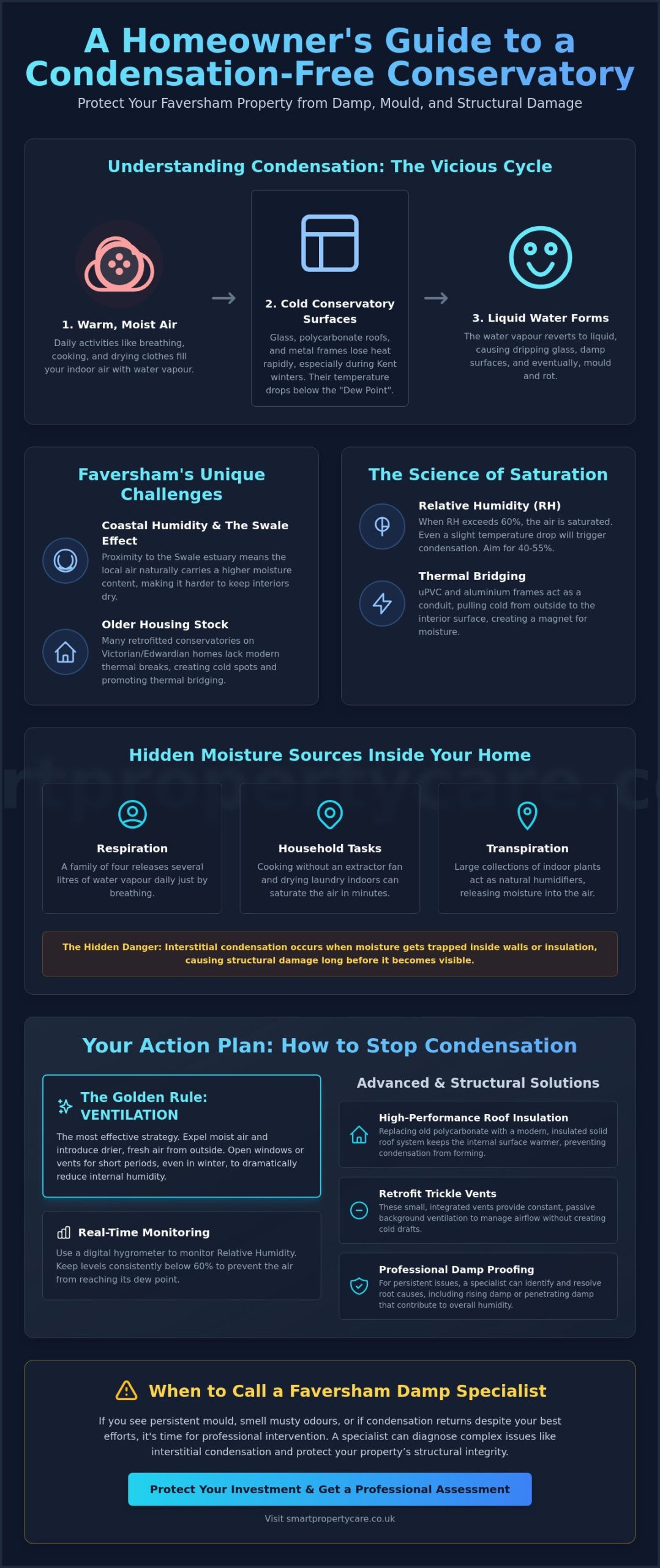
To master how to stop condensation in conservatory Faversham properties, you must first understand the physics of your living space. At its core, you need to recognize what condensation is: a phase change where water vapour in the air reverts to a liquid state upon hitting a cold surface. This transition occurs at the “dew point,” a specific temperature threshold that varies based on the amount of moisture in the air. Conservatories are uniquely vulnerable because they’re essentially glass boxes with high thermal conductivity, making them the most likely area in any Kent home to reach this threshold.
Relative Humidity (RH) plays a critical role in this cycle. When the RH level in your home exceeds 60%, the air becomes saturated, and even a slight drop in temperature will trigger moisture release. This issue is often exacerbated by thermal bridging. This occurs when the aluminium or uPVC frames of your conservatory act as a direct conduit, pulling the biting Kent winter cold through to the interior. These frames become significantly colder than the surrounding air, creating a permanent magnet for moisture that no amount of simple heating can fully resolve.
The Science of Temperature Contrast
Glass and polycarbonate roofs are notorious for their lack of thermal mass. Unlike the solid brick walls of your main house, these materials lose heat almost instantly once the sun sets. This creates a sharp temperature contrast between the conservatory and the rest of your home. As warm air naturally migrates from your heated kitchen or lounge into the conservatory, it brings a heavy moisture load with it. This air hits the cold spots, usually the roof ridge or the lower window beads, and immediately liquefies, leading to the puddles and damp patches that ruin furniture and décor.
Moisture Sources in a Standard Household
It’s a common misconception that condensation only comes from external leaks. In reality, most moisture is generated internally through daily living. Consider these common contributors:
- Respiration: A family of four releases several litres of water vapour daily just by breathing.
- Household Tasks: Drying laundry indoors or cooking without an extractor fan can saturate the air in minutes.
- Transpiration: Large collections of indoor plants act as natural humidifiers.
Modern conservatories are designed to be watertight and draught-proof, which means they’re also excellent at trapping this moisture. While surface condensation on the glass is a visible nuisance, the greater risk is interstitial condensation. This is moisture that penetrates the structural joints or insulation layers, where it can cause hidden damage long before it becomes visible to the naked eye. Identifying these triggers is the first step toward restoring your conservatory to a dry, usable space.
Why Faversham Properties Face Unique Conservatory Moisture Challenges
Faversham’s geographical position creates a specific set of environmental pressures for local homeowners. While the town’s maritime history is a point of pride, its proximity to the Swale means the local air often carries a higher moisture content than inland Kent. This coastal humidity acts as a constant baseline, making the challenge of how to stop condensation in conservatory Faversham installations more complex than a standard DIY fix might suggest. You aren’t just fighting internal steam; you’re managing a high-humidity external environment that pushes against your home’s thermal boundaries.
The local housing stock presents its own hurdles. Many of the town’s Victorian and Edwardian terraces have had conservatories retrofitted over the decades. These older structures often lack the integrated thermal breaks found in modern 2026 building standards. When North Kent winter temperatures plummet, older single-glazed or early double-glazed units become ice-cold surfaces almost instantly. This rapid temperature drop, combined with the damp North Kent air, creates a relentless cycle of moisture accumulation that can quickly overwhelm a room’s natural ability to breathe.
Coastal Humidity and the Swale Effect
Living near the Swale estuary means dealing with salt-heavy, humid air on a daily basis. This external environment makes it harder for moisture to evaporate naturally from your property’s exterior surfaces. When this heavy air is drawn into a conservatory through gaps or poor seals, it raises the internal relative humidity significantly faster than in drier regions. Faversham’s specific microclimate necessitates a robust, high-performance ventilation strategy to ensure the air remains moving and dry. Consistent maintenance of external seals is vital here, as salt air can degrade traditional mastics and sealants, leading to penetrating damp that often masquerades as simple surface condensation.
Integrating Conservatories with Period Faversham Homes
Attaching a modern glass structure to solid-wall Kentish brickwork requires technical precision. Older bricks are porous by design. They were intended to “breathe,” but when they’re enclosed within a conservatory, they can become a source of damp bridging. This happens when moisture travels through the original house wall and becomes trapped behind the conservatory’s flashing or frame. It’s a common cause of the musty smells often associated with older Kentish lean-tos.
It’s essential to check for rising damp at the specific junction where the structure meets the period brickwork. If the original damp proof course has been compromised or bypassed by the installation of a new floor slab, you’ll face persistent moisture issues that no amount of window-opening will solve. Professional assistance in diagnosing condensation issues ensures you aren’t treating a surface symptom when the real problem is structural. If you suspect your property’s boundaries are failing, a specialist damp survey can provide the clarity needed to protect your home’s integrity.
Practical Strategies to Reduce Humidity and Improve Airflow
Mastering how to stop condensation in conservatory Faversham installations often comes down to precise, daily adjustments. The “Golden Rule” of ventilation is the creation of a consistent cross-flow of air. Simply cracking a single window isn’t enough; you must provide both an entry and exit point for moisture-laden air to escape. This rhythmic exchange prevents the air from becoming stagnant and saturated. To manage this with precision, we recommend using a digital hygrometer. Monitoring your real-time humidity levels allows you to take action before the air reaches that critical 60% saturation point where mould begins to thrive.
Your internal doors also play a strategic role in moisture management. While it’s tempting to leave the conservatory door open to share heat from the main house, this often backfires. Warm, moist air from kitchens and bathrooms will migrate into the cooler conservatory and condense instantly on the glass. Keeping these doors closed isolates the conservatory’s environment. Simultaneously, maintaining a low, consistent background heat in the conservatory is essential. By slightly raising the surface temperature of the glass and frames, you push the dew point further away, making it much harder for condensation to form in the first place.
Mechanical Ventilation and Dehumidifiers
When passive ventilation isn’t enough, mechanical intervention becomes necessary. For the typical North Kent climate, choosing the right dehumidifier is vital. Compressor models are common but lose efficiency in cold spaces. We suggest using a desiccant dehumidifier for conservatories, as these remain highly effective even when temperatures drop below 15°C. For a more permanent, whole-home solution, a Positive Input Ventilation (PIV) system can be installed. These units replace damp air with filtered, dry air from the loft space, creating a slight pressure that forces moisture out through natural exit points. If you notice persistent damp in specific corners, place a small circulation fan there to break up stagnant air pockets.
Lifestyle Adjustments for a Drier Space
Small habits can lead to a transformed environment. Start with these essential changes:
- Laundry: Never dry clothes in a conservatory. A single load of wet washing can release significant volumes of water vapour, which will settle on your roof and windows within minutes.
- Plant Management: Be mindful of the “plant trap.” High-transpiration species like ferns or palms release moisture into the air. If your conservatory is struggling with damp, consider moving these to a different room.
- The Morning Purge: Implement a 10-minute “purge” every morning. Open all windows and doors fully for a short burst. This quickly replaces the moisture built up overnight with fresh, drier air without significantly cooling the structural mass of the room.
These disciplined routines, combined with the right technology, ensure your space remains dry, clear, and fully usable throughout the year.
Advanced Structural Solutions: From Roofs to Professional Damp Proofing
When lifestyle adjustments and portable dehumidifiers fail to provide a permanent fix, you must look toward the structure itself. Resolving how to stop condensation in conservatory Faversham homes often requires upgrading the thermal performance of the building envelope. Many older conservatories in Kent were built with thin polycarbonate or standard glass roofs that offer negligible insulation. These surfaces become excessively cold, acting as a primary site for moisture to liquefy. Upgrading to a “warm roof” system, which uses solid, insulated tiles, can transform the space. However, be aware that replacing a translucent roof with a solid one legally re-classifies the structure as an extension. This change requires Building Regulations approval because it no longer meets the 75% translucent roof rule for exemptions.
Ventilation technology has also evolved significantly. Under the 2026 edition of Building Regulations Part F, there is a much stricter emphasis on integrated airflow. Almost all replacement windows are now required to include trickle vents to ensure a constant, passive exchange of air. If your current frames lack these, they can often be retro-fitted by a specialist. This small structural addition provides the consistent background ventilation needed to prevent the air from reaching its dew point overnight, protecting your furniture and blinds from mould growth.
Glazing Upgrades and Thermal Breaks
Modern glazing does more than just hold back the wind. Upgrading to argon-filled double glazing or Low-E glass significantly reduces the cold-surface effect. These units use a microscopic metal coating to reflect heat back into the room, keeping the internal pane of glass much warmer. Similarly, ensuring your aluminium frames have high-performance thermal breaks is essential. These breaks are non-conductive barriers that stop the freezing external temperatures from traveling through the metal frame to the interior. High-performance glazing and thermally broken frames effectively move the dew point away from the glass surface, preventing moisture from forming even on the coldest Faversham nights.
Checking the Damp Proof Course (DPC)
Sometimes, what appears to be a condensation problem is actually a structural failure. A bridged or failed damp proof course in the conservatory’s dwarf wall can allow moisture to rise from the ground, significantly increasing the internal humidity. You should look for signs of salt staining or peeling paint near the floor level, which often indicates penetrating damp rather than simple surface moisture. If the garden soil or a new patio has been laid above the level of the DPC, moisture will bypass the barrier and enter the brickwork directly.
Distinguishing between these issues requires precision. If you are dealing with persistent low-level moisture that doesn’t respond to ventilation, a professional damp survey is the only way to identify the true root cause. Our experts can provide a comprehensive diagnosis to ensure you aren’t wasting money on ventilation when the problem is structural. For a definitive solution to your moisture issues, book a specialist condensation control assessment today.
When to Call a Faversham Damp Specialist for Persistent Mould
There comes a point where lifestyle adjustments and localized heating are no longer sufficient to protect your property. If you have implemented the ventilation strategies discussed earlier but still find black spots spreading across your blinds, furniture, or dwarf walls, you have reached the limit of DIY intervention. Persistent mould is a clear signal that moisture has bypassed your surface-level controls and is now compromising the building’s substrate. Understanding how to stop condensation in conservatory Faversham properties means recognizing when the environmental load has become a structural threat.
Ignoring these signs poses a genuine risk to both your property and your family’s health. Enclosed, poorly ventilated spaces can trap high concentrations of hazardous mould spores, including Aspergillus and Stachybotrys. These species are known to trigger respiratory issues and allergic reactions, particularly in children and the elderly. At Smart Property Care Ltd, we provide a definitive solution through professional mould remediation. We don’t settle for temporary “cover-up” fixes; we restore the environment to a safe, sterile, and dry condition.
The Professional Remediation Process
Our approach is rooted in technical precision and disciplined execution. We utilize advanced thermal imaging technology to identify hidden cold bridges and moisture ingress points that are invisible to the naked eye. This allows us to target the root cause with surgical accuracy. Once identified, we apply professional-grade chemical treatments designed to kill mould spores deep within the brickwork or plaster. For walls damaged by long-term saturation, we employ specialist plastering techniques. This restorative process replaces salt-contaminated materials with high-specification, moisture-resistant finishes, ensuring the problem does not return. As a family-run, expert-led service, we take immense pride in delivering a polished result that provides immediate peace of mind.
Protecting Your Investment and Health
Allowing conservatory damp to persist is a costly mistake. Moisture rarely stays localized; it can easily migrate into the main house, leading to timber rot in floor joists or adjacent door frames. Professional preservation is an investment in your home’s long-term value and structural integrity. A restored system ensures your conservatory remains a high-value asset rather than a liability during a future property sale. We offer a comprehensive, client-focused service that prioritizes clarity and efficiency. If you are struggling with how to stop condensation in conservatory Faversham homes, do not wait for the damage to spread. Contact Smart Property Care today to schedule a specialist survey in Faversham or Herne Bay and reclaim your living space.
Secure a Restored, Moisture-Free Environment for Your Home
Achieving a dry, clear conservatory requires a disciplined approach to moisture management. You now understand that mastering how to stop condensation in conservatory faversham properties involves more than just opening a window; it requires a combination of consistent cross-flow ventilation, precise humidity monitoring, and high-performance structural upgrades. Whether you’re addressing coastal humidity from the Swale or retrofitting 2026-compliant trickle vents, the goal is always a restored, usable environment that adds value to your property. Consistent maintenance and technical precision are your best defenses against the Kent winter.
When surface-level fixes fall short, professional intervention is the only way to ensure your property remains protected. Smart Property Care Ltd brings over 20 years of local Kent experience to every project. As a family-run business based in Herne Bay, we are dedicated specialists in damp proofing and mould remediation. We provide the technical expertise needed to eliminate damp at its source and restore your peace of mind. Book a Professional Damp Survey for Your Faversham Home today to protect your investment. Your home deserves the highest standard of care and professional preservation.
Frequently Asked Questions
Why is condensation in my conservatory worse in the winter?
Winter condensation peaks because the temperature gap between the internal air and external glazing is at its widest. When warm, moist air touches freezing glass, it reaches the dew point instantly and turns into liquid. This is a primary challenge for anyone researching how to stop condensation in conservatory Faversham homes during the colder months when the North Kent climate is at its dampest.
Can a dehumidifier completely stop conservatory condensation?
A dehumidifier is an effective management tool but rarely a standalone solution for structural issues. It works by removing moisture from the air, which lowers the dew point and reduces the volume of water available to condense. While a desiccant model is highly effective in cold Kentish conservatories, it won’t fix underlying problems like poor thermal breaks in your window frames or an uninsulated roof.
Is it better to leave the conservatory window open or closed at night?
It’s generally better to keep windows closed at night to maintain a stable internal temperature. Leaving a window fully open allows the structural mass of the room to cool down too much, which makes condensation more likely when the house warms up in the morning. Instead, rely on modern trickle vents to provide necessary background ventilation without the rapid heat loss that causes glass surfaces to freeze.
Will blinds or curtains help reduce condensation on conservatory glass?
Blinds and curtains usually exacerbate the problem rather than solving it. They create a stagnant pocket of air between the fabric and the glass, which stays much colder than the rest of the room. This prevents warm air from circulating against the window, leading to heavy moisture build-up and eventual mould growth on the blinds themselves. Keep blinds open during cold spells to allow air to reach the glass.
How can I tell if the moisture is condensation or a roof leak?
Condensation typically appears as a uniform mist or fine droplets across the entire glass surface or frame. A roof leak is usually localized, appearing as distinct drips or staining in one specific area, often coinciding with rainfall. If you see moisture on the windows every morning regardless of the weather, you’re almost certainly dealing with a condensation and ventilation issue rather than a structural breach.
Can I use anti-mould paint to stop conservatory condensation?
Anti-mould paint is a reactive measure rather than a solution for how to stop condensation in conservatory Faversham properties. While these paints contain biocides that inhibit fungal growth, they do nothing to address the underlying thermal bridging or high humidity. You must resolve the moisture source and improve the thermal envelope first to prevent long-term structural damage to your property’s interior finishes.
Does underfloor heating help prevent moisture build-up in a conservatory?
Underfloor heating is an excellent preventative measure because it provides consistent, radiant heat that warms the structure itself. By raising the surface temperature of the floor and the lower sections of the walls, it pushes the dew point further away. This prevents the “cold spot” effect that often triggers condensation at the base of conservatory frames, keeping the environment dry and comfortable.
When does conservatory condensation become a structural damp problem?
Condensation becomes a structural damp issue when moisture begins to saturate the building’s substrate. If you see peeling plaster, salt efflorescence on brickwork, or a persistent musty smell, the water is no longer just on the surface. At this stage, the moisture is compromising the integrity of your walls. You need a specialist survey to determine if you’re dealing with interstitial condensation or a failure in the damp proof course.