
Your Victorian home isn’t failing; it’s suffocating under modern materials that were never meant to touch its solid walls. You’ve likely noticed that musty scent lingering after a Dover downpour or felt the sting of anxiety seeing salt crystals bloom on your wallpaper just as you’re preparing for a property survey. It’s a common frustration, especially since 67% of UK properties experience moisture issues. Many homeowners don’t realize that victorian house damp problems dover are often worsened by non-breathable “fixes” that trap water within the masonry.
We understand that protecting a period property in our coastal environment requires a specialized, authoritative touch. This guide reveals how to safeguard your home using breathable, expert-led solutions like specialist plastering and mould remediation that respect original craftsmanship. You’ll learn the vital differences between rising damp and moisture from Dover’s wind-driven rain, providing the peace of mind that comes with a restored, healthy environment. We’ll preview the essential steps for effective damp proofing and condensation control that align with the latest 2026 preservation standards.
Key Takeaways
- Understand how Dover’s coastal exposure and wind-driven rain interact with Victorian solid-wall construction to create unique moisture challenges.
- Learn why restoring breathability through specialist plastering is the most effective way to resolve victorian house damp problems dover compared to modern sealed systems.
- Correctly differentiate between rising, penetrating, and condensation damp to ensure your property receives the precise remedial action it requires.
- Implement a proactive maintenance checklist that prioritizes subfloor ventilation and clear airbricks to protect your home’s structural integrity.
- Discover the value of a specialist damp survey in providing an accurate moisture map that goes far beyond a standard mortgage valuation.
Why Victorian Homes in Dover Face Unique Damp Challenges
Dover’s 19th-century terraces are architectural treasures, but their solid wall construction makes them vulnerable to the elements. Unlike modern buildings that use cavity walls to trap moisture, Victorian homes were built with solid brick or flint. These walls act like a sponge, absorbing water and relying on natural airflow to dry out. When this balance is disrupted, victorian house damp problems dover become a persistent reality for homeowners. As of 2026, shifting weather patterns and increased rainfall are putting more pressure on East Kent’s historic housing stock than ever before.
The topography of Dover plays a significant role in these challenges. Many period properties are nestled in the valley or perched on exposed cliffs, each facing different environmental stresses. Understanding Structural Damp is essential for anyone living in these coastal environments, as the traditional methods used to build these homes are often at odds with modern living standards and coastal weather intensity.
The English Channel Factor: Salt and Humidity
Living on the frontline of the English Channel brings a specific set of problems. Sea salt spray is a major contributor to dampness because salt is hygroscopic; it naturally attracts and retains moisture from the air. Even on days without rain, salt deposits on your masonry can pull humidity into the brickwork, making walls feel damp to the touch. This effect is particularly aggressive in high-elevation areas like the Western Heights or near Dover Castle, where wind-driven rain hits the building’s envelope with immense force. The high coastal humidity often prevents these saturated walls from drying naturally, leading to a cycle of moisture retention that can eventually require professional mould remediation.
Dover’s High Water Table and Solid Foundations
The valley geography of Dover means many Victorian homes are built on land with a high water table. While the surrounding natural chalk provides some drainage, the “made ground” often found in historic urban centers can hold significant amounts of groundwater. This leads to several issues:
- Rising Damp: Groundwater travels upward through porous bricks via capillary action.
- Bridged DPCs: Traditional slate damp proof courses are often brittle and crack over time. They are also easily bridged by modern driveway installations or raised garden beds.
- Basement Ingress: Period basements in the town center often face hydrostatic pressure, requiring specialist basement waterproofing (tanking) to remain usable.
We see many instances where the original slate barrier has failed, allowing moisture to bypass the home’s primary defense. When coupled with the chalk-rich soil that can fluctuate in moisture content, the foundations of these properties are under constant environmental siege. Identifying whether your home sits on natural chalk or reclaimed land is a vital step in choosing the right damp proofing strategy for your specific location.
The Breathability Crisis: Lime vs. Modern Materials
Victorian architecture relies on a delicate balance of moisture movement. These buildings were never designed to be airtight or moisture-proof. Instead, they were built to be “breathable.” This means the porous bricks and lime mortars allow moisture to enter and, crucially, evaporate away. When homeowners introduce modern, non-porous materials like cement render or gypsum plaster, they disrupt this natural cycle. This “breathability crisis” is a leading cause of victorian house damp problems dover, as moisture becomes locked within the fabric of the building.
Using the wrong materials often leads to a cascade of structural issues. Trapped moisture within solid walls provides the ideal conditions for fungal growth and insect infestations. Without proper evaporation, you may find yourself requiring dry rot treatment or woodworm treatment for floor joists and wall plates. Expert guidance on Diagnosing Moisture in Masonry Walls highlights that masonry must be allowed to shed water to remain structurally sound. We prioritize restoring this equilibrium to protect the long-term health of your home.
Why Cement Rendering Often Fails in Dover
Cement is a rigid, brittle material. In a coastal town like Dover, properties experience significant thermal movement due to shifting sea winds and temperature fluctuations. This causes cement render to develop hairline cracks. Rainwater is then driven into these cracks by Channel winds. Because cement is non-breathable, the water cannot evaporate back out. It becomes trapped against the brickwork, leading to a “suffocation” effect where damp patches appear unexpectedly high on internal walls. Our approach focuses on removing these barriers and restoring the wall’s ability to shed moisture effectively.
The Role of Specialist Plastering in Damp Remediation
Standard gypsum plaster is highly vulnerable to hygroscopic salts, which are prevalent in Dover’s maritime climate. These salts pull moisture directly from the atmosphere, causing “phantom damp” even after a new damp proof course is active. Specialist plastering is essential because it acts as a breathable barrier. It manages residual salts and allows the masonry to dry without ruining your interior decor. This precision ensures a healthy, dry environment that lasts. If you suspect your walls are struggling to breathe, a tailored damp investigation can reveal the best path forward for your period home.
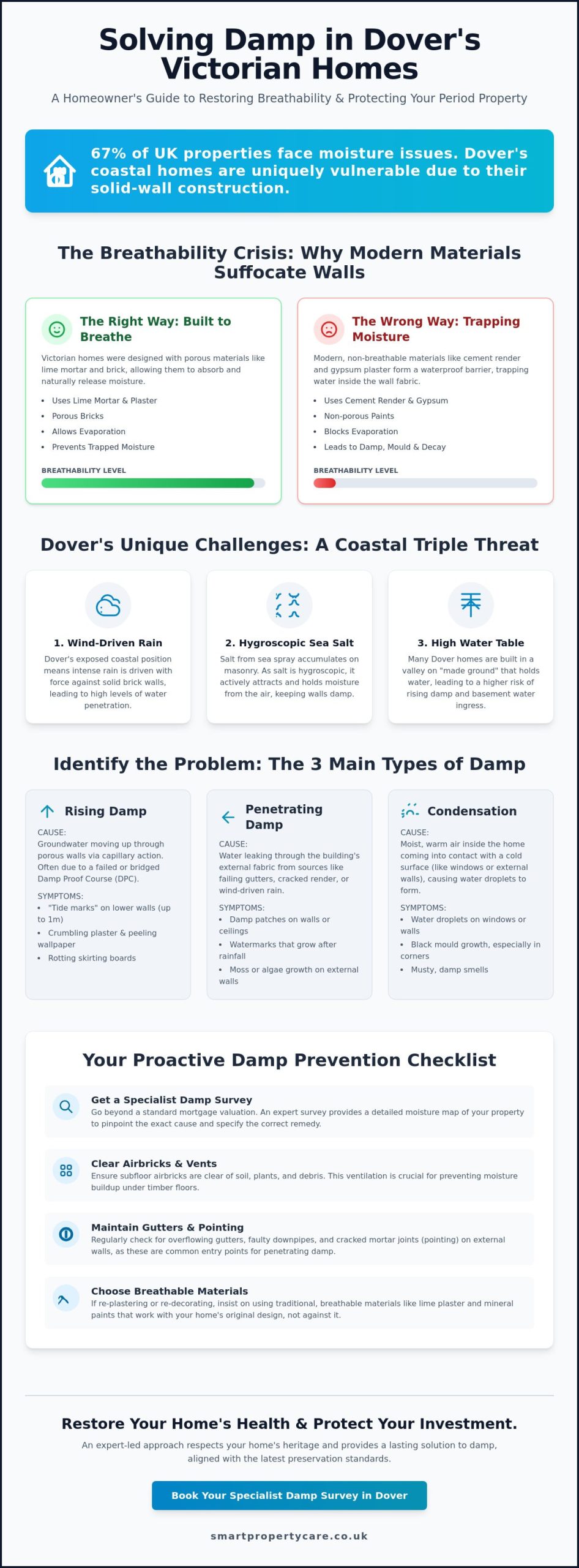
Diagnosing the ‘Dover Three’: Rising, Penetrating, and Condensation
Effective preservation starts with accurate identification. Victorian house damp problems dover often stem from one of three distinct sources, yet they’re frequently confused by general contractors. Not all moisture is the same; misdiagnosis leads to expensive, unnecessary work. In East Kent, we categorize the majority of issues into the “Dover Three”: rising damp, penetrating damp, and condensation. Each requires a distinct, high-standard approach, from mechanical damp proofing to advanced condensation control.
Identifying Rising Damp and Salt Contamination
Rising damp is often identified by a characteristic “tide mark” appearing up to one meter above the floorboards. You might notice crumbling skirting boards or white, powdery efflorescence blooming on your brickwork. Because of Dover’s proximity to the sea, the air is thick with chlorides and nitrates. These sea salts make salt contamination significantly more aggressive here than in inland Kent towns. Hygroscopic salts trapped within the masonry continue to pull moisture from the air, keeping a wall damp even during the height of a dry summer.
Penetrating Damp and Coastal Weathering
Penetrating damp is a common byproduct of Dover’s narrow Victorian streets and exposed elevations. Wind-driven rain from the Channel finds its way through eroded mortar joints or “blown” bricks where the face has flaked off. Faulty guttering or blocked downpipes often exacerbate the problem, dumping water directly onto saturated solid walls. In these cases, restoring the exterior through specialist rendering or repointing provides a protective shield against the elements.
Finally, condensation has become the “modern” damp problem in period homes. As we’ve added PVC windows and blocked fireplaces to save energy, we’ve inadvertently trapped moisture inside. Research indicates that over 60% of Britons report having experienced condensation or mould, which often leads to black spots in corners and behind wardrobes. Unlike structural moisture, this requires a focus on airflow and professional mould remediation to ensure a healthy living space. Correctly identifying which of these three you’re facing is the first step in solving victorian house damp problems dover for good.
A Homeowner’s Checklist for Preventing Victorian Damp
Proactive maintenance is the cornerstone of property preservation. While environmental pressures from the English Channel are constant, local homeowners can take immediate steps to mitigate victorian house damp problems dover. A disciplined approach to external inspections often prevents the need for major remedial intervention. By following a structured seasonal checklist, you can protect your home’s structural integrity and maintain a healthy living environment.
Subfloor Voids and Airbrick Maintenance
Victorian floors typically sit on timber joists over a hollow void. This space requires constant airflow to remain dry and stable. Blocked or painted-over airbricks are the primary cause of woodworm and rot in Dover’s historic housing stock. In mid-terraced properties, ensuring clear airbricks at both the front and rear is essential to maintain vital cross-ventilation. If you notice a springy feel in your floorboards or a persistent earthy smell, your subfloor timbers may already be suffering from fungal decay caused by trapped moisture.
Managing External Ground Levels
One of the most frequent issues we encounter is “bridging.” This occurs when modern improvements, such as block-paved driveways or raised flower beds, are built above the level of the original damp proof course (DPC). Following the “6-inch rule” is vital; your DPC must remain at least 150mm above the finished ground level to prevent moisture from bypassing your home’s defenses. In Dover’s chalky soil, installing French drains or lowering external garden beds can significantly reduce hydrostatic pressure against your foundations. We recommend a clear path for water to drain away from the building’s envelope.
Your prevention strategy should also include these critical checks:
- Gutter Clearance: Clear gutters and downpipes every autumn to prevent water from cascading down and saturating the masonry.
- External Pointing: Inspect for signs of coastal weathering or eroded mortar joints that allow wind-driven rain to penetrate.
- Furniture Placement: Keep large items of furniture slightly away from external walls to facilitate condensation control and airflow.
- Ventilation: Ensure internal air vents in kitchens and bathrooms are functional and never blocked by decor or insulation.
Before beginning any significant renovation or landscaping project, it’s wise to book a specialist damp survey to ensure your plans don’t inadvertently create new moisture paths. Our team provides the precision and local expertise needed to keep your period property dry and secure. If you’ve spotted any of these warning signs, contact Smart Property Care for a comprehensive assessment of your home’s condition.
Specialist Damp Surveys and Restoration in Dover
When navigating a property transaction or planning a major restoration, a general mortgage valuation rarely provides the depth needed to understand the structural health of a period home. These surface-level inspections often flag “potential damp” without identifying the source, causing unnecessary anxiety for buyers and sellers alike. A specialist damp survey is a precision diagnostic tool designed to uncover the reality of victorian house damp problems dover. By utilizing advanced moisture mapping and ultrasonic timber probing, we provide a definitive picture of a building’s condition that goes far beyond a simple visual check.
Our approach balances modern diagnostic technology with a deep respect for traditional building methods. We produce a comprehensive, costed specification for any required remedial works, which serves as a vital document during price negotiations or insurance claims. This level of detail ensures that you aren’t just buying a property; you’re investing in a preserved environment backed by technical data and expert craftsmanship.
Why a Local Dover Specialist Matters
Dover’s architectural landscape is diverse, ranging from the historic terraces along Snargate Street to the expansive Victorian villas in the Buckland area. Each pocket of the town presents unique structural quirks and environmental stresses. We understand how the local chalk-rich soil and Channel-facing elevations dictate the performance of a building’s envelope. As a family-run business with over 20 years of experience across Kent, we bring a level of local reliability and approachable expertise that national franchises simply cannot match. We take immense pride in being a trusted partner for homeowners who value punctuality and disciplined workmanship.
Our Holistic Remediation Process
We move swiftly from identifying a need to providing a comprehensive, long-term solution. Our process isn’t about “quick fixes” or masking symptoms; it’s about addressing the root cause of moisture ingress to prevent future decay. We integrate our core services to create a tailored preservation plan for every client. This often involves combining mechanical damp proofing with mould remediation and specialist timber treatments to ensure every facet of the problem is resolved.
Whether you’re dealing with the aftermath of a failed modern render or preparing a heritage home for the next generation, our team is ready to restore your peace of mind. We deliver high-end results that protect your investment and your health. Contact Smart Property Care for a professional damp survey in Dover today and take the first step toward a dry, healthy, and structurally sound Victorian home.
Protecting Your Period Property for Generations
Resolving victorian house damp problems dover requires more than just masking symptoms with modern sealants. It demands a deep understanding of solid-wall breathability and the aggressive impact of Channel weather on historic masonry. By prioritizing traditional materials like lime and ensuring your subfloor voids remain clear, you prevent structural decay before it starts. Accurate diagnosis remains your strongest defense against rising damp, penetrating moisture, and condensation.
We bring over 20 years of Kent property preservation experience to every project. As a family-run team of local specialists, we provide the precision and high-end craftsmanship your Victorian home deserves. Our detailed technical reports and costed specifications offer total transparency, giving you the peace of mind to proceed with confidence. Don’t let moisture compromise your investment or your health. We are ready to help you transform your environment into a dry, healthy space.
Book Your Specialist Victorian Damp Survey in Dover Today and secure a structurally sound future for your home.
Frequently Asked Questions
Is damp normal in a Victorian house in Dover?
Damp is a frequent occurrence in Dover’s Victorian terraces, but it shouldn’t be considered an acceptable part of owning an old home. While solid walls naturally absorb some moisture, persistent dampness indicates that the building’s breathability is compromised or maintenance has lapsed. Left unaddressed, these issues lead to structural decay. We focus on restoring the original equilibrium of your property to ensure a dry, healthy environment.
How much does a damp survey cost in Dover in 2026?
A professional damp survey in Dover typically starts at £119, with the average investigation cost being approximately £177 as of June 2026. For larger period properties or complex investigations involving timber probing, prices can reach up to £325. You should ensure your surveyor provides a comprehensive moisture map and a costed remedial specification rather than just a basic visual check.
Can I fix Victorian damp problems myself?
You can manage basic preventative tasks like clearing airbricks and gutters, but structural victorian house damp problems dover require professional expertise. Attempting to install a damp proof course or apply specialist plastering without the correct diagnostic technology often leads to misdiagnosis. Incorrect DIY repairs can inadvertently trap moisture within the masonry, which significantly increases the eventual cost of professional restoration.
What is the difference between rising damp and condensation in a coastal home?
Rising damp originates from groundwater traveling upward through porous masonry, typically leaving salt deposits and a tide mark on the lower wall. Condensation is an internal issue caused by daily activities like cooking or bathing when moisture is trapped by modern PVC windows. In our coastal climate, high humidity often makes condensation appear as black mould in corners, whereas rising damp is a structural failure at the ground level.
Will damp proofing devalue my period property?
Professional damp proofing preserves the value of your period home by securing its structural integrity against decay. Surveyors frequently flag moisture issues during property sales, which can lead to significant price reductions or collapsed transactions. Presenting a detailed technical report from a specialist demonstrates that the building is maintained to a high standard, providing immediate peace of mind to potential buyers.
How long does it take to dry out a Victorian wall after treatment?
A traditional solid wall generally requires one month of drying time for every 25mm of wall thickness once the source of moisture is removed. For a standard Victorian brick wall, this process can take several months. We utilize specialist plastering to manage this transition, which allows you to redecorate your interior without the risk of residual salts or moisture damaging your new finishes.
Does Dover’s sea air make mould growth worse?
Dover’s maritime climate significantly increases the risk of mould because sea air carries hygroscopic salts that settle on your walls. These salts pull additional moisture from the atmosphere even on dry days. This high coastal humidity prevents internal surfaces from drying naturally, creating an ideal environment for mould spores. Effective condensation control and professional mould remediation are essential to counteract these aggressive local factors.
Can I use modern paint on my Victorian walls?
You should avoid using standard modern “vinyl” paints because they create a non-porous plastic film that traps moisture inside the wall. This suffocation is a primary cause of victorian house damp problems dover and leads to bubbling paint and crumbling plaster. Instead, use breathable clay-based or mineral paints. These materials allow water vapor to escape freely, maintaining the vital breathability of your home’s historic fabric.