
Did you know that 32% of listed buildings in England are currently battling damp, mould, and condensation? If you own a historic property near the Cathedral or within the city walls, you likely understand the frustration of cold, moisture-saturated walls that never seem to dry. You want a healthy home, but the fear of “cowboy” builders using modern cement on your delicate lime masonry is a valid concern. Learning how to deal with damp in a listed building Canterbury requires a shift in mindset; you must work with the building’s natural breathability rather than trying to seal it out with modern chemicals.
We agree that protecting your home’s heritage is just as important as fixing the moisture. This guide promises to show you how to effectively manage damp using expert preservation techniques that maintain your property’s value and comply with the Planning (Listed Buildings and Conservation Areas) Act 1990. We’ll preview the 2026 requirements for Listed Building Consent, explain why the £0 application fee is your best friend, and help you find a local specialist who respects Kentish vernacular architecture.
Key Takeaways
- Master the concept of ‘breathability’ to understand how Canterbury’s unique medieval and Georgian architecture naturally manages moisture.
- Discover the exact steps for how to deal with damp in a listed building Canterbury using heritage-approved materials like Natural Hydraulic Lime.
- Learn how to navigate the 2026 Listed Building Consent process and why early consultation with local conservation officers is vital for a seamless project.
- Identify the critical differences between rising damp, penetrating moisture, and condensation to ensure you apply the correct, bespoke solution.
- Explore the ‘un-damp proofing’ method to safely remove harmful modern cement and tanking slurries that trap moisture within historic masonry.
Understanding the ‘Breathability’ Concept in Canterbury’s Historic Architecture
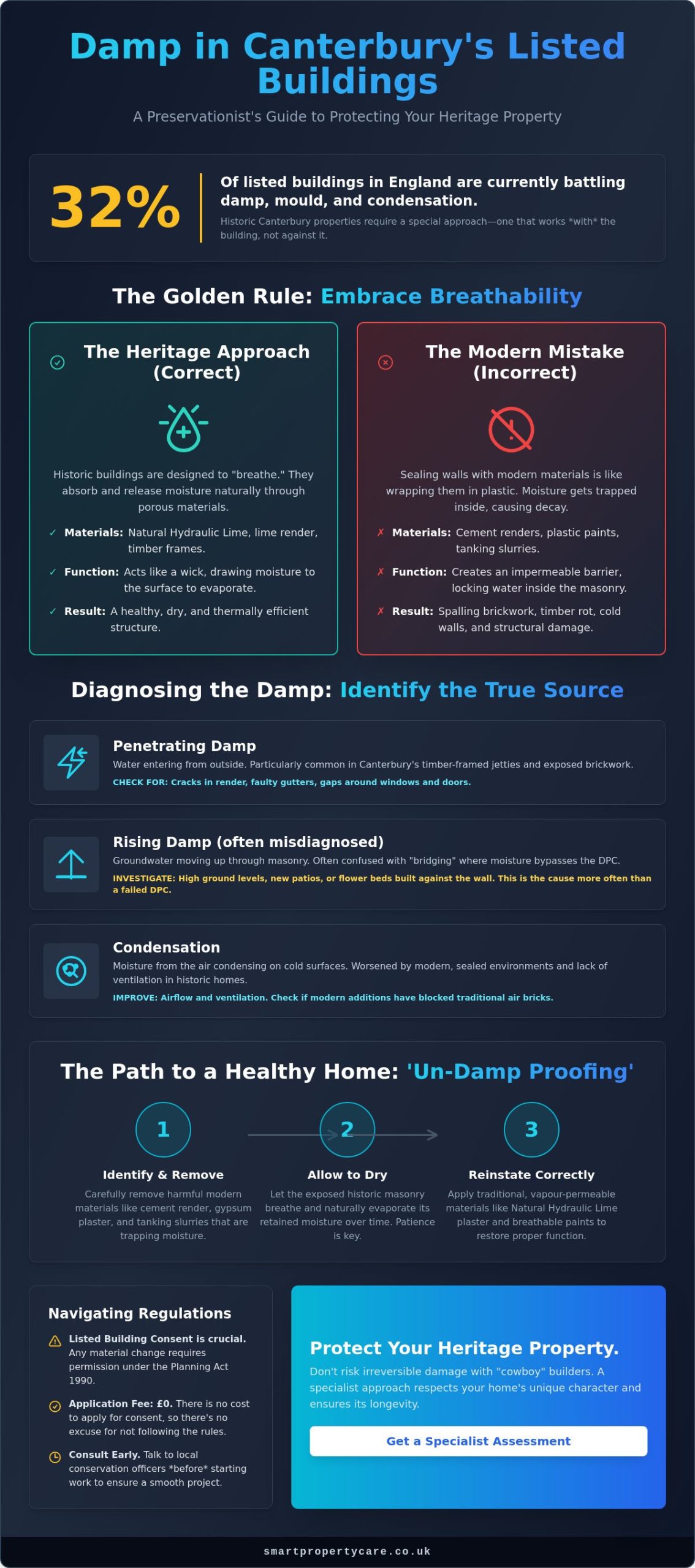
Traditional properties in Canterbury weren’t designed to be airtight. Unlike modern houses that rely on plastic membranes and cavity walls to keep moisture out, historic structures function as “open” systems. They rely on the movement of air and moisture through the building fabric to remain healthy. When you’re researching how to deal with damp in a listed building Canterbury, you must understand that blocking this natural process is the primary cause of structural decay. Modern solutions like cement-based renders or “tanking” slurries act like a plastic wrap; they trap water inside the masonry where it eventually causes timber rot or stone spalling. A foundational grasp of Understanding Structural Damp is essential for any heritage property owner who wants to avoid expensive, irreversible mistakes.
In the medieval streets near the Cathedral, timber-framed buildings with wattle and daub infill have survived for centuries because they can “breathe.” Similarly, the fine Georgian brickwork found throughout the city was built using lime mortars that allow moisture to evaporate freely. If these buildings are treated with modern, impermeable materials, the moisture is forced deeper into the structure. This leads to a saturated core, which significantly reduces the thermal performance of your walls. Wet walls are cold walls; they draw heat away from your home, making it harder and more expensive to keep warm during a Kentish winter.
The Science of Porous Building Materials
Lime mortar is the hero of heritage preservation. It acts as a sacrificial wick, being more porous than the brick or flint it surrounds. This draws liquid water to the surface where it can safely evaporate. In a Grade II listed Kentish cottage, breathability is the continuous process where moisture is absorbed into the fabric of the building and then evaporated away without causing structural decay. Problems arise when homeowners apply modern plastic-based paints or hard cement repointing. These materials are too rigid and impermeable, causing the softer historic bricks to crumble behind a hard, “waterproof” shell. Following the standards set out in BS 7913:2013 is a critical step in learning how to deal with damp in a listed building Canterbury.
Canterbury’s Climate and Your Property
Canterbury’s geography creates a specific set of challenges for property owners. The city sits in the Stour valley, characterized by a high water table and humid air that rolls in from the East Kent coast. During the damp winters, historic flint and brickwork are under constant pressure from high humidity. If your traditional rainwater goods, such as cast-iron gutters and downpipes, aren’t meticulously maintained, the walls become saturated. This environmental moisture, combined with the regulatory focus of Awaab’s Law which enters its second phase in October 2026, makes moisture management a priority for both health and heritage preservation. Proper ventilation and the use of breathable finishes are the only ways to ensure your home remains dry and structurally sound in this unique local climate.
Identifying the Source: Is it Rising, Penetrating, or Condensation?
Accurate diagnosis is the first step in learning how to deal with damp in a listed building Canterbury. Many homeowners mistake “bridging” for rising damp. This occurs when modern additions, such as a new patio or a high flower bed, are built above the original damp-proof course or the historic floor level. It creates a path for moisture to skip over protective layers and enter the wall. You might see a classic “tide mark,” but the solution isn’t a chemical injection; it’s the removal of the bridge. Understanding Why Historic Buildings Need to ‘Breathe’ is vital here, as misidentifying the source often leads to expensive and damaging “repairs” that fail to address the root cause.
Penetrating damp is particularly common in Canterbury’s famous timber-framed jetties. Cracks in traditional lime render or gaps around ancient window frames allow rainwater to seep into the oak structure. If left unchecked, this moisture invites secondary issues like woodworm and dry rot. These fungal and insect infestations thrive in the damp, stagnant conditions found behind modern cement patches. Spotting the early signs, such as small “flight holes” in floor joists or a mushroom-like smell in the cellar, can save you thousands in structural timber repairs. If you’re concerned about the integrity of your beams, our team can provide a Professional Damp Survey in Herne Bay, Canterbury & East Kent to identify these hidden threats.
Visual Cues for the Canterbury Homeowner
You can often identify the problem by looking closely at the wall surface. White, crusty powder on your bricks is salt efflorescence. This indicates that moisture is moving through the masonry and evaporating, leaving minerals behind. If you see black mould, the issue is likely condensation caused by modern living. Showers, cooking, and drying clothes release gallons of water vapor that settle on cold, uninsulated historic walls. Unlike salt, mould is a biological growth that requires consistent surface dampness. We often find this in properties where traditional chimneys have been blocked up, removing the natural ventilation these buildings rely on.
The Role of Professional Damp Surveys
A standard “free” survey is often little more than a sales pitch for chemical treatments that are inappropriate for heritage stock. For a listed property, you need a specialist who understands Kentish vernacular architecture. A professional report will use thermal imaging and moisture mapping to prove exactly where the water is coming from. This data is essential if you need to justify specific repairs to a conservation officer. If you’re currently in the process of purchasing a historic home, having this technical clarity ensures you aren’t buying a property with hidden structural liabilities.
The ‘Un-Damp Proofing’ Process: Restoring Breathability to Your Walls
When considering how to deal with damp in a listed building Canterbury, the most effective solution is often ‘un-damp proofing’. This involves the meticulous removal of previous, inappropriate interventions like cement-based renders and waterproof tanking slurries. These modern materials act as a seal, forcing moisture to rise higher into the structure or migrate into floor timbers. We replace these barriers with breathable alternatives that allow the masonry to function as it was originally intended. This restorative approach doesn’t just hide the symptoms; it addresses the physical health of the building fabric.
Injected damp proof courses (DPCs) are rarely appropriate for Canterbury’s solid-walled heritage stock. These chemical barriers often fail because they cannot form a continuous layer in irregular historic masonry, such as flint or rubble-filled walls. Instead of relying on chemicals, we focus on managing the moisture through traditional craftsmanship. Once the harmful materials are removed, the drying-out period begins. This phase requires patience, as a thick solid wall can take one month per inch of thickness to reach equilibrium. We guide homeowners through this transition, ensuring the building remains stable and protected throughout the process.
Replacing Cement with Lime
We use Natural Hydraulic Lime (NHL) to ensure the new mortar matches the strength and porosity of your original masonry. The choice of grade is specific to the location: NHL 2 is ideal for internal walls or soft stone, while NHL 3.5 serves as a bespoke all-rounder for Canterbury’s brickwork. For highly exposed areas like chimney stacks or parapets facing East Kent’s coastal winds, we utilize NHL 5 for superior durability. Using local sands and aggregates is essential because matching the specific buff or warm-grey mortar colour of the local Kentish vernacular is a mandatory requirement for maintaining conservation standards. This attention to detail ensures a seamless finish that satisfies both the homeowner and the conservation officer.
Specialist Internal Plastering
Standard gypsum plaster is a common cause of failure in historic homes. It is hygroscopic, meaning it attracts moisture from the air, and it lacks the flexibility to handle the natural movement of old timber frames. To prevent future salt contamination and mould growth, we employ traditional hair-lime plaster. This material is reinforced with animal hair for tensile strength, allowing it to bridge small gaps and move without cracking. You can learn more about the technical requirements of this stage in our guide: Why You Need Specialist Plastering After Damp Proofing. This specialist finish provides a healthy, breathable internal environment that protects your decorative finishes for decades.
Navigating Listed Building Consent and Legal Requirements in Kent
Understanding how to deal with damp in a listed building Canterbury is as much about legal compliance as it is about technical skill. Under the Planning (Listed Buildings and Conservation Areas) Act 1990, any work that alters the character or fabric of a protected property requires formal approval. Carrying out unauthorized works is a criminal offense that can lead to heavy fines or even imprisonment. We recommend a structured four-step approach to ensure your project remains compliant and your property’s value is protected.
- Consult Early: Speak with the Canterbury City Council Conservation Officer before any physical work begins. It’s worth noting that the Listed Building Consent application fee is currently £0, so there is no financial barrier to seeking official approval.
- Technical Justification: Commission a specialist damp and timber report. This document provides the diagnostic evidence needed to prove the necessity of the repairs to the local authority.
- Like-for-Like Materials: Ensure all lime, timber, and masonry matches the original exactly. Even small deviations in mortar mix or timber species can lead to enforcement action.
- Detailed Documentation: Keep a meticulous record of every stage. This includes photographs of the “before” state, the materials used, and the finished work. This archive is vital for future structural surveys and when you eventually sell your home.
When is Consent Required?
The law distinguishes between ‘repair’ and ‘alteration’, but the line is often thin in the eyes of the law. Minor repairs using identical materials might not need consent, but removing historic plaster or external render almost always does. Common pitfalls include changing a window profile or adding a modern ventilation brick without prior approval. Using non-traditional materials like modern gypsum or cement is a high-risk strategy. If these are applied without consent, you may be forced to remove them at your own expense, potentially damaging the historic fabric further.
Working with Canterbury’s Conservation Teams
Presenting a remediation strategy requires a professional touch. Your proposal should align with the Joint Historic England/RICS position statement on moisture investigation. This document advocates for a holistic approach that prioritizes the building’s health over quick-fix chemical solutions. Canterbury’s conservation teams respect contractors who demonstrate a deep understanding of Kentish heritage and traditional building science. By following these established standards, you demonstrate that you are a responsible steward of the city’s architectural history. If you need help preparing a technical justification for your property, contact Smart Property Care for professional heritage guidance.
Expert Property Preservation: The Smart Property Care Approach
Smart Property Care understands that owning a heritage home in Kent is a significant responsibility. We bring over 20 years of local expertise to every project, ensuring that your property remains a valuable asset for the next generation. Our team specializes in how to deal with damp in a listed building Canterbury by using a methodology that respects the past while utilizing the precision of the present. We don’t just apply a one-size-fits-all fix; we develop a bespoke strategy that considers the unique interplay of your home’s timber frame and historic masonry. This commitment to high-end craftsmanship ensures that every repair is both functional and aesthetically sympathetic to the original architecture.
Damp rarely travels alone. It often brings secondary threats like woodworm or fungal decay that can compromise structural timbers. Our comprehensive preservation plans integrate mould remediation and rot treatment into a single, seamless workflow. This holistic approach relieves the stress of managing multiple contractors, providing you with a single point of contact who takes immense pride in delivering a dry, healthy environment. By addressing the root cause and the resulting damage simultaneously, we provide the emotional peace of mind that comes from knowing your home is in the hands of a fully insured, heritage-aware partner.
Modern Technology Meets Traditional Craft
While we value traditional building methods, we utilize modern diagnostic tools to minimize disruption to your historic fabric. We use thermal imaging cameras to identify hidden moisture pockets and leaking pipes behind ancient wattle and daub without removing a single piece of original material. This non-invasive precision allows us to target repairs with surgical accuracy, which is essential for satisfying conservation requirements. For properties with compromised structural elements, our meticulous carpentry team restores oak frames using traditional joints and seasoned timber. If your moisture issues have invited pests, we provide Professional Woodworm Treatment in Kent to secure your home’s structural future.
Your One-Stop Shop for Property Renovation
We act as your comprehensive partner from the initial diagnostic survey to the final application of breathable specialist plaster. Our project management is disciplined and punctual, mirroring the organized and clean nature of the physical work we perform on-site. We provide transparent pricing and detailed technical specifications for even the most complex listed projects, ensuring you have total clarity before any work commences. This level of professional organization distinguishes us as a premium yet accessible partner for Canterbury homeowners who value quality and reliability. Book your specialist listed building damp survey in Canterbury today to begin the process of restoring your property to its former glory.
Securing the Future of Your Heritage Home
Proper moisture management relies on restoring the natural breathability of your walls and ensuring every repair meets the strict standards of the Planning (Listed Buildings and Conservation Areas) Act 1990. Modern, non-breathable materials cause lasting damage to historic masonry. Choosing a specialist who understands how to deal with damp in a listed building Canterbury is the most important decision you’ll make for your home’s longevity. Our team provides the authoritative guidance and high-end craftsmanship required to navigate these complexities with confidence.
Smart Property Care offers 20+ years of dedicated experience in Kentish property preservation. We provide comprehensive damp and timber reports for listed property owners, specializing in bespoke lime mortar applications and meticulous heritage carpentry. We transform damp, cold spaces into dry, healthy environments while protecting the historic value of your asset. Our transparent approach and certified expertise offer the immediate reassurance you need for a successful restoration project. Request a Specialist Listed Building Damp Survey in Canterbury today to protect your home for the next generation. You can restore your property’s health without compromising its heritage status.
Frequently Asked Questions
Do I need Listed Building Consent to fix a damp problem in Canterbury?
Yes, you generally require Listed Building Consent if the damp remediation involves altering the character or fabric of the property. This includes removing historic plaster or applying new external renders. When considering how to deal with damp in a listed building Canterbury, the application fee for this consent is currently £0, making it a cost-effective way to ensure your project remains legal and compliant with the Planning (Listed Buildings and Conservation Areas) Act 1990.
Can I use a modern dehumidifier in a listed building?
You can use a dehumidifier, but it only addresses the symptoms of internal condensation rather than the root cause of structural moisture. While it helps manage humidity levels, overusing a dehumidifier in a historic property can lead to the over-drying and shrinkage of ancient timber frames. It’s best used as a temporary measure while you implement a long-term strategy for moisture management using breathable materials.
Why is my listed building suddenly damp after installing new windows?
Installing modern, airtight windows often removes the natural draughts that historic buildings rely on for ventilation. This reduction in airflow causes moisture from daily activities to settle on cold walls, leading to sudden condensation and mould growth. This issue highlights why heritage authorities prefer maintaining traditional timber frames or using slimline heritage glazing that preserves the building’s original open breathing system.
Is an injected damp proof course (DPC) legal for Grade II listed properties?
Injected damp proof courses are not illegal, but they are frequently rejected by conservation officers for use in Grade II listed properties. These chemical barriers are often considered inappropriate because they are irreversible and fail to work effectively in irregular, solid masonry like flint or rubble-fill. Following the guidance in BS 7913:2013, experts prioritize fixing the source of the moisture over installing modern chemical barriers.
How much does a specialist damp survey for a listed building cost in Kent?
A professional, independent damp survey in the Canterbury area typically costs between £400 and £650 + VAT as of May 2026. This price range ensures you receive a detailed inspection from a qualified surveyor holding CSRT or CSSW credentials. These specialist reports are vital when researching how to deal with damp in a listed building Canterbury, providing the technical evidence required to justify repairs to local conservation teams.
What happens if I use cement render on a breathable lime wall?
Using cement render on a traditional lime wall traps moisture within the masonry, leading to rapid structural decay. Because cement is impermeable, any water that enters the wall through cracks or ground capillary action cannot evaporate. This trapped moisture causes the original bricks to soften and crumble, a process known as spalling, and often results in severe internal damp and timber rot behind the render.
How long does it take for a thick historic wall to dry out after treatment?
A thick historic wall typically takes approximately one month per inch of thickness to dry out once the source of damp is removed. For a standard 12-inch solid brick wall, this means you should expect a drying-out period of roughly one year. Patience is essential during this phase; applying internal finishes too early can trap remaining moisture and lead to salt efflorescence or decorative failure.
Can damp in a listed building lead to dry rot?
Damp conditions are a direct precursor to dry rot (Serpula lacrymans), which can cause catastrophic structural failure in timber-framed buildings. Dry rot thrives when timber moisture content exceeds 20%, allowing the fungus to spread through masonry to find new wood to consume. Professional mould remediation and moisture control are the only ways to prevent these fungal spores from destroying your home’s historic oak or pine structural elements.