
What if the faint, musty scent in your Canterbury Victorian terrace isn’t just “old house smell” but the first warning of a structural repair bill exceeding £10,000? You’ve likely spent years meticulously maintaining your home, and the thought of a hidden fungus quietly devouring your floor joists is enough to keep any Kent homeowner awake at night. It’s often difficult to distinguish between harmless surface mould and the devastating reality of dry rot early signs when they first emerge behind skirting boards or under floorboards.
This 2026 guide provides you with the professional clarity needed to identify these threats before they escalate into a structural crisis. We’ll give you a definitive yes/no checklist tailored to Kent’s unique property stock, from coastal cottages in Deal to modern developments in Ashford. You’ll gain a clear understanding of the risks to your specific building and know exactly how to secure a certified expert survey to protect your investment. Our goal is to replace your uncertainty with a seamless, high-end solution that ensures your property remains safe and sound.
Key Takeaways
- Understand the aggressive nature of *Serpula lacrymans* and why early detection is the only way to safeguard your Kent property.
- Master our definitive five-point checklist to identify dry rot early signs before they compromise your home’s structural integrity.
- Learn to distinguish between common wet rot and the far more invasive dry rot to avoid unnecessary panic and ensure correct treatment.
- Discover how the unique coastal climate and historic architecture of East Kent create specific vulnerabilities for local homeowners.
- Find out why professional intervention is essential and the specific steps involved in a meticulous specialist survey for total peace of mind.
What is Dry Rot and Why is Early Detection Critical in Kent?
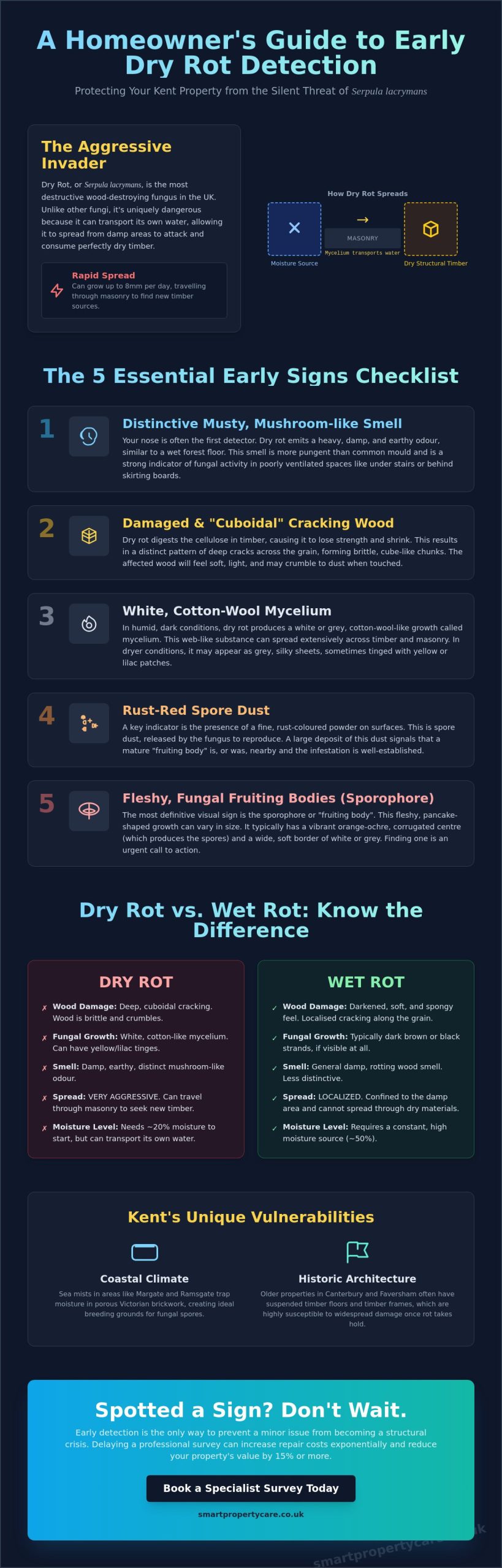
Dry rot, scientifically known as Serpula lacrymans, stands as the most aggressive wood-destroying fungus affecting British properties. To understand What is Dry Rot, you must first look past the confusing name. It isn’t actually dry. While the fungus requires an initial moisture source to germinate, it’s uniquely dangerous because of its ability to transport water. Once established, it can move moisture from damp areas to dry timber, allowing it to consume structural wood that would otherwise be safe. Dry rot is a fungal infection that can travel through masonry to reach new timber sources.
In humid coastal environments like Margate and Ramsgate, the risk is particularly high. Sea mists and high salt content can trap moisture within Victorian brickwork, creating the perfect incubator for spores. In these conditions, the fungus can spread at a rate of 4mm to 8mm every single day. Spotting dry rot early signs is the only way to prevent a localized damp issue from evolving into a full-scale structural crisis that threatens the entire building.
The High Stakes of Delayed Identification
Older properties in Canterbury often feature traditional timber-framed construction or suspended timber floors that are highly vulnerable. When dry rot takes hold of floor joists or roof timbers, it digests the cellulose that gives wood its strength. This process leaves the timber brittle, cracked, and prone to sudden collapse. Delaying an inspection doesn’t just risk your safety; it exponentially increases the scope and cost of dry rot treatment. In the current East Kent property market, a RICS survey that identifies active rot can reduce a home’s valuation by 15% or more, frequently causing sales to fall through at the final hurdle.
The Sensory Guide: What Does Dry Rot Smell Like?
Your nose often detects dry rot early signs long before visual symptoms appear. The fungus emits a heavy, damp, and earthy odour. It’s a distinctive scent that mimics a forest floor or wet soil after a heavy rain. It’s much more pungent and organic than the stale, musty smell associated with common black mould. If you notice this mushroom-like aroma, you should immediately investigate “dead air” spaces where ventilation is restricted. In Faversham’s period cottages, this typically means checking behind skirting boards, under the stairs, or within cellar voids. Finding the source early provides the peace of mind that your home’s structural integrity remains protected.
The Essential Checklist: 5 Early Signs of Dry Rot
Identifying dry rot early signs saves thousands in structural repairs and protects the long-term value of your Kent property. Use this definitive checklist during your next DIY walk-through. If you spot even one of these indicators, it’s vital to book a professional damp survey immediately. Dry rot (Serpula lacrymans) is exceptionally aggressive. It progresses from invisible microscopic spores to total structural failure with alarming speed, often hiding behind plasterboard or under floorboards until the damage is extensive.
1. Damaged or “Cuboidal” Cracking in Timber
Dry rot targets the very foundation of your home’s woodwork by removing the cellulose. This process leaves the timber without any structural integrity. You’ll notice a distinct “cuboidal cracking” pattern where the wood breaks into small, brittle cubes. The texture is a primary giveaway; the timber feels unnaturally light, soft, or crumbles into a fine powder between your fingers. Understanding the science of wood decay helps explain why this isn’t just a surface issue. It’s a deep-seated biological breakdown that compromises floor joists and roof timbers from the inside out.
2. Spore Dust and “Fruiting Bodies”
Keep a close watch for a fine, rust-coloured dust settling on horizontal surfaces like skirting boards, window sills, or stored boxes. These are billions of spores looking for their next moisture source. In the more advanced early stages, the fungus produces a “sporophore” or fruiting body. This fleshy, pancake-shaped growth is hard to miss. These bodies typically feature vibrant orange-ochre centres with distinct white or grey edges. They’re a clear signal that the fungus is mature and actively spreading throughout the building’s fabric.
3. Mycelium Growth and Hyphae Strands
Mycelium appears as a white, cotton-wool-like substance spreading across timber or masonry. It’s soft and puffy but indicates a massive underlying infestation. From this mass, the fungus sends out grey, cobweb-like strands called hyphae. These strands act as a sophisticated search network, seeking out new moisture sources to keep the colony alive. They’re incredibly hardy and can penetrate through thick brickwork or mortar. This is a frequent problem in older terrace houses in Dover or Herne Bay, where the fungus travels through shared party walls to infect neighbouring properties without warning.
Don’t leave your property’s safety to chance. If you’ve identified any of these symptoms, our team provides the meticulous expertise needed to stop the spread. Contact us today for a comprehensive inspection and restore your peace of mind.
Distinguishing Dry Rot from Wet Rot and Common Damp
Identifying the specific cause of timber decay is the first step toward a permanent solution for your property. While wet rot treatment is a frequent requirement in older Kent homes, dry rot is a far more aggressive “travelling” fungus. It doesn’t stay confined to the immediate area of a leak. Instead, it moves through brickwork and behind plaster to find new timber food sources, making it a significant threat to structural integrity.
Misidentifying these issues leads to wasted investment and continued damage. The Society for the Protection of Ancient Buildings explains that dry rot (Serpula lacrymans) can thrive in timber with a moisture content as low as 20%. In contrast, wet rot typically requires a saturation level of 40% to 50% to survive. This lower threshold means dry rot can persist in environments that may appear dry to the naked eye. Recognising dry rot early signs accurately ensures you apply the correct remedial strategy before the fungus spreads to adjacent rooms.
Dry Rot vs. Wet Rot: Key Differences
Look closely at the texture of the affected wood. Dry rot creates deep, cuboidal cracking where the timber breaks into distinct, brittle cubes. It often produces a soft, white felt-like growth or large, orange-coloured fruiting bodies. Wet rot usually results in a longitudinal or stringy texture. The wood may feel spongy or look bleached, but it generally stays localized to the moisture source. While wet rot remains trapped where the water is, dry rot uses grey, root-like strands called hyphae to bridge gaps across non-organic materials like stone or mortar. Review our detailed dry rot vs wet rot comparison for a side-by-side analysis of these physical traits.
Is it Just Mould? Understanding Surface Growth
Homeowners often confuse common black mould (Aspergillus) with timber-destroying fungi. Black mould is an airborne moisture issue caused by poor ventilation and condensation. It sits on the surface of paint, wallpaper, or sealant. You can often test this yourself. If you can wipe the growth away with a damp cloth and the wood or plaster beneath remains solid and unstained, it isn’t dry rot. Spotting dry rot early signs correctly prevents unnecessary panic over surface-level damp. If your issue is purely atmospheric rather than fungal, our guide on how to get rid of mould on walls provides a permanent roadmap for Kent residents to improve air quality and protect their interiors.
Local Risk Factors: Why Coastal and Historic Kent Homes Are at Risk
Kent’s unique geography creates a specific set of challenges for property maintenance. The East Kent climate, influenced by the North Sea, brings high salt air and persistent humidity that directly impacts timber health. In historic hubs like Sandwich and Canterbury, the architectural landscape is dominated by timber-framed Tudor buildings and expansive Victorian villas. While these properties are prestigious, their age and construction methods make them highly susceptible to fungal attacks if the internal environment isn’t managed with precision.
The Coastal Humidity Factor in Herne Bay and Margate
Properties located within 2 miles of the Kent coastline are in a high-risk zone. Sea spray and high relative humidity frequently push timber moisture content above the 20% danger threshold. When salt-laden air penetrates masonry, it holds moisture against internal wood frames. Homeowners must stay vigilant for dry rot early signs, such as a distinct mushroom-like scent or fine orange dust on surfaces. Coastal storms often cause penetrating damp that bypasses old mortar joints, feeding dormant spores behind your walls. We’ve seen cases where a single season of heavy coastal rain has triggered significant outbreaks in previously dry voids.
Historic Timber and Modern Renovations
The “concealed moisture” trap is a common issue during the refurbishment of older Kentish properties. In Canterbury and Faversham, using non-breathable renders or modern vinyl paints on historic brickwork often leads to disaster. These materials seal the building, preventing moisture from evaporating naturally. If you’ve recently applied modern plastering over old timber lath, you’re potentially trapping damp against original joists. This creates a perfect incubator for rot. We suggest regular checks of cellar timbers and sub-floor voids, especially if your property has undergone recent decorative updates. Our team often finds that what looks like a simple cosmetic crack is actually a symptom of deep-seated structural decay.
Blocked air bricks are another critical failure point in seaside towns. Salt crust, sand, and modern paving often obstruct these vents, cutting off the airflow needed to keep sub-floors dry. Without this ventilation, the humidity in the crawl space rises, and the rot begins its silent spread through the structural skeleton of your home. It’s a common problem that requires a bespoke solution to ensure the building’s longevity.
If you’re concerned about hidden damp in your coastal or historic home, our expert team provides meticulous inspections to give you total peace of mind. Contact us for a professional property health check to protect your Kent investment.
From Identification to Eradication: Professional Surveys in East Kent
Once you recognize the dry rot early signs, your immediate actions dictate the cost and complexity of the eventual repair. It’s vital that you resist the urge to poke the affected timber or scrub the area with household bleach. Disrupting a mature fruiting body can release millions of microscopic spores into your home’s atmosphere, while bleach only adds more moisture to a fungus that thrives on it. The most effective step is to isolate the area and contact a specialist immediately.
What to Expect During a Specialist Survey
A Smart Property Care survey is a forensic investigation into your building’s health. Our surveyors utilize high-precision moisture meters and borescope sub-floor cameras to track fungal spread behind walls and beneath floorboards. We don’t just identify the rot; we locate the moisture source that triggered the outbreak. Whether it’s a leaking pipe in Dover or rising damp in a Herne Bay terrace, we find the root cause to ensure the fungus never returns. Every homeowner receives a detailed technical report outlining the exact scope of the infestation and our proposed solution.
The “stripping back” phase is where our meticulous approach saves your property. Dry rot mycelium can travel through brickwork and mortar to find new timber sources. We remove plaster and floorboards at least one metre beyond the last visible sign of infection. This rigorous process ensures we’ve captured the entire network of the fungus, preventing a secondary outbreak six months down the line. It’s a disciplined method that prioritizes long-term structural safety over quick, superficial fixes.
The Smart Property Care Solution
With over 20 years of experience in property preservation across Kent, we provide a seamless “one-stop-shop” service. You won’t need to coordinate between different trades or manage multiple contractors. Our in-house team handles everything from structural carpentry to specialist salt-neutralizing plastering. We deliver bespoke remedial works designed to restore the structural integrity of your home while maintaining its aesthetic character. Our team is fully insured and certified, providing the peace of mind that comes from professional, high-end craftsmanship.
Don’t let a small patch of decay turn into a structural crisis. Take control of your property’s future by consulting with the experts who understand Kent’s unique building stock. Book your specialist damp and timber survey today to protect your investment for years to come.
Secure Your Property’s Future Today
Identifying dry rot early signs is the most effective way to prevent the extensive structural damage that threatens Kent’s unique coastal and historic architecture. By spotting symptoms like orange spore dust or shrinking timber now, you can avoid the significant disruption and high costs associated with major remedial works. Timely action preserves both the integrity of your home and its long-term market value.
Smart Property Care provides the professional clarity you need. With over 20 years of local expertise, our family-run team delivers a meticulous approach to every inspection. We specialize in producing comprehensive damp and timber reports that meet strict RICS compliance standards, ensuring your property remains a safe and valuable asset. Our experts handle the technical complexities so you can enjoy total peace of mind.
Don’t let hidden fungal growth compromise your investment. Request a Professional Dry Rot Survey in Kent to safeguard your home with a bespoke solution. We’re ready to help you maintain a dry, healthy, and secure living environment for years to come.
Frequently Asked Questions
Can I treat dry rot myself with store-bought chemicals?
You shouldn’t attempt to treat dry rot yourself using off-the-shelf chemicals. While retail fungicides are available, they rarely penetrate the 100mm depth required to kill the Serpula lacrymans fungus effectively. Professional remediation involves identifying the underlying moisture source and applying industrial-grade biocides. Our team provides a meticulous survey to ensure the fungus is eradicated at its root, giving you long-term peace of mind.
How quickly does dry rot spread through a house?
Dry rot can spread at a rate of 80mm to 100mm per month under optimal conditions of 20% timber moisture content. This aggressive growth allows the fungus to move from a damp basement to upper-floor joists within a single season. Identifying dry rot early signs is essential to prevent structural damage that could affect 15% or more of your home’s structural timber. Quick action saves you from more expensive, large-scale refurbishments later.
Is dry rot dangerous to human health?
Dry rot isn’t classified as a toxic fungus like certain black moulds, but it poses risks to individuals with pre-existing respiratory conditions. The fungus produces millions of spores that can exacerbate asthma or cause hypersensitivity pneumonitis in sensitive residents. We prioritise a clean, dust-free environment during the removal process to protect your family’s health. Our certified technicians use professional extraction equipment to maintain air quality throughout the repair.
Will my home insurance cover the cost of dry rot repairs?
Most standard UK home insurance policies don’t cover dry rot repairs because insurers classify it as gradual deterioration rather than an accidental event. A 2023 review of major UK providers showed that 95% of policies specifically exclude damage caused by wet or dry rot. However, if the rot resulted from a sudden, documented pipe burst, you might be eligible for a claim. We can provide a detailed, transparent report to assist with your insurance enquiries.
Can dry rot grow on modern building materials like plasterboard?
Dry rot can grow across modern materials like plasterboard and insulation to reach its next food source. While the fungus doesn’t digest the gypsum in plasterboard, it uses the surface as a bridge to transport moisture and nutrients to nearby wood. Our technicians often find mycelium strands behind 12.5mm plasterboard sheets during comprehensive property surveys in Kent. It’s a common misconception that modern homes are immune to these fungal attacks.
What is the most common cause of dry rot in Kent properties?
The most common cause of dry rot in Kent is poor sub-floor ventilation combined with historical rising damp in Victorian and Edwardian properties. Approximately 40% of our local call-outs involve blocked air bricks that have allowed humidity levels to rise above the critical 20% threshold. This creates the perfect environment for dry rot early signs to manifest in floor joists and skirting boards. Maintaining your property’s exterior drainage is a vital preventative step.
Can dry rot spread through brickwork or concrete?
Dry rot can spread through brickwork and concrete by extending specialised strands called rhizomorphs. These grey, root-like strands travel through mortar joints and porous masonry to find new timber sources up to several metres away. It’s a unique characteristic that allows the fungus to bypass non-organic barriers that would stop other types of decay. This is why we treat the surrounding masonry, not just the affected wood, during a professional intervention.
How do I tell the difference between dry rot and a harmless mushroom?
You can distinguish dry rot by its distinct pancake-shaped fruiting body and the presence of fine, rust-coloured spore dust. Unlike common household mushrooms, a dry rot sporophore features a deep orange centre with a white, waxy outer edge. If you notice a mushroom-like growth accompanied by a damp, musty odour, it’s a 90% certainty that you’re dealing with a serious fungal infection. Contact us for a free, no-obligation quote to identify the growth accurately.