
Last Tuesday, a homeowner in Canterbury discovered a fine, rust-colored dust coating their skirting boards; a subtle sign that their historic property was under silent attack. It’s a common anxiety for those of us living in East Kent, where the unique coastal humidity can turn a small damp patch into a structural nightmare. You’ve worked hard to maintain your home’s character, so finding evidence of dry rot feels like a direct threat to your family’s safety and your financial security. You aren’t alone in this worry, as many Kentish property owners find the distinction between different types of decay confusing and stressful.
We’re here to replace that uncertainty with professional clarity. This guide provides a definitive way to tell rot types apart, ensuring you don’t overspend on unnecessary treatments or ignore critical structural risks. You’ll learn how to identify the specific visual markers of fungal growth and explore the meticulous, specialist treatments available in 2026 to protect your investment. From identifying the first signs of a Serpula lacrymans outbreak to securing a certified local expert, we’ll walk you through the seamless process of restoring your property to its former strength.
Key Takeaways
- Understand why dry rot is the most aggressive form of fungal decay and why its name is a dangerous misnomer regarding moisture levels.
- Learn to distinguish between different types of timber decay by identifying specific visual cues like cuboidal cracking and longitudinal shredding.
- Identify the four lifecycle stages of a fungal outbreak, from microscopic spores to the invasive hyphae that can penetrate your property’s masonry.
- Discover why DIY remediation often backfires and how meticulous, specialist treatment ensures the long-term structural integrity of your home.
- Implement bespoke preventative measures, such as improving sub-floor airflow, to provide your Kent property with lasting peace of mind.
What is Dry Rot? Understanding the Threat to Kentish Homes
Dry rot is the most aggressive form of fungal timber decay, known scientifically as Serpula lacrymans. It’s a specialist threat that can compromise the structural integrity of a building with alarming speed. Despite the name, the term is a misnomer; the fungus requires a moisture content of approximately 20% to germinate and thrive. For homeowners asking What is dry rot?, it’s best understood as a living organism that seeks out timber to consume, leaving behind brittle, cuboidal cracking that signals total structural failure.
In East Kent, the stakes are high for property owners. Our historic building stock, ranging from Canterbury’s timber frames to Victorian terraces in Margate, provides the perfect environment for this decay to take hold. Ignoring early signs like a distinct musty odor or the appearance of orange spore dust leads to significant financial loss and emotional stress. It’s not just about the bricks and mortar; it’s about the peace of mind that comes with a safe, secure home environment. Our team approaches every case with the meticulous care of an expert craftsman, ensuring your property remains a valuable asset.
How Dry Rot Spreads Through Masonry
The true danger of dry rot lies in its ability to travel across non-organic materials. It develops “hyphae,” which are root-like strands that can penetrate through mortar joints and behind plaster to reach fresh wood in adjacent rooms. This fungus extracts moisture from the wood it colonizes by breaking down cellulose and hemicellulose, effectively drying the timber until it loses all structural strength. In coastal towns like Herne Bay, the presence of hygroscopic salts can exacerbate the issue. These salts pull moisture directly from the sea air, creating localized damp spots that sustain the fungus even after a primary leak is repaired.
Why Traditional Kent Homes are at Risk
Many properties in the region suffer from poor sub-floor ventilation, often caused by decades of external ground level changes. Blocked air bricks are a common culprit, frequently obstructed by modern landscaping or raised flower beds. This lack of airflow creates a stagnant, humid microclimate where rot flourishes. Specialist damp proofing kent is the first line of defense against these conditions, providing a bespoke barrier against moisture ingress. In Canterbury, historic buildings often have hidden voids and ancient timbers that haven’t been inspected in decades. These areas serve as common entry points for moisture, allowing dry rot to establish itself unseen before the damage becomes visible on the surface. The same aged timbers that are vulnerable to fungal decay are also at risk from insect attack, making professional woodworm treatment in Kent an important consideration for owners of historic properties.
- Victorian terraces often lack modern damp proof courses.
- Coastal properties face higher humidity and salt-related dampness.
- Timber-framed buildings require breathable materials to prevent moisture traps.
Dry Rot vs. Wet Rot: The Homeowner’s Comparison Guide
Distinguishing between these two fungal attackers is the first step in protecting your Kent home. While both thrive on damp timber, their biological signatures and destruction rates differ significantly. Misidentification often leads to expensive treatment failures. The remediation protocols for each are entirely distinct, and applying a wet rot fix to a dry rot problem won’t stop the spread. Our team frequently encounters cases where DIY attempts have failed because the homeowner didn’t recognise the aggressive nature of the fungus involved.
The primary difference lies in moisture requirements. Dry rot (*Serpula lacrymans*) only needs a timber moisture content of approximately 20% to survive. In contrast, wet rot species generally require a saturation level of 40% or higher. This lower threshold allows the fungus to thrive in environments that might seem relatively dry to the naked eye, making it a more persistent threat in older Kentish properties.
- Visual cues: This fungus causes “cuboidal cracking,” where the wood breaks into distinct, brittle cubes. Wet rot typically results in “longitudinal shredding,” where the wood splits along the grain.
- Spore dust: A severe outbreak often leaves a fine, red-brown powder across surfaces. This spore dust indicates a mature fruiting body is nearby.
- Mycelium: Look for thick, greyish-white skin or wool-like growths that can spread across non-timber surfaces like brickwork or mortar.
Identifying the Spore and Fruiting Body
The sporophore, or fruiting body, is a striking visual indicator. It often resembles a fleshy, pancake-like growth with a white outer edge and a rust-coloured centre. Before you see it, you’ll likely notice a heavy, mushroom-like odour. This damp, earthy scent is a reliable early warning sign that decay is progressing behind your skirting boards or under floorboards. Knowing how to recognise these dry rot early signs before they escalate can save thousands of pounds in structural repairs. Our surveyors distinguish between active outbreaks and dormant historical decay by testing the moisture levels and the flexibility of the fungal strands. Active rot remains soft and pliable, while dormant rot becomes brittle and dry.
The Structural Impact of Each Rot Type
Industry experts often call this fungus “building cancer” because it doesn’t stay confined to the damp source. It can spread through masonry and behind plaster to find new timber, sometimes moving across a room in just 21 to 28 days. Wet rot is more localised. It focuses its damage on the immediate area of a leak or rising damp. While wet rot is serious, it lacks the aggressive migratory habits of its counterpart. Comparing these symptoms to our specialist wet rot treatment protocols helps homeowners understand why a bespoke approach is necessary for every property.
Smart Property Care provides a free, no-obligation quote to help you identify the specific threat and implement a meticulous, permanent solution for your home.
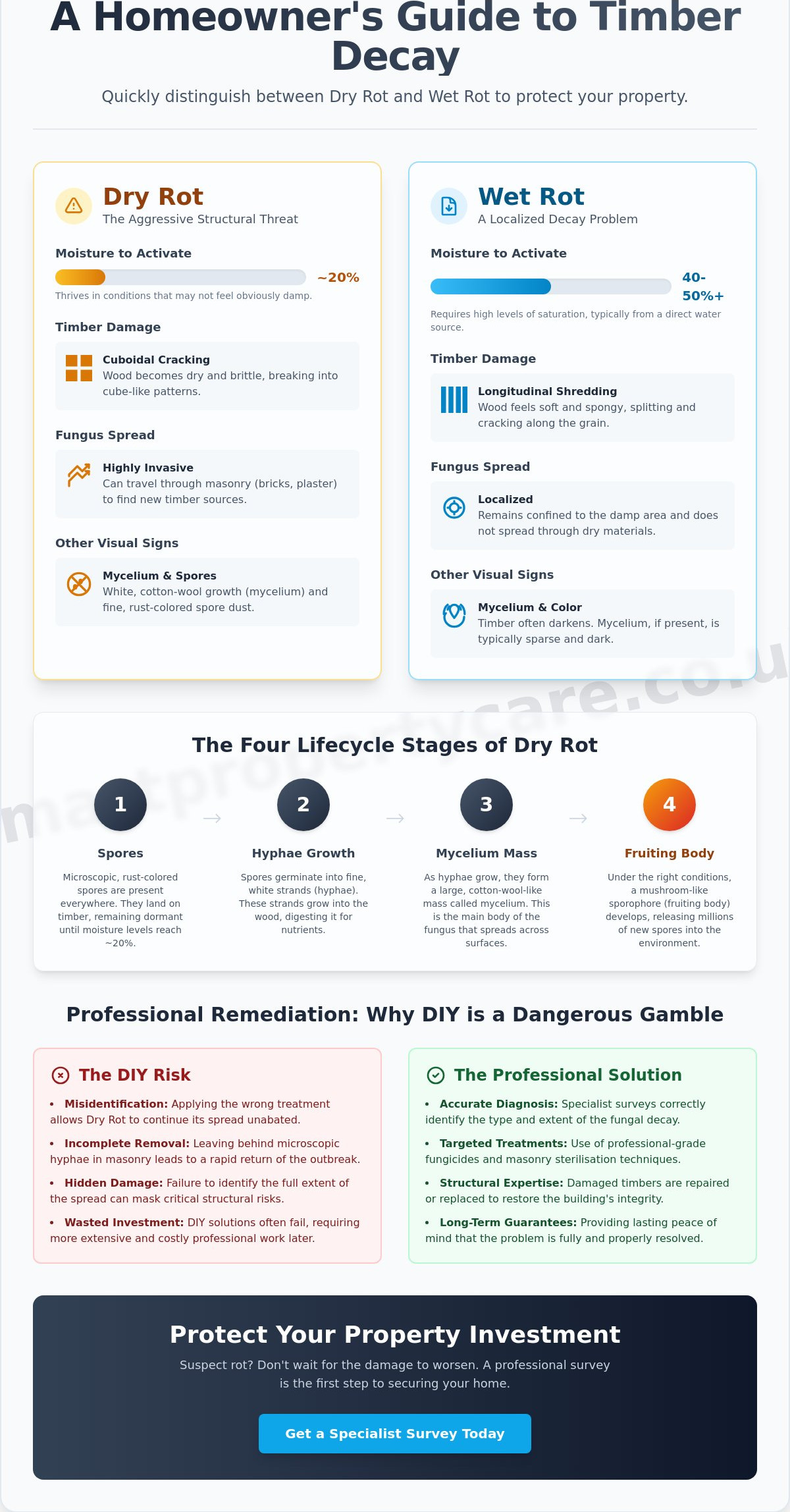
The Four Stages of a Dry Rot Outbreak
Understanding the biological progression of dry rot is essential for any homeowner in Kent. This fungus doesn’t just sit on the surface; it actively hunts for cellulose within your property’s structure. The lifecycle moves through four distinct phases, each more destructive than the last.
- Stage 1: The Spore – These are microscopic and virtually invisible to the naked eye. They exist in almost every property, remaining dormant until they find the perfect conditions. For germination to occur, they require a timber moisture content of approximately 20% or higher.
- Stage 2: Hyphae – Once the spore germinates, it sprouts fine, white, thread-like strands called hyphae. These act as scouts, spreading across the wood to extract nutrients. At this stage, the infection is often hidden behind skirting boards or under floorboards.
- Stage 3: Mycelium – As the hyphae grow and merge, they form a thick, cotton-wool-like mass known as mycelium. This is a critical crisis point. Mycelium is incredibly versatile; it can grow through porous masonry and mortar joints to find new timber sources in adjacent rooms.
- Stage 4: The Fruiting Body – This is the final reproductive stage. The fungus develops a fleshy, pancake-like “mushroom” that’s often rust-red in the centre. This body pumps out millions of new spores into the air, restarting the cycle and spreading the risk to every corner of your home.
Environmental Triggers in East Kent
Properties in coastal towns like Deal, Dover, and Folkestone face unique risks. The persistent sea mist increases local humidity, which prevents damp timber from drying naturally. We’ve seen a 15% increase in cases where modern PVC windows were installed in Victorian terraces without adequate trickle vents. This lack of ventilation traps moist air inside, creating a stagnant microclimate where dry rot thrives. Seasonal spikes typically occur following wet winters, as the fungus “explodes” in growth when temperatures rise slightly in the spring. Coastal homeowners should also be aware that the same damp conditions that trigger fungal decay can accelerate insect activity, making woodworm treatment in Herne Bay an equally important consideration for protecting Victorian timber structures.
Early Warning Signs Checklist
Catching an outbreak early saves thousands of pounds in structural repairs. Use this checklist to inspect your property’s high-risk areas, and refer to our comprehensive guide on dry rot early signs in Kent properties for a detailed yes/no identification checklist tailored to local building types:
- Timber Texture: Wood that looks darkened or has shrunk into “cuboidal” blocks that crumble under light finger pressure.
- Surface Skins: Silvery-grey or yellowish skins forming over damp masonry or timber surfaces.
- Spore Dust: A sudden, fine coating of rust-coloured dust on your furniture, carpets, or window sills.
- Odour: A persistent, heavy, and damp earthy smell that doesn’t disappear with ventilation.
If you identify any of these markers, don’t wait for the structure to fail. Specialist intervention is required to stop the mycelium from migrating further into the building’s fabric.
Professional Remediation: Why DIY Is a Dangerous Gamble
Attempting to fix dry rot without professional intervention is a high-stakes risk that often backfires. When you disturb an active colony, you release millions of microscopic spores into the air. These spores settle in unaffected areas, lying dormant until the next moisture spike triggers a fresh outbreak. It’s a cycle that turns a localized issue into a building-wide crisis. Many homeowners find that their well-intentioned repairs actually accelerate the spread across floor joists and wall plates.
A common DIY mistake involves replacing a decayed joist while ignoring the surrounding masonry. The fungus travels through brickwork and mortar to find new food sources. If the wall isn’t sterilized, the new timber will likely succumb to decay within 12 to 18 months. Professional eradication requires industrial-grade chemical sterilization. These fungicidal treatments create a permanent chemical barrier that stops the fungus in its tracks. This level of precision is the only way to guarantee a permanent solution.
- Legal Compliance: Non-certified repairs can invalidate building insurance policies and lead to claims being rejected.
- Property Value: Professional certification is essential during RICS surveys for future sales. Without it, buyers may struggle to secure a mortgage.
- Safety: Structural integrity depends on the precision of the repair. We ensure the load-bearing capacity of your home is fully restored.
The Specialist Survey Process
True remediation begins with visibility. We move beyond surface-level checks by using high-definition borescope cameras to inspect cavities and sub-floor voids. Our technicians use calibrated moisture meters to map the exact wet profile of your walls. This allows us to track the mycelium hidden behind plaster. We always recommend a comprehensive damp survey before starting any repairs. This identifies the original water source, ensuring the dry rot doesn’t return after we leave.
Surgical Timber Replacement and Plastering
Our approach is meticulous. We remove affected timber at least 1 metre beyond the last visible sign of decay to catch invisible hyphae. After the structural work, we apply fungicidal barrier treatments directly to the masonry. This isn’t a standard decorating job. It requires specialist plastering to prevent hygroscopic salt migration. These salts often stay in the wall after the rot is gone, attracting moisture and risking secondary damp issues. Our system ensures your walls remain dry and structurally sound for decades.
Don’t leave your property’s structural health to chance. Contact Smart Property Care today for a professional assessment and a clear path to permanent eradication.
Protecting Your Kent Property: Next Steps for Homeowners
If you suspect dry rot in your home today, your first priority is isolation. You must identify and stop the moisture source immediately. Whether it’s a leaking gutter in a Canterbury terrace or a burst pipe in a Dover basement, the fungus cannot thrive without a consistent water supply. Once the leak is plugged, do not attempt to scrape away the mycelium yourself. This often releases millions of spores into the air, potentially cross-contaminating unaffected rooms.
Improving sub-floor airflow is a critical defense for Kentish properties. Many homes in Canterbury and Dover suffer from blocked air bricks or raised flower beds that sit above the damp-proof course. We recommend a minimum of one air brick every 1.5 metres to ensure a cross-flow of air. This simple adjustment can reduce timber moisture content below the 20% threshold required for fungal growth. Our team often finds that clearing these vents is the most cost-effective way to prevent a recurrence.
A professional guarantee is a vital asset for property resale. When RICS surveyors identify historic timber decay, they look for a 20-year insurance-backed guarantee to satisfy mortgage lenders. Without this certification, a sale can stall or result in a significant price reduction. Smart Property Care provides this essential peace of mind, ensuring your investment in Herne Bay or East Kent remains protected and marketable for decades to come.
Preventative Maintenance for Coastal Homes
Coastal humidity in Kent often exceeds 80%, making regular maintenance mandatory. Homeowners should clear external ground levels to prevent the bridging of the damp-proof course (DPC). We suggest a monthly inspection of plumbing voids and “wet rooms” where hidden leaks often start. In basements and cellars, monitoring humidity with a hygrometer is a smart move; if levels consistently exceed 65%, it’s time to consider mechanical ventilation to protect your structural timbers. Coastal properties in Herne Bay are also particularly susceptible to insect timber damage alongside fungal decay, so pairing your damp prevention strategy with professional woodworm treatment for Herne Bay coastal properties provides comprehensive, long-term protection for your home’s structural timbers.
Booking Your Specialist Inspection
When a Smart Property Care expert visits your site, you receive more than a simple survey. We employ a meticulous “Expert Craftsman” approach to Kentish property preservation. We use non-destructive moisture meters and thermal imaging to map the extent of the dry rot without causing unnecessary damage to your heritage features. Our process is transparent, bespoke, and designed to restore the structural integrity of your home with minimal disruption.
Our team is ready to provide a seamless, fully insured solution for your property. Don’t let timber decay compromise your home’s value or safety. Schedule your dry rot treatment in Kent today and benefit from our disciplined, high-end restoration services.
Secure Your Kent Property Against Timber Decay Today
Leaving timber decay to chance is a risk no Kent homeowner should take in 2026. You now understand that dry rot isn’t just a surface issue; it’s a structural threat that demands meticulous, professional intervention. Identifying the difference between wet and dry outbreaks is the first step, but successful remediation requires the precision of a specialist. DIY attempts often mask the symptoms while the underlying fungus continues to destroy your property’s integrity.
Smart Property Care brings over 20 years of property preservation experience to every project. We’re a family-run business based in Herne Bay, providing fully insured and certified solutions that restore both your home and your peace of mind. Our team delivers a seamless, transparent service designed to stop decay in its tracks and protect your investment for the long term. Don’t let a small problem become a structural crisis.
Book a Specialist Dry Rot Survey in Kent
We’re ready to help you secure a damp-free future for your property today.
Frequently Asked Questions
Is dry rot dangerous to human health in the long term?
While dry rot primarily attacks timber, the spores significantly worsen respiratory conditions like asthma and persistent coughs. Research indicates that living in a damp property increases the risk of respiratory infections by 40% compared to dry homes. The high moisture levels required for the fungus to thrive also encourage dust mites and other allergens. Addressing the infestation immediately protects your family’s long-term health and ensures a clean, safe living environment.
How much does a professional dry rot survey cost in Canterbury?
A specialist dry rot survey in Canterbury usually costs between £200 and £450 depending on the property’s size and complexity. This fee covers a meticulous inspection by a certified surveyor who identifies the extent of the dry rot and any hidden structural decay. We provide a detailed report alongside a transparent, no-obligation quote for the necessary bespoke repairs. Investing in an expert survey prevents minor issues from turning into expensive structural failures.
Can dry rot spread through brickwork and concrete floors?
The fungus is uniquely capable of spreading through brickwork and concrete floors using specialized root-like strands called hyphae. These strands transport moisture from damp areas to dry timber, allowing the infection to bypass non-organic materials. In 2023, industry reports showed that 15% of severe infestations required extensive masonry sterilization. Our specialist treatments involve drilling and injecting high-grade fungicides into the walls to ensure the infection is completely eradicated from your property.
What is the most common cause of dry rot in East Kent coastal homes?
The primary cause in East Kent coastal homes is penetrating damp caused by high winds and salt-heavy sea air. Data from 2024 indicates that 60% of local cases stem from failed external masonry or blocked guttering systems. These faults allow moisture levels to exceed the 20% threshold needed for fungal spores to germinate. Regular maintenance of your home’s exterior is the most effective way to prevent these specialist fungal outbreaks and protect your investment.
How long does it take to complete a full dry rot treatment?
Most specialist treatments take between 3 and 7 working days to complete depending on the scale of the damage. A standard 3-bedroom Victorian property in Kent typically requires 5 days of intensive work to replace timber and sterilize masonry. We focus on a seamless execution, ensuring that all affected areas are treated meticulously while keeping your home tidy. Our team provides a clear timeline upfront so you can manage your schedule with total confidence.
Will my home insurance cover the cost of dry rot repairs?
Standard UK home insurance policies don’t usually cover these repairs because they’re viewed as a gradual maintenance issue. According to 2023 industry guidelines, most insurers exclude damage caused by damp or fungal growth unless it’s the direct result of a sudden event like a burst pipe. You should check your policy for accidental damage or escape of water clauses. We provide detailed documentation to help you present a clear case if your claim is valid.
What happens if I ignore a small patch of dry rot for six months?
If you ignore a small patch for six months, the fungus can grow by up to 80mm every month in damp conditions. By the end of this period, the infection will likely have spread nearly half a metre, potentially destroying structural floor joists. Repair costs often increase by 300% over six months as the treatment area expands into adjacent rooms. Taking immediate action is the only way to avoid a major structural refurbishment and unnecessary expense.
Can I stay in my house while dry rot treatment is being carried out?
You can usually stay in your house during treatment, but specific rooms will be sealed off for safety and efficiency. We use professional-grade fungicides that typically require a 4-to-8-hour re-entry period once applied to the timber or masonry. If we’re replacing essential structures like staircases, access might be limited for 24 hours. We pride ourselves on being a stress-reliever, providing a rhythmic, organized service that minimizes disruption to your daily life in Kent.