
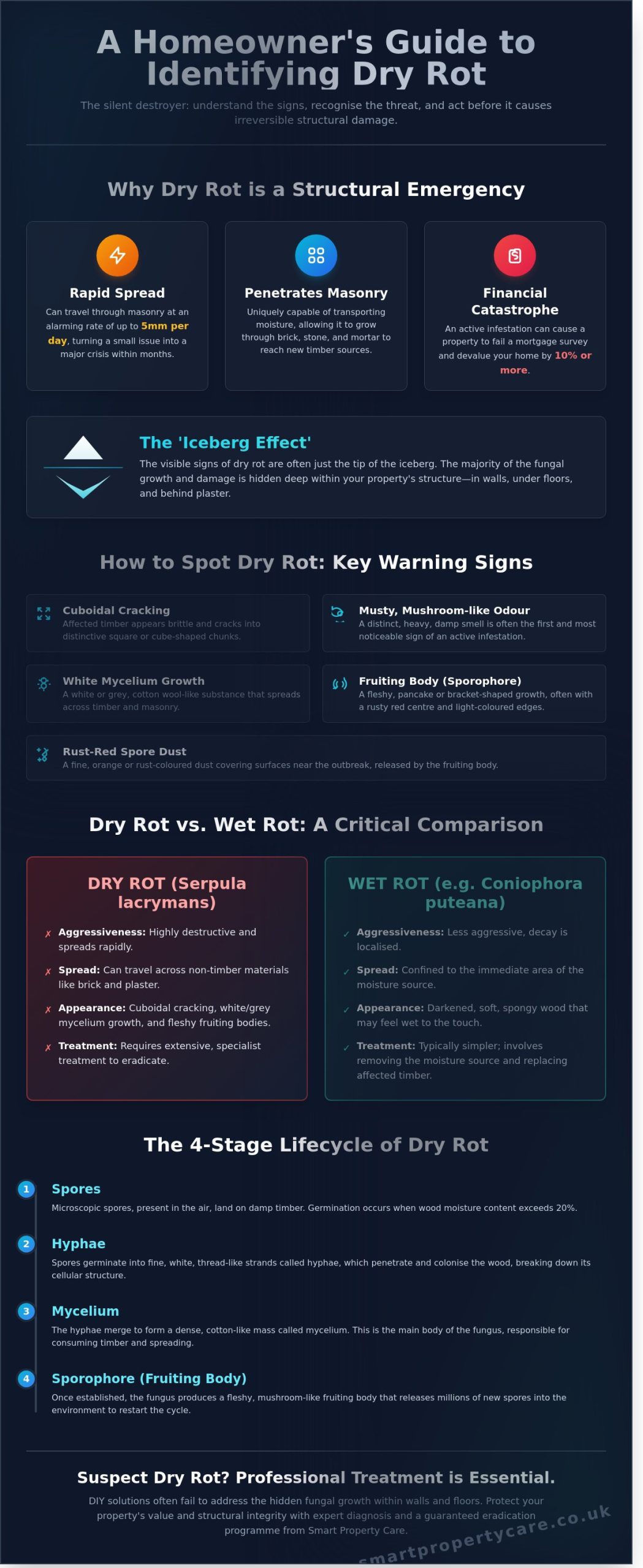
Dry rot can travel through solid masonry at a rate of up to 5mm per day, turning a minor damp issue into a structural emergency in just a few months. When you suspect an outbreak, securing a professional dry rot treatment is the only way to prevent the silent destruction of your home’s timber frame. You’re right to feel concerned about the potential for structural collapse or the high costs often associated with specialist repairs. The confusion between aggressive dry rot and less serious wet rot only adds to the stress of maintaining your Kent property.
At Smart Property Care Ltd, we provide the expert clarity needed to protect your investment. You’ll discover the essential steps to identify the fungus, treat the root cause, and restore your home’s structural integrity with absolute precision. This guide covers everything from initial diagnosis to our bespoke eradication programme, ensuring you gain the long-term guarantee and peace of mind you deserve.
Key Takeaways
- Learn to identify the critical warning signs of Serpula lacrymans, including cuboidal timber cracking and the distinct musty odour common in coastal Kent homes.
- Discover why professional dry rot treatment is essential for permanent eradication, targeting the “iceberg effect” of fungal growth hidden deep within your property’s structure.
- Understand the meticulous step-by-step process required to eliminate moisture sources and expose affected areas, ensuring a comprehensive and lasting repair.
- Gain peace of mind by leveraging two decades of local expertise to protect your home’s structural integrity with seamless, high-end craftsmanship.
Understanding Dry Rot in Kent Properties: Why It Is a Structural Emergency
Dry rot, scientifically known as Serpula lacrymans, represents the most aggressive form of fungal decay affecting UK homes today. It’s a relentless biological force that can compromise the structural integrity of a building in a surprisingly short timeframe. For homeowners in Kent, the threat is particularly acute due to our unique geography. The coastal humidity found in East Kent towns like Herne Bay and Margate creates a perfect microclimate for spore germination. Despite its misleading name, Understanding Dry Rot involves recognising that the fungus actually requires a consistent moisture source to survive and thrive. It doesn’t just sit on the surface; it consumes the cellulose within the timber, leaving it brittle, cracked, and structurally useless.
Canterbury and Faversham are renowned for their stunning Victorian and Edwardian architecture, but these historic timber frames are uniquely vulnerable. Modern living standards, such as increased insulation and central heating, can often trap moisture within these older structures. When this dampness meets untreated timber, it triggers the germination of dormant spores. Professional dry rot treatment is the only way to halt this progression once it starts. Without intervention, the fungus will continue to feed until the timber loses all load-bearing capacity, leading to sagging floors and, in extreme cases, partial building collapse.
How Dry Rot Spreads Through Masonry
One of the most terrifying aspects of this fungus is its ability to move beyond timber. It develops specialised root-like structures called hyphae, which are capable of transporting moisture across “inert” materials like brick, stone, and mortar. This means the infestation isn’t confined to a single beam. It can travel through party walls in terraced streets, infecting neighbouring properties even if there’s no direct timber-to-timber contact. In optimal conditions, the fungus can spread at a rate of up to 1 metre per year. This rapid expansion makes it a true structural emergency that requires immediate attention from an expert craftsman.
The Economic Impact on Property Value
An active infestation is more than just a repair headache; it’s a financial catastrophe. Dry rot can cause a property to fail a mortgage survey instantly, as lenders are often unwilling to release funds on a building with active fungal decay. This can lead to a significant devaluation of your home, sometimes reducing the market price by 10% or more to account for the perceived risk and repair costs.
Early detection is the most effective way to protect your investment. Arranging a professional damp survey allows for a meticulous assessment of the property’s health. By identifying the moisture source that fuels the growth, we ensure that any subsequent dry rot treatment is targeted and permanent. This proactive approach provides the peace of mind that your property remains a safe, valuable asset for years to come.
Identifying the Signs: Is it Dry Rot or Wet Rot?
Distinguishing between dry rot (Serpula lacrymans) and wet rot is the most critical step in protecting your property’s structural integrity. While both thrive on moisture, dry rot is significantly more aggressive. It consumes the cellulose within the timber, leaving behind a characteristic ‘cuboidal’ cracking pattern where the wood breaks into brittle, square chunks. You might also notice a thick, white, cotton wool-like growth known as mycelium spreading across surfaces. These visual markers indicate an active and destructive infestation. Knowing how to spot dry rot early signs — such as a faint musty odour or subtle discolouration behind skirting boards — can mean the difference between a minor repair and a five-figure structural bill. For a comprehensive breakdown of how to tell these decay types apart and what specialist intervention looks like, our detailed guide on dry rot identification, comparison, and specialist treatment in Kent provides authoritative clarity for property owners. If you discover timber that feels soft or spongy rather than showing deep cracking, this may indicate a need for professional wet rot treatment instead, as the two conditions require distinct eradication approaches.
Before you see the damage, you’ll often smell it. A heavy, mushroom-like or damp, musty odour typically permeates the affected area. If the infestation is advanced, a ‘fruiting body’ or sporophore will appear. This fleshy, pancake-shaped growth produces millions of rust-red spores, often visible as a fine orange dust on surrounding furniture or floors. Unlike wet rot, which remains localised to the immediate moisture source, dry rot has the unique ability to transport water and spread across non-organic materials like brickwork and mortar.
The Dry Rot Lifecycle: From Spore to Fruiting Body
The lifecycle of dry rot consists of four distinct stages: spores, hyphae, mycelium, and the sporophore. Each phase presents its own challenges for effective dry rot treatment. Initially, microscopic spores land on damp timber and germinate into fine, thread-like hyphae. These threads quickly colonise the wood, eventually merging into a dense network of mycelium. The mycelium acts as the vegetative part of the fungus, capable of penetrating deep into masonry to seek out new timber sources. Finally, the fungus produces a sporophore to release more spores, completing the cycle. Professional intervention requires different chemical treatments and masonry sterilisation techniques depending on which stage of this cycle we identify during our survey.
Common Misidentifications and Risks
Homeowners often mistake dry rot for harmless cellar fungus or common surface mould. This confusion is dangerous. Ignoring ‘white fuzz’ on floor joists in Kentish basements can lead to catastrophic structural failure. While surface mould is often a ventilation issue, dry rot is a deep-seated biological attack. If you’re unsure about the growth on your walls, you can learn how to get rid of mould on walls to see if your issue is environmental or structural. Misidentifying the problem leads to inadequate repairs, which is why a professional dry rot treatment survey is essential for long-term peace of mind. If you suspect your timber is compromised, request a free, no-obligation quote from our expert team to ensure your property remains safe and secure.
The Professional Dry Rot Treatment Process: A Step-by-Step Guide
Effective dry rot treatment requires a disciplined, multi-stage approach. We don’t just patch the visible damage; we eliminate the root cause to ensure the fungus never returns. Our technicians follow a meticulous protocol that prioritises structural integrity and long-term property health. This isn’t a simple DIY task. It’s a specialist restoration process that demands technical precision and professional-grade materials.
The process begins with a rigorous search for the moisture source. Dry rot (Serpula lacrymans) thrives in damp, unventilated spaces. Whether it’s a leaking gutter in a Canterbury terrace or rising damp in a Maidstone cottage, we find and fix the leak first. Without removing the water, any chemical treatment will eventually fail. Once the site is dry, we move to the exposure phase. We remove plaster and floorboards at least 1 metre beyond the last visible sign of infection. This is crucial because dry rot strands can travel through masonry and behind wall surfaces, hidden from the naked eye.
- Infected Timber Removal: We cut out all contaminated wood and bag it immediately. This prevents spores from spreading to other parts of your property during the works.
- Masonry Sterilisation: Our team applies a high-strength, HSE-approved fungicidal masonry biocide. This deep-penetrating treatment sterilises the brickwork and mortar beds, creating a chemical barrier that stops fungal strands from passing through the walls.
- Structural Reinstatement: We replace damaged sections with new, pre-treated timber. We then apply a high-performance preservative to all remaining structural elements to provide a final layer of bespoke protection.
Moisture Control and Ventilation
Older Kentish homes often suffer from blocked air bricks or inadequate sub-floor airflow. We restore these vital ventilation points to keep timber moisture levels below the critical 20% threshold. For properties with cellar spaces, basement waterproofing offers a permanent solution to prevent future outbreaks. We also utilise specialist rendering to block penetrating damp, ensuring your walls remain dry and the fungus remains dormant.
Chemical Treatments and Safety
We use professional-grade fungicides that are fully HSE-approved and significantly more potent than retail alternatives. Safety is our primary concern. We establish clear re-entry periods, typically between 1 and 4 hours, ensuring the building is safe for residents. Our technicians manage every safety protocol, from PPE to air quality, giving you total peace of mind. This organised approach ensures a seamless transition from a damaged space to a fully restored, healthy home.
Why DIY Dry Rot Treatment Often Fails in Older Buildings
Many Kent property owners attempt to tackle fungal outbreaks using off-the-shelf sprays found in local hardware stores. While these products claim to eradicate the issue, they rarely provide a permanent solution for dry rot treatment in older buildings. The fundamental problem lies in the ‘iceberg effect.’ Fungal growth visible on a skirting board or joist represents only 10% of the total infestation. The mycelium strands, or hyphae, often penetrate deep into the mortar joints and porous brickwork where surface sprays cannot reach.
DIY attempts frequently fail because they ignore the underlying moisture source. Without identifying whether a leaking gutter, a breached damp proof course, or poor sub-floor ventilation is the culprit, the fungus will re-emerge within 6 to 12 months. Professional intervention ensures the environment is permanently altered to prevent regrowth. Our methodology is backed by 30-year insurance-protected guarantees that DIY methods simply cannot offer.
The Importance of Masonry Irrigation
Surface-level applications are insufficient for thick Victorian or Edwardian walls. Our technicians employ a rigorous process called masonry irrigation to neutralise deep-seated spores. We drill 12mm diameter holes at 250mm staggered intervals into the affected masonry, then inject a high-strength biocide under pressure. This ensures the chemical permeates the entire thickness of the wall. Surface-only treatment allows the hyphae to survive in the core, leading to a secondary outbreak once the surface chemical dissipates. ‘Professional masonry irrigation creates a chemical barrier that prevents the fungus from travelling through the very fabric of the building.’
Specialist Plastering After Treatment
Correcting the damage requires more than just timber replacement. Standard gypsum plaster is highly absorbent and can act as a bridge for future fungal growth. After the dry rot treatment is complete, we replace the affected areas with salt-retardant specialist plastering. This is vital because contaminated masonry often contains hygroscopic salts. These salts continue to draw moisture from the atmosphere even after the primary leak is fixed. Specialist plaster prevents these salts from reaching the decoration, keeping your walls dry and your home protected. During a thorough survey, our technicians also check for signs of beetle activity, as the same damp conditions that harbour fungal decay can simultaneously support infestations requiring professional woodworm treatment in Kent to fully safeguard your timber frames.
Local Expertise for Kent Homeowners: The Smart Property Care Advantage
Choosing a partner for dry rot treatment requires more than technical knowledge; it demands local accountability and a deep understanding of regional building stock. Smart Property Care brings 20 years of dedicated experience to homeowners across Herne Bay, Canterbury, and the wider Kent region. As a family-run business, we don’t just see a job site. We see a home that requires protection and a client who deserves transparency. Our Expert Craftsman approach means we prioritise meticulous attention to detail at every stage of the process.
We take immense pride in maintaining clean, organised worksites. We understand that remedial work can be intrusive, so our teams work efficiently to minimise disruption. Our specialist reports provide a clear, evidence-based foundation for all repairs. These documents offer total peace of mind, backed by comprehensive guarantees that protect your property investment for the long term. We combine the high standards of a modern, polished entity with the personal touch of a local tradesman who cares about the community.
Serving Our Communities: From Faversham to Dover
Our team is intimately familiar with the specific damp and decay challenges found across East Kent. We regularly resolve complex structural issues in Whitstable, Sittingbourne, and Ashford, adapting our methods to suit the property type. Coastal properties in Dover often face high salt content and wind-driven rain, while rural cottages in Faversham may struggle with traditional solid wall construction. We understand how these local environmental factors accelerate fungal growth. This geographic expertise allows us to identify the root cause of moisture ingress faster than national contractors who lack local context. Coastal homeowners in Herne Bay should also be aware that the same damp conditions that encourage dry rot can simultaneously harbour beetle infestations, making woodworm treatment in Herne Bay an equally important consideration for protecting Victorian and Edwardian timber frames.
- Coastal Expertise: Managing high humidity levels in Whitstable and Dover properties.
- Rural Heritage: Protecting period timber frames in Faversham and surrounding villages.
- Urban Reliability: Providing rapid response times for homeowners in Canterbury and Sittingbourne.
Booking Your Specialist Dry Rot Survey
Dry rot is an aggressive fungus that can spread through masonry to find new timber sources. It doesn’t stop on its own. Delaying a professional inspection often leads to significantly higher repair costs as the structural integrity of your floors and roof becomes compromised. A specialist survey is the first step in reclaiming your home. We provide a fully costed specification for all necessary remedial works, ensuring there are no hidden surprises during the dry rot treatment process.
Our surveys are designed to be thorough and authoritative. We use precision moisture meters and invasive sub-floor inspections where necessary to map the full extent of the outbreak. You’ll receive a detailed breakdown of the required timber replacements and chemical treatments needed to sterilise the affected area. Take the first step toward a dry, safe home today.
Protect Your Kent Property From Structural Damage
Dry rot is a relentless fungal invader that requires immediate professional attention to prevent catastrophic structural failure. Understanding the distinction between wet and dry rot is vital, as the latter can spread through masonry to infect timber throughout your entire home. Attempting a DIY fix often fails because it misses the underlying moisture source, leading to recurring issues that devalue your property. A comprehensive dry rot treatment plan is the only way to ensure your building remains safe and sound.
Smart Property Care provides the authoritative expertise you need. With over 20 years of property preservation experience, our Herne Bay-based family team delivers a meticulous, high-end service across Kent. We’re fully insured and certified specialists who take immense pride in our craftsmanship. We treat every home with the discipline and care it deserves, moving swiftly from initial identification to a permanent, seamless solution. You can trust our local knowledge to safeguard your investment against the unique damp challenges found in our regional architecture.
Book your expert dry rot survey in Kent today to secure your home’s future. It’s time to replace property stress with the confidence of a professionally preserved home.
Frequently Asked Questions
How much does professional dry rot treatment cost in Kent?
Professional dry rot treatment costs vary significantly based on the scale of the fungal spread and the structural repairs required. Industry data from Checkatrade suggests that minor localized treatments often start around £1,000, while extensive structural timber replacements in larger Kent properties can exceed £5,000. We provide a bespoke survey to deliver transparent pricing tailored to your property’s specific requirements.
Can I stay in my house during dry rot treatment?
You can usually stay in your home during the process, although the specific rooms undergoing treatment will be strictly off-limits. Our team isolates the affected area to ensure your daily routine continues with minimal disruption. If the project requires the extensive use of specialized fungicides or significant structural work, we might recommend vacating the immediate vicinity for 24 hours to ensure your total comfort.
Is dry rot dangerous to human health or just the building?
Dry rot primarily destroys the structural integrity of your property, but the damp conditions that sustain it can trigger respiratory issues. The Serpula lacrymans fungus releases airborne spores that may aggravate asthma or allergies in approximately 15% of sensitive individuals. We focus on eradicating the fungus and the underlying moisture source to protect both your building’s skeleton and your family’s well-being.
How long does the treatment process typically take?
A standard dry rot treatment project typically takes between 3 and 7 working days to complete from start to finish. This timeframe allows for the meticulous removal of infected timbers, chemical application, and the installation of new, pre-treated wood. Larger heritage properties in Kent with multi-floor infestations may require up to 14 days to ensure we achieve a seamless and permanent result.
Will my home insurance cover the cost of dry rot repairs?
Most standard UK home insurance policies don’t cover dry rot treatment because it’s often classified as a maintenance issue caused by gradual water ingress. Statistics from the Association of British Insurers show that “wear and tear” exclusions apply to over 90% of claims related to fungal decay. It’s vital to check your specific policy for “accidental damage” or “hidden leak” clauses that might offer some financial relief.
How can I prevent dry rot from returning after treatment?
You prevent a recurrence by keeping the moisture content of your home’s timber below 20% at all times. We recommend checking your gutters every 12 months and ensuring that all sub-floor air bricks remain clear to allow for constant ventilation. Our experts often install high-performance damp proof courses to provide a permanent barrier against the moisture that fuels fungal growth.
What is the difference between dry rot and woodworm?
Dry rot is a fungal infection that chemically breaks down timber cellulose, whereas woodworm refers to the larvae of beetles that physically bore holes through the wood. Dry rot is identified by deep cracks and cotton-like growth; woodworm is characterized by small exit holes and “frass” or wood dust. Both require a professional response, but the eradication techniques and chemical treatments used for each are entirely distinct. If you’ve spotted the telltale signs of beetle activity alongside fungal decay in your coastal home, our guide to expert woodworm treatment in Herne Bay explains the specialist eradication process in full. For a broader overview of beetle infestations across the county, our comprehensive guide to professional woodworm treatment in Kent covers how to identify live infestations and implement an effective eradication plan.
Do I need to replace all the wood in a room if dry rot is found?
You don’t need to replace every piece of timber, but you must remove all wood within a 500mm to 1-metre radius of the visible infection. This safety buffer ensures that microscopic hyphae hidden inside seemingly healthy wood are completely removed. We take a surgical approach to timber replacement, saving as much of your original property as possible while ensuring the structural repair is fully certified and secure.