
Did you know that one in five pre-1919 homes in the UK suffers from structural damp simply because the wrong material was applied to its walls? For many property owners, a small crack in the exterior isn’t just an eyesore; it’s a source of genuine anxiety about what might be happening underneath. You want a home that stands proud in its street, yet the confusion between traditional lime and modern cement often leads to costly mistakes. When it comes to professional rendering repair faversham, making the wrong choice isn’t just a cosmetic error. It’s a direct risk to your property’s long-term health.
We understand that protecting a heritage property or a modern residence requires more than a quick patch-up. This article provides the expert insight needed to identify, repair, and prevent rendering failures effectively. You’ll discover how to navigate conservation regulations and meet the 2026 thermal standards, which have tightened U-value requirements for external walls to 0.15 W/m²K. We’ll walk through the technical requirements of different substrates and the precise methods used to restore your home’s kerb appeal. By the end, you’ll know exactly how to keep your environment dry, mould-free, and structurally sound for decades.
Key Takeaways
- Identify how Faversham’s unique coastal humidity and architectural heritage dictate the specific materials needed to prevent moisture entrapment.
- Learn the “hollow sound” test to detect blown render and distinguish between cosmetic hairline cracks and serious structural fissures.
- Determine whether your property requires breathable lime or a modern monocouche system to ensure your rendering repair faversham project provides lasting protection.
- Discover the critical substrate preparation steps, including salt neutralization and biological growth removal, that guarantee a successful, long-term bond.
- Understand how specialist external finishes act as a primary shield against damp and rot, preserving your home’s structural health and kerb appeal.
Understanding Rendering Failure in Faversham’s Unique Climate
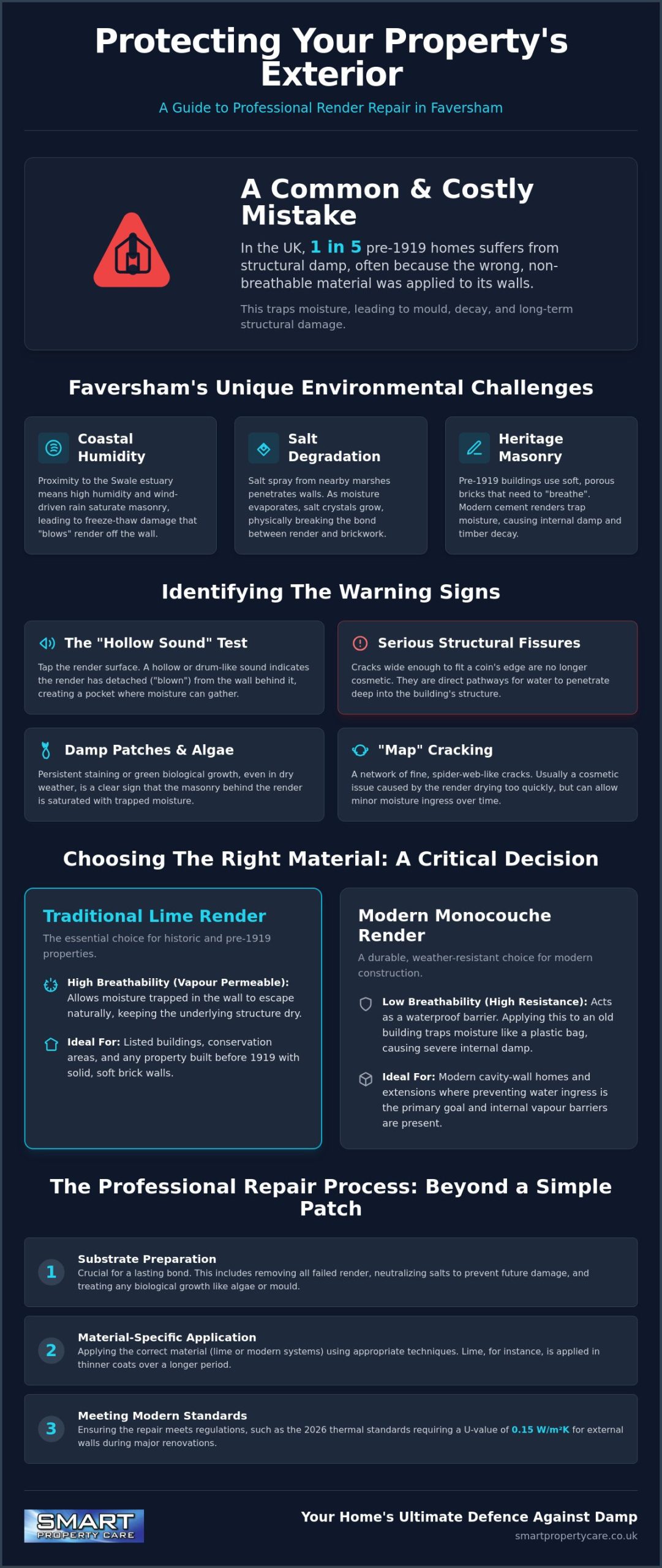
Faversham’s geographic position creates a specific set of challenges for property maintenance. The town sits alongside the Swale estuary, where high humidity levels and coastal winds ensure that masonry is frequently saturated. This moisture doesn’t just sit on the surface. It penetrates deep into the building fabric. When this water becomes trapped behind an External render, the structural health of the property is immediately at risk. The cycle of saturation followed by rapid temperature drops causes the water to freeze and expand. This internal pressure is what forces the render to “blow” or pull away from the substrate, creating the hollow patches often found during a professional rendering repair faversham assessment.
The architectural diversity of the town complicates these repairs. A Medieval timber-framed cottage on Abbey Street reacts differently to moisture than a Victorian terrace or a modern development near the outskirts. Each era used different masonry units and mortars. Applying a one-size-fits-all solution usually leads to failure. Modern renders are often too rigid for historic buildings, while traditional mixes may not provide the impact resistance needed for exposed modern builds. Understanding these nuances is the first step in creating a lasting shield for your home.
Coastal Exposure and Salt Degradation
Properties located near Faversham Creek or the surrounding marshes face the added threat of salt spray. Salt is a silent destroyer of masonry. When salt-laden moisture enters the pores of a brick, it eventually evaporates and leaves behind salt crystals. These crystals grow and expand with incredible force. This process, known as subflorescence, physically breaks the bond between the render and the wall. You may first notice efflorescence, which appears as white, chalky streaks on your exterior. This is a primary indicator that salt is moving through your walls. If left untreated, this leads to spalling, where the actual face of the brickwork begins to flake away, compromising the entire structural integrity of the wall.
The Heritage Factor: Faversham’s Historic Masonry
Faversham’s town centre is a protected conservation area for good reason. Its historic buildings were constructed using soft, porous, handmade bricks designed to breathe. These structures rely on the movement of moisture to stay dry. Using modern, non-breathable cement render on these properties is a critical mistake. It acts like a plastic wrap, sealing moisture inside the wall. This trapped dampness quickly migrates inward, causing mould growth and the decay of internal timber frames. For pre-1919 properties, breathability is the most vital technical requirement. Choosing the correct lime-based materials ensures that your rendering repair faversham project respects the building’s history while providing modern levels of protection.
Identifying the Warning Signs: When Does Render Need More Than a Patch?
Identifying the threshold between a cosmetic blemish and a structural threat is critical for any homeowner. While a minor hairline crack might seem insignificant, it often serves as the entry point for moisture that eventually compromises the entire facade. For those managing a rendering repair faversham project, distinguishing these signs early prevents the escalation of costs and protects property value. Visual cues provide the first line of evidence. Map cracking, which resembles a spider web across the surface, typically indicates that the render was applied too thickly or dried too quickly. While unsightly, it is the deeper, linear fissures that demand immediate attention. If a crack is wide enough to insert the edge of a coin, it’s no longer just a surface issue. It’s a path for water. Persistent staining, green algae growth, or damp patches that never seem to dry out even in summer suggest that the masonry behind the render is already saturated.
The Link Between Render and Penetrating Damp
External defects are almost always the root cause of internal moisture issues. Capillary action describes the physical process where liquid moisture is pulled through microscopic cracks in the render and into the porous masonry by surface tension, eventually saturating the internal plaster. This process bypasses the building’s natural defences. If you notice peeling wallpaper, salt tide marks on interior walls, or a musty odour, the exterior render has likely failed. In these instances, a professional damp survey is essential to pinpoint the exact breach before any remedial work begins.
Blown Render: The Hidden Danger
Blown render occurs when the bond between the coating and the wall breaks, creating an air pocket. You can identify these sections using a simple tapping test. Knock gently on the wall with your knuckles or a small wooden mallet; a solid wall produces a sharp “thud”, while blown render emits a distinctive hollow ring. These de-bonded sections are a significant safety risk. Large sheets of heavy render can detach without warning, causing injury or damaging property below.
Patching these areas is rarely a permanent solution. Because the surrounding render is often nearing the end of its lifespan, a patch creates a new joint that is prone to cracking. Beyond technical failure, matching textures and colours on aged surfaces is notoriously difficult. When dealing with period properties, these repairs must also comply with UK building regulations for historic homes to ensure the materials used are technically compatible with the original substrate. If your tapping test reveals multiple hollow zones, a more comprehensive rendering repair faversham project is usually the only way to restore full structural integrity. For total peace of mind, arranging a thorough inspection can help you decide between a targeted fix or a complete system upgrade.
Traditional Lime vs. Modern Monocouche: Choosing the Right Material
Selecting the correct material is the most technical decision in any rendering repair faversham project. Many homeowners mistakenly believe that cement is the strongest option for every wall. In reality, using modern cement on a pre-1919 property is a primary cause of damp. Cement is rigid and non-porous. It creates a seal that prevents water vapour from escaping. Over time, this moisture accumulates behind the render, leading to thermal bridging where cold spots on internal walls attract condensation and mould. Matching the repair material to the specific masonry of your Faversham home is the only way to ensure a lasting, dry result.
The Case for Lime Rendering in East Kent
Lime is the essential choice for Faversham’s heritage stock. Unlike cement, traditional lime render is vapour-permeable. It allows the building to breathe by drawing moisture out of the masonry and letting it evaporate into the air. This protects the delicate timber frames and soft bricks common in Abbey Street or the town centre. Lime is also naturally flexible. It can accommodate the subtle seasonal movements of an older building without cracking. Lime mortar is the gold standard for conservation projects because it preserves the structural longevity of historic masonry while providing a soft, authentic aesthetic.
Modern High-Performance Renders
For properties built after 1950 with cavity walls, modern systems like monocouche or silicone-based renders offer superior efficiency. Monocouche is a “one-coat” system that is through-coloured. This means the pigment runs through the entire depth of the material, so you won’t need to repaint it every few years. These materials are highly water-repellent but remain flexible enough to resist the hairline cracks that plague traditional cement. Silicone renders typically last 25 to 30 years if they are professionally applied and maintained.
If you’re looking to reduce energy bills, insulated rendering systems are becoming the standard in Kent. These systems can improve your home’s EPC rating by significantly reducing heat loss through external walls. With the 2026 standards requiring tighter U-values of 0.15 W/m²K for renovations involving more than 25% of a wall, an insulated render often provides the most compliant and cost-effective path forward. These systems don’t just fix cracks; they transform the thermal performance of your environment. Choosing a high-performance rendering repair faversham solution ensures your property remains efficient and structurally sound for decades.
The Professional Rendering Repair Process: Restoring Structural Integrity
Success in any rendering repair faversham project depends entirely on the standard of preparation. Simply applying a new layer over a failing substrate is a recipe for rapid de-bonding. A professional approach treats the facade as a technical system, ensuring the underlying masonry is stable, clean, and dry before the first scratch coat is even mixed. This disciplined methodology distinguishes a temporary cosmetic fix from a long-term structural restoration that protects your home for decades.
The process requires a deep understanding of how different materials interact with the local environment. We don’t just look at the surface; we examine the health of the wall itself. This involves identifying the root causes of failure, such as thermal movement or moisture ingress, and addressing them before the new render is applied. By following a rhythmic and logical sequence of preparation, treatment, and application, we ensure the finished result is both aesthetically perfect and technically resilient.
Step 1: Diagnostic Assessment and Stripping
We begin every project with a comprehensive diagnostic assessment. It’s vital to check for rising damp or existing salt contamination before applying new materials. If moisture is still rising through the wall or salt crystals are present in the brickwork, they will eventually push the new render off the wall. Precision is paramount during the stripping phase. We carefully remove only the blown or degraded sections, using specialized tools to avoid loosening healthy render or damaging the delicate brick faces beneath.
Once the substrate is exposed, we focus on decontamination. All moss, algae, and fungal spores are chemically treated with biocide. This ensures that biological growth won’t regenerate and compromise the bond from the inside out. We also apply salt-neutralising agents if the masonry has been exposed to coastal air, preventing future efflorescence from affecting the new finish.
Step 2: Re-Rendering and Protective Finishes
The application phase involves building up layers with calculated precision. We install high-grade stainless steel or PVC beading around windows, doors, and corners. This creates sharp, functional lines that direct water away from vulnerable joints and provides a clean, professional finish. To prevent future fissures, we embed alkali-resistant mesh into the base coat across high-stress areas like window reveals and floor levels. This mesh acts as a reinforcement, absorbing the thermal stresses that typically cause cracks in standard renders.
The final curing process is handled with care to account for the local Kentish climate. We ensure the render dries at a controlled rate, preventing it from becoming brittle or powdery. A final weather-sealing coat provides the ultimate defence against Faversham’s winter storms and salt-laden air. This comprehensive process transforms your property’s exterior into a resilient, waterproof shield. If you suspect your exterior walls are failing, you can request a specialist assessment to determine the most effective repair strategy for your home.
Why Specialist Rendering is the Ultimate Defence Against Damp
Choosing a specialist for your rendering repair faversham project provides more than just a fresh exterior. It delivers the peace of mind that comes from a 20-year legacy in property preservation. We don’t view rendering as a standalone cosmetic task. It’s a critical structural component that must work in harmony with your home’s masonry, timber, and ventilation systems. Our approach combines high-end craftsmanship with a deep understanding of building science. This ensures that every repair doesn’t just hide a problem but actively solves it. By integrating traditional carpentry and building skills, we address the root causes of decay, providing a holistic restoration that general contractors often overlook.
The Smart Property Care promise is built on precision, cleanliness, and local reliability. We understand the disruption that external works can cause to a busy household. That’s why our disciplined teams maintain an organized site and follow a logical, rhythmic workflow. We take immense pride in delivering a transformed environment that looks exceptional and performs flawlessly. Whether you’re restoring a period cottage or a modern townhouse, our expertise acts as a stress-reliever, ensuring your property remains a safe, dry, and valuable asset.
Beyond Aesthetics: The ROI of Quality Repair
Investing in professional rendering offers a significant return on investment that goes far beyond kerb appeal. A failing exterior is the primary gateway for moisture. By sealing these breaches, you prevent the internal saturation that leads to costly mould remediation and structural timber rot. In the competitive Faversham property market, buyers are increasingly savvy about structural health. They look for well-maintained exteriors as a sign of a home that’s been cared for correctly. Furthermore, with the 2026 thermal standards requiring better insulation, a high-performance render system significantly reduces heat loss, lowering your energy bills and improving your home’s EPC rating.
Your Local Faversham Preservation Partners
We are a family-run business with deep roots in East Kent. This local connection means we understand the specific challenges posed by the Swale estuary’s climate and the unique architectural fabric of our town. We don’t rely on industry stereotypes. Instead, we project an image of a modern, polished entity that maintains a personal, client-focused touch. We bridge the gap between traditional craftsmanship and modern technological solutions, ensuring your rendering repair faversham is executed to the highest professional standards. Don’t leave your home’s protection to chance. Book your specialist survey today to secure your property’s future and enjoy total peace of mind.
Securing the Longevity of Your Faversham Home
Protecting your property from the Swale estuary’s humidity requires more than a standard patch. We’ve explored how identifying blown render early and selecting the correct breathable materials prevents penetrating damp from compromising your structure. Whether you own a historic timber-framed cottage or a contemporary residence, your choice of facade treatment is its primary shield. Expertly executed repairs don’t just stop water; they improve thermal efficiency and safeguard the building’s value for the next generation.
Professional rendering repair faversham ensures your home meets modern thermal standards while preserving its architectural integrity. With over 20 years of local Kent experience, Smart Property Care Ltd provides precision in both traditional lime and modern high-performance renders. As comprehensive damp and timber preservation experts, we deliver technical solutions that restore your kerb appeal and structural health.
Secure your property with an expert rendering survey from Smart Property Care Ltd. Take the first step toward a dry, efficient, and beautifully restored home today.
Frequently Asked Questions
How much does rendering repair cost in Faversham for a typical terraced house?
Costs vary significantly based on the extent of the damage and the specific materials required for your property’s age. Factors such as scaffolding requirements, the removal of failed layers, and the choice between traditional lime or modern silicone all influence the final investment. Every home has different substrate needs, so a site-specific survey is the best way to determine the scope of work for your project.
Can I render over my existing damp walls to stop the moisture?
No, you shouldn’t apply new render over active damp. Doing so traps moisture within the masonry, which leads to “blown” patches and internal mould growth. You must identify and resolve the underlying cause, such as rising damp or a leaking pipe, before starting any rendering repair faversham project. Addressing the root cause first ensures the new finish remains bonded and effective for decades.
How long does a professional rendering repair job usually take?
A standard repair project usually takes between three and seven working days to complete. The exact timeline depends on the size of the area and the specific curing time required between different coats. Weather conditions in Kent also play a role, as heavy rain or extreme temperatures can delay the application of the final decorative finish.
Do I need planning permission for rendering my house in Faversham?
Most rendering work is considered Permitted Development and won’t require formal planning permission. However, Faversham contains several protected conservation areas and listed buildings where strict regulations apply. If your home falls into these categories, you’ll likely need consent from the local council to ensure the materials and colours respect the heritage environment. Professional rendering repair faversham services can help you navigate these local requirements.
Is it better to patch repair render or completely re-render the wall?
Patching is suitable for isolated impact damage, but a complete re-render is often necessary for widespread failures. If your walls produce a hollow sound when tapped, the bond has failed across a large section of the facade. A full re-render provides a seamless, waterproof barrier and prevents the mismatched textures and colours that often occur with multiple patch repairs.
What is the best time of year to carry out rendering repairs in Kent?
The months between April and September offer the most reliable conditions for external work. Successful curing requires consistent temperatures stay above 5°C and below 25°C. Avoiding the winter frost is essential, as freezing temperatures can cause wet render to crack or fail to bond correctly with the substrate before it has fully dried.
How do I know if my render is lime or cement-based?
You can often tell by the hardness and colour of the material. Cement render is typically grey, extremely hard, and brittle. Traditional lime is usually off-white or buff, feels slightly softer, and may crumble if scratched with a metal key. Identifying this correctly is vital, as lime is essential for pre-1919 homes to ensure the walls remain vapour-permeable.
Can rendering help reduce the energy bills in my Faversham home?
Yes, modern rendering systems significantly improve your home’s thermal performance. Applying an External Wall Insulation (EWI) system can reduce heating bills by 15% to 30%. These systems help your property meet the 2026 U-value standards, keeping your living environment warmer in the winter and much cooler during the summer months.