
That modern chemical injection you might consider for a standard house could be the very thing that irreparably damages your historic property’s timber frame. When it comes to damp proofing for listed buildings sandwich, the traditional “quick fix” often does more harm than good by trapping moisture within the fabric of the building. You have likely felt the frustration of recurring damp patches despite previous treatments, or perhaps you’re worried that the necessary repairs will lead to a complex legal battle with heritage officers.
We understand that owning a piece of Kent’s history comes with a unique set of responsibilities. You want a home that’s dry and healthy, but you must also protect its architectural integrity for future generations. This specialist guide will show you how to achieve both. Discover how sympathetic, breathable methods and reversible systems can solve your moisture issues while satisfying Dover District Council regulations. We’ll walk you through the process of securing Listed Building Consent, which is free to apply for, and explain why modern standards like BS 8102:2022 are vital for your peace of mind. By the end of this article, you’ll have a clear roadmap to a restored, compliant, and damp-free historic home.
Key Takeaways
- Learn why breathability is essential for medieval structures and how modern chemical barriers can inadvertently trap moisture.
- Identify specific defects like hygroscopic salt contamination to ensure your preservation strategy is both accurate and effective.
- Discover how specialist damp proofing for listed buildings sandwich uses reversible cavity drain membranes to meet strict heritage standards.
- Navigate Dover District Council regulations with confidence to ensure all work remains compliant with the Planning Act 1990.
- Benefit from the local heritage expertise of Smart Property Care Ltd to secure a permanent solution that protects your property’s long-term value.
The Challenge of Damp Proofing for Listed Buildings in Sandwich
Sandwich is a remarkable example of medieval urban planning. It’s home to one of the best-preserved medieval town centres in the UK. With nearly 18,000 listed properties across Kent, the second highest in England, the preservation of these structures is a serious responsibility. These historic homes weren’t built like modern houses. They rely on a philosophy of moisture management rather than total exclusion. By using porous materials like lime mortar and timber, these buildings were designed to “breathe.” This allows moisture to evaporate naturally from the surface of the walls.
Understanding Structural Damp is fundamental to recognizing why these historic systems fail when modern, non-porous materials are introduced. These modern “improvements,” such as cement renders or plastic-based paints, seal the building. They force moisture into the core of the walls where it can’t escape. Sympathetic damp proofing isn’t about adding barriers. It’s the precision restoration of these original moisture-management systems. It ensures your property remains dry while retaining its historic value.
The Sandwich Environment: Coastal and River Factors
The town’s geography as a historic Cinque Port presents unique challenges. Being close to the River Stour means dealing with a high water table. This environmental factor often leads to rising damp in the town’s traditional wattle and daub or brick structures. The local geology of East Kent further complicates moisture management. Coastal winds and driving rain also play a significant role, testing the resilience of every joint and surface. These factors require a specialist approach that understands the specific demands of the local Sandwich architecture.
Why Modern Chemical Injections Often Fail Historic Fabric
Standard industry practices, such as chemical injection damp proof courses, are often a disaster for listed properties. These injections create impermeable barriers that trap moisture behind the line of treatment. In ancient timber frames, this trapped water leads to accelerated decay and structural instability. Effective damp proofing for listed buildings sandwich requires a different approach that respects the building’s original design. Breathability is the ability of a building to transfer moisture from inside to out without damage. When we ignore this principle, we risk the very history we’re trying to protect. Choosing a craftsman who understands these nuances provides the peace of mind you need for your historic home.
Identifying Common Damp Defects in Sandwich’s Historic Homes
Sandwich contains some of the most significant timber-framed and brick structures in East Kent. While these buildings have stood for centuries, they face modern pressures that their original builders never anticipated. Effective damp proofing for listed buildings sandwich begins with a precise diagnosis. It’s easy to mistake hygroscopic salt contamination for active rising damp. These salts, often left behind by historic flooding or decades of chimney soot, pull moisture directly from the air. Treating this as a rising damp issue with a “quick fix” injection won’t solve the problem; it requires a deep understanding of the building’s chemical profile.
The town’s narrow medieval streets create a unique environmental microclimate. Water management is a constant battle. Blocked gutters or cracked cast-iron downpipes can saturate a wall in a single storm. In these tight urban spaces, splashback from passing traffic or overflowing rainwater goods often causes penetrating damp that mimics other defects. If you’re noticing tide marks or crumbling plaster, a specialist assessment is the first step toward a dry home.
Ground level changes are another frequent culprit in Sandwich. Over centuries, modern pavements and road surfaces have been layered on top of each other. This often results in external ground levels sitting significantly higher than the historic internal floors. This “bridging” allows moisture to bypass any existing damp course or saturate the base of timber frames. Left unchecked, these damp conditions provide the perfect environment for secondary issues like woodworm infestations or the rapid spread of dry rot.
Rising Damp vs. Penetrating Damp in Period Properties
Distinguishing between these two is critical for conservation. Rising damp typically leaves a distinct horizontal “tide mark” on lime-plastered walls or flint foundations. Penetrating damp is more localized, appearing after heavy rain near failed pointing or where external render has “blown” and detached from the brickwork. It’s essential to commission a professional damp survey to ensure you aren’t applying the wrong treatment to a delicate historic structure.
The Hidden Danger of Condensation in Listed Buildings
Modern living habits often clash with historic design. Cooking, bathing, and heating create high levels of internal humidity that original passive ventilation systems can’t always manage. In timber-framed properties, this moisture often settles in unventilated corners, leading to black mould growth. We focus on balancing your thermal comfort with the building’s need for constant airflow. This prevents condensation from settling on cold historic surfaces and causing long-term structural decay.
Sympathetic Solutions for Damp in Listed Buildings
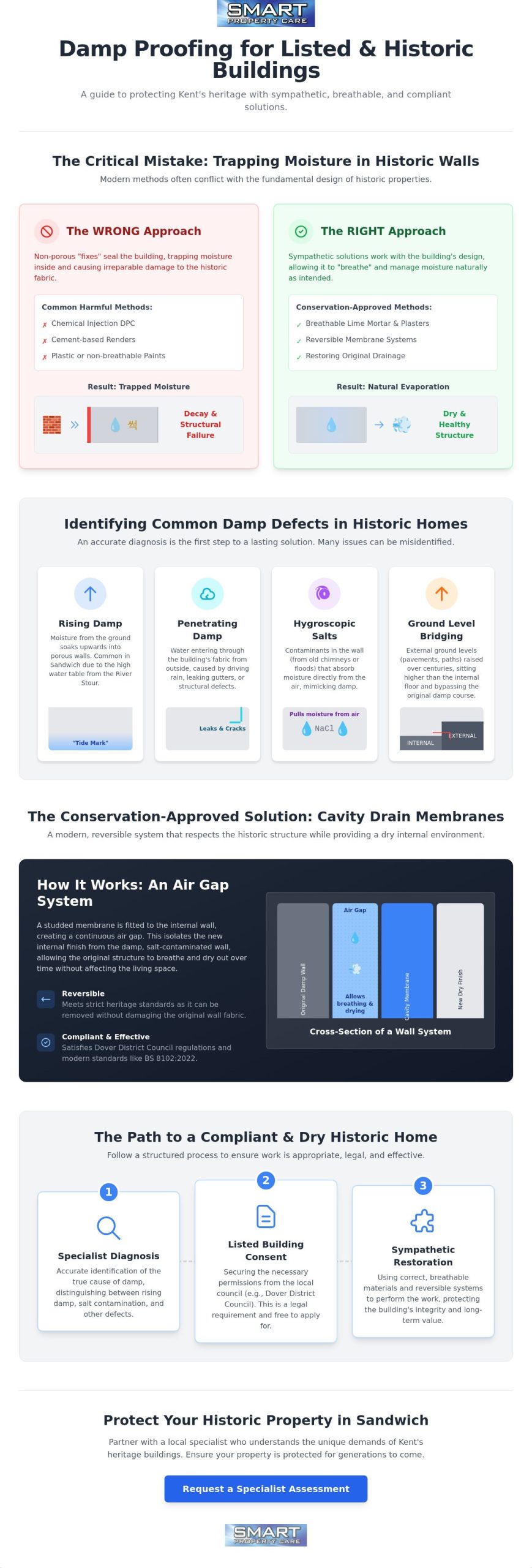
Protecting a medieval structure requires a shift in mindset. Instead of fighting moisture with impermeable barriers, we focus on managing it through sympathetic restoration. Effective damp proofing for listed buildings sandwich often involves reintroducing the very materials the original craftsmen used. By replacing hard cement renders with traditional lime mortars, we allow the walls to dry out naturally. This restoration of breathability is the most effective way to ensure the long-term health of Sandwich’s historic brick and timber.
When internal moisture management is required, cavity drain membranes offer a sophisticated, reversible solution. These systems satisfy heritage officers because they don’t require aggressive preparation of the historic fabric. The membrane creates a controlled gap between the damp wall and the new internal finish, allowing moisture to be managed and drained away without being trapped. This approach aligns with the latest conservation trends, providing a dry internal environment while preserving the structural integrity of the building.
We also look beyond the walls. Addressing the source of rising damp often means improving external drainage or lowering ground levels. In Sandwich, where modern pavements have risen over the years, creating a small trench or “French drain” can prevent water from bridging the historic damp course. This simple, non-intrusive adjustment often yields better results than any chemical treatment. It’s about working with the building’s existing geometry to redirect water away from the foundation.
Traditional Lime Rendering and Plastering
Lime is more than just an aesthetic choice; it’s a functional necessity. It acts as a sacrificial layer, drawing out moisture and salts to protect the underlying brick or stone. Our specialist plastering techniques ensure that the new finish is both salt-resistant and fully breathable. We take pride in matching the local vernacular of Sandwich, selecting the right aggregates and finishes to maintain the town’s unique visual character while providing a robust defense against moisture.
Mechanical Ventilation and Heat Recovery (MVHR)
Managing internal humidity is the final piece of the preservation puzzle. We can introduce mechanical ventilation and heat recovery (MVHR) systems subtly, ensuring they don’t interfere with historic windows or decorative features. Passive ventilation solutions also provide a low-impact way to maintain airflow. These systems work quietly to prevent the mould growth mentioned in earlier sections, balancing modern comfort with heritage requirements. By controlling the internal environment, we reduce the pressure on the historic fabric and ensure your home remains healthy and dry.
Navigating Listed Building Consent in Sandwich
Understanding the legal framework is just as critical as the physical restoration of your property. The Planning (Listed Buildings and Conservation Areas) Act 1990 governs every significant change you make to a protected home in Sandwich. Many owners assume that “like-for-like” repairs bypass the need for formal paperwork. However, Dover District Council often requires consent for any works that affect the character or historic fabric of the building. This includes most methods of damp proofing for listed buildings sandwich, especially those involving the removal of historic plaster or the addition of membranes.
A detailed damp and timber report is your strongest asset during this process. Rather than a generic proposal, a specialist report provides the Conservation Officer with an evidence-based strategy for remediation. This document demonstrates a deep respect for the building’s history and proves that the proposed works are necessary for its survival. Providing this level of detail upfront often simplifies the path to approval and builds immediate trust with local authorities.
When is Consent Required?
The line between general maintenance and “alteration” is often thin. While cleaning gutters is maintenance, replacing a large section of lime plaster with a modern alternative is an alteration that requires consent. Heritage officers in Sandwich frequently reject chemical injections because they are intrusive and non-reversible. The principle of reversibility is central to modern conservation. If a treatment can be removed in the future without damaging the original structure, it’s far more likely to receive the green light from Dover District Council.
Working with Dover District Council
Engaging with local heritage experts early in the process can save weeks of delays. Dover District Council offers a pre-application advice service that allows you to discuss moisture mapping and photographic surveys before you submit a formal application. This collaborative approach ensures your remediation strategy aligns with local heritage requirements from the start. It is a criminal offence to carry out alterations to a listed building, both internally and externally, without first obtaining Listed Building Consent from the local planning authority.
If you’re unsure about the requirements for your specific property, contact our specialist team for professional guidance on heritage compliance.
Why Choose a Local Specialist for Sandwich Property Preservation?
Smart Property Care Ltd is a family-run business with over 20 years of experience dedicated to the preservation of East Kent’s architectural heritage. National franchises often lack the specific, grounded knowledge required for the medieval structures found in our town. We possess a deep understanding of Sandwich’s specific building stock, having worked on everything from the historic Guildhall to the intricate private residences that line the narrow medieval streets. Our “Expert Craftsman” philosophy combines modern diagnostic precision with the traditional building skills passed down through generations. This allows us to provide comprehensive protection, encompassing everything from woodworm treatment to the complex structural repairs necessitated by centuries of river-side exposure.
Our Specialist Damp Survey Process
A successful project begins with an accurate diagnosis. We utilize a non-invasive survey process designed specifically for sensitive historic surfaces. By employing thermal imaging and advanced moisture monitoring, we can see behind the fabric of the building without disturbing a single original timber. This technology helps us identify the root cause of moisture, such as hidden leaks or thermal bridging, rather than just treating the symptoms on the surface. We then provide a clear, costed specification that respects your budget while strictly adhering to the heritage guidelines we’ve outlined. This level of detail ensures that your damp proofing for listed buildings sandwich is both effective and legally compliant.
Peace of Mind for Sandwich Homeowners
Owning a listed building should be a source of pride, not a constant worry. We offer long-term protection that preserves the structural integrity and future resale value of your home. Our service is designed to be as non-disruptive as possible. We maintain a clean, professional site, treating your historic property with the immense respect it deserves. We take pride in our punctuality and our disciplined approach to craftsmanship. This commitment to quality makes us a dependable partner for any preservation project in the town. Contact us today for a sympathetic, expert approach to your listed building’s needs and enjoy the reassurance that comes from working with a local specialist who truly understands Sandwich architecture.
Securing the Future of Your Historic Home
Protecting a listed property in Sandwich requires more than just stopping water. It’s about restoring a delicate balance of breathability and structural health. By choosing sympathetic, reversible methods like lime-based materials and cavity drain membranes, you ensure your home remains dry while strictly adhering to Dover District Council regulations. We’ve explored how a professional diagnosis differentiates between simple maintenance and critical structural defects, giving you the clarity needed to proceed with confidence.
Specialist damp proofing for listed buildings sandwich is a task for craftsmen who respect the town’s unique architecture. With over 20 years of local experience in Kent, our PCA-trained specialist surveyors bring deep expertise in traditional lime plastering and heritage preservation to every project. We don’t just treat symptoms. We provide permanent, compliant solutions that safeguard your property’s value and history. Your home is a piece of history. We’re here to help you protect it.
Book a Specialist Damp Survey for Your Listed Building today and enjoy the peace of mind that comes from expert care.
Frequently Asked Questions
Can I use a standard damp proof course on a Grade II listed building in Sandwich?
You should avoid standard chemical injection damp proof courses on Grade II listed buildings. These modern treatments are often rejected by heritage officers because they create impermeable barriers that can cause moisture to build up in historic fabric. Instead, we focus on restoring breathability through traditional materials or using reversible cavity drain membranes that satisfy strict conservation requirements while protecting the structure.
How much does a specialist damp survey cost for a listed property?
The cost of a specialist damp survey varies depending on the size and architectural complexity of your historic home. Each survey involves non-invasive moisture mapping and thermal imaging to ensure we identify the root cause of the issue without damaging sensitive surfaces. We provide a detailed, costed specification following the site visit, ensuring you have a clear understanding of the necessary preservation works.
Do I need planning permission for damp proofing in a conservation area?
You will likely need Listed Building Consent for damp proofing for listed buildings sandwich, even if you don’t require full planning permission. Sandwich is covered by an Article 4(2) Direction, which removes many permitted development rights to protect the town’s character. Since unauthorized work on a listed building is a criminal offence, you must consult with Dover District Council heritage officers before starting any remedial treatments.
What is the best way to treat rising damp in a timber-framed house?
The most effective way to treat rising damp in a timber-framed house is to manage the external environment and restore breathability. We often lower external ground levels to prevent water from bridging the historic frame and replace modern cement renders with traditional lime mortar. This allows moisture to evaporate naturally, protecting the ancient timber from the decay and fungal issues mentioned earlier in this guide.
Will damp proofing affect the value of my listed property?
Correct, sympathetic damp proofing significantly enhances the value and longevity of your listed property. Conversely, using modern non-breathable materials can lead to structural damage that devalues the home and complicates future sales. A dry, well-maintained historic home with a clear record of heritage-compliant repairs provides immense peace of mind for prospective buyers and surveyors who understand the importance of proper maintenance.
How long does sympathetic damp treatment take to dry out?
Sympathetic damp treatments generally require one month of drying time for every inch of wall thickness. Because we use breathable materials like lime, the wall continues to release moisture naturally even after the surface appears dry. We monitor the moisture levels throughout this period to ensure the structural fabric has stabilized before any final decorative finishes are applied, ensuring a high-quality and lasting result.
Is lime plaster better than modern gypsum for damp walls?
Lime plaster is vastly superior to modern gypsum for historic walls because it is porous and allows moisture to pass through. Gypsum is an impermeable material that can cause dampness to build up behind the plaster, leading to mould growth and timber decay. Using lime ensures your walls can breathe, maintaining the natural moisture-management system designed into Sandwich’s medieval structures centuries ago.
Can I install a basement tanking system in a listed cellar in Sandwich?
You can install a basement waterproofing system in a listed cellar, provided it uses a reversible cavity drain membrane. Modern cementitious tanking is usually rejected because it is permanent and can trap water against the historic brickwork. A membrane system complies with British Standard 8102:2022 and manages water ingress without altering the original structural fabric, making it a preferred choice for damp proofing for listed buildings sandwich.