
With an estimated 1.3 million households currently living in damp conditions across the UK, the threat to your property’s structural integrity is more than just a surface issue. For homeowners in Dover, the unique coastal climate and historic architecture often accelerate the spread of rising moisture. This makes a professional damp proof course injection dover essential for those who want to stop the cycle of recurring mould and crumbling walls. If you’ve spent years on quick fixes, you know that temporary solutions don’t work. You deserve the peace of mind that comes with a dry, healthy environment and a home that stands strong against the elements.
We understand the frustration of seeing expensive repairs undermined by persistent moisture. This article demonstrates how a specialist DPC injection provides a definitive barrier against groundwater. You’ll discover how we combine high-performance chemical technology with specialist salt-management plastering to restore your internal walls permanently. We’ll also explain the technical standards you should expect, including why British Standard BS6576 is the essential benchmark for your property’s protection. By the end of this guide, you’ll have a clear, jargon-free roadmap to a restored and moisture-free home.
Key Takeaways
- Understand why Dover’s coastal climate and historic Victorian terraces create a unique risk for masonry decay and rising moisture.
- Learn how a professional damp proof course injection dover utilizes advanced silane creams to establish a permanent, water-repellent barrier.
- Compare modern injection techniques against traditional “cut-in” methods to find the most efficient and least disruptive solution for your home.
- Discover why specialist plastering is the essential final step to prevent hygroscopic salts from causing secondary damp problems.
- Gain a clear understanding of the full restoration process, from specialist moisture mapping to the final application of salt-resistant renders.
Rising Damp in Dover: Why Coastal Properties are at Unique Risk
Dover’s streets are lined with beautiful Victorian and Edwardian terraces, yet these historic properties face a relentless battle against environmental moisture. The town’s direct exposure to the English Channel creates a harsh maritime climate where salt-laden air constantly penetrates porous masonry. This aggressive environment accelerates the decay of traditional lime mortars and soft red bricks. In many older Kentish homes, the original damp-proof course (DPC), often constructed from slate or bitumen, has simply reached the end of its functional life. Once this physical barrier becomes brittle or cracks under the settlement of the building, groundwater begins its steady, destructive climb through the wall structure.
Modern property maintenance often unintentionally worsens these historic issues. We frequently encounter homes where the installation of new block-paving, high-level patios, or raised garden beds has effectively “bridged” the original damp-proof line. This creates a direct path for moisture to bypass old defenses, leading to saturated internal plasterwork and a cold, unhealthy living environment. When the original barrier is compromised, a professional damp proof course injection dover provides the necessary chemical shield to stop capillary rise and protect your home’s structural integrity permanently.
Dover’s Historic Architecture and Damp Vulnerability
Dover’s historic town centre features a high density of solid brick construction. Unlike modern cavity walls, these solid structures provide a continuous path for moisture to travel upward through capillary action. The chalky soil prevalent in the region acts as a natural reservoir, constantly feeding groundwater into the base of your home. Homeowners often attempt to hide the damage with waterproof paints or “quick-fix” solutions. These products are counterproductive; they trap moisture within the masonry, leading to accelerated brick spalling and structural weakening. A professional injection system addresses the root cause rather than just masking the symptoms.
Identifying Rising Damp vs. Penetrating Damp in Dover
Accurate diagnosis is the first step toward a dry home. Rising damp typically reveals itself through a distinct “tide mark” on ground-floor walls, usually stopping around one metre in height. This is often accompanied by white, powdery salt deposits that bubble the paintwork. In a coastal environment like Dover, it’s easy to confuse this with penetrating damp caused by wind-driven sea spray or failing rainwater goods. To avoid wasting money on the wrong treatment, it’s essential to book a professional damp survey. This allows us to map moisture profiles and ensure a specialist injection is the correct remedy for your property.
The Science of Damp Proof Course (DPC) Injection
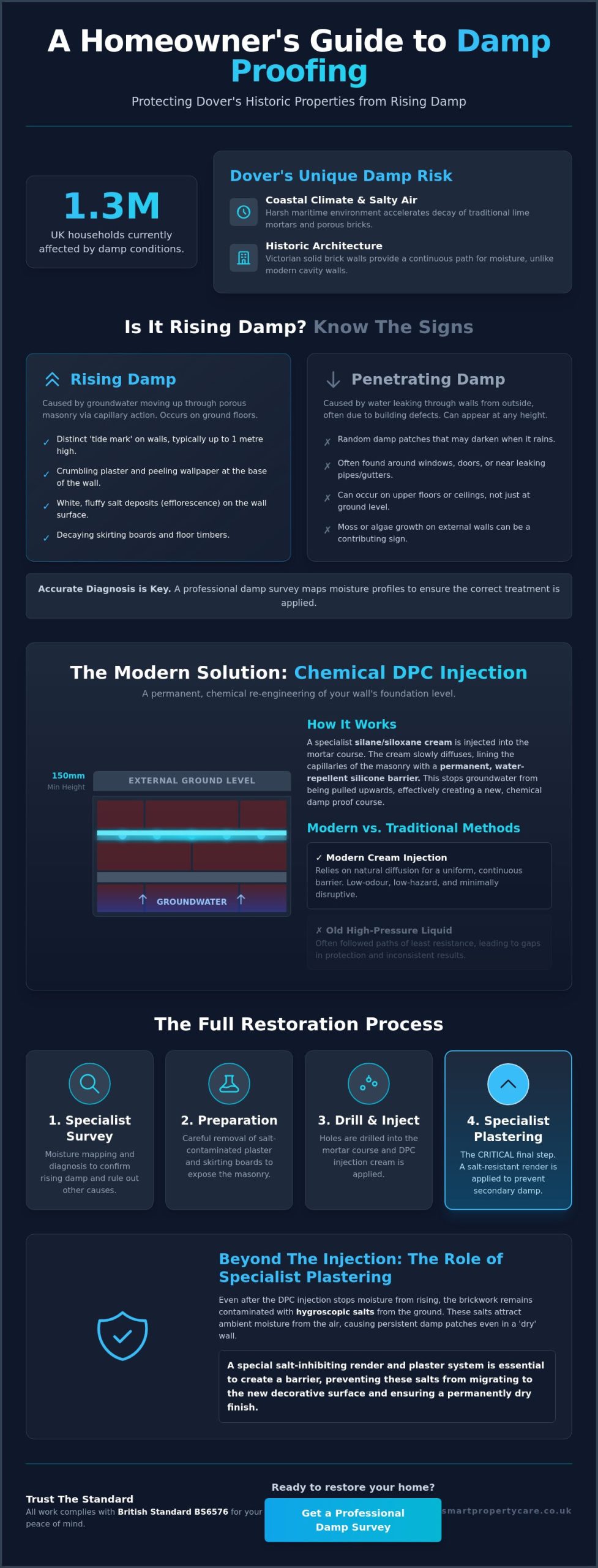
A professional damp proof course injection dover is not merely a repair; it’s a chemical re-engineering of your home’s foundation level. At its core, DPC injection involves introducing a concentrated water-repellent cream into the mortar bed of a wall. This substance migrates through the porous structure, lining the capillaries with a hydrophobic silicone resin. This process stops groundwater from being pulled upwards by surface tension. According to Part C of the Building Regulations, a damp proof course must be installed at least 150mm above the finished ground level to remain effective. Our modern injection methods ensure this barrier is uniform and permanent.
Historically, technicians used high-pressure liquid injections to force chemicals into the masonry. This method often led to inconsistent results, as the liquid followed the path of least resistance, leaving gaps in protection. Modern property preservation has shifted toward silane-based creams. These formulations rely on natural diffusion. Once we inject the cream into pre-drilled holes, it slowly spreads through the mortar joint before curing. This creates a continuous waterproof layer that withstands the high-moisture pressures common in Dover’s coastal environment.
Silane vs. Siloxane: Modern Chemical Barriers
We use high-performance silane and siloxane blends because of their superior molecular bonding capabilities. These chemicals are solvent-free and low-odour, making them ideal for occupied residential properties in Dover. Unlike older solvent-based liquids, these creams bond directly with the silicates in the masonry. This creates a durable shield that won’t degrade over time. It’s a high-end solution for homeowners who value longevity. If you’re concerned about the health of your property, our damp proofing specialists can assess which formulation is best for your specific brick type.
Pressure Injection vs. Hand-Injected Creams
The transition to hand-injected creams has revolutionized the industry. Pressure injection is now rarely used because it carries the risk of masonry damage or “blowouts” in older, fragile walls. Hand-injection allows for much greater precision. We saturate every centimetre of the mortar joint, ensuring there are no weak points for moisture to exploit. While some minor damp treatments might not require formal oversight, significant structural damp proofing should always be checked against current building regulations approval standards. This ensures your home remains safe, dry, and compliant with modern safety benchmarks.
Comparing DPC Injection to Traditional Damp Proofing Methods
Historically, property owners faced a difficult choice when their original slate barriers failed. You could either opt for physical replacement or hope that surface treatments would suffice. Physical DPC replacement, often called the ‘cut-in’ method, is an invasive procedure. It requires the removal of entire brick courses to slide in a new plastic membrane. For the delicate Victorian masonry found across Dover, this process presents significant structural risks and immense disruption. In contrast, a modern damp proof course injection dover is a surgical intervention. We treat the problem from within the mortar joint, preserving the original brickwork while delivering a high-performance barrier.
DIY surface treatments and ‘damp-proof’ paints are frequently marketed as easy fixes. These products are fundamentally flawed. They create a non-breathable skin that traps moisture inside the wall. This leads to the very masonry decay and timber rot you’re trying to avoid. Professional chemical injection is the industry standard because it allows the wall to breathe while blocking liquid water from rising. It’s the preferred method for occupied homes in Kent because it avoids the dust, noise, and structural instability associated with traditional mechanical damp proofing.
Why Injection is the Most Cost-Effective Solution
Choosing injection is the most cost-effective path for Kent homeowners. Physical membrane insertion involves extensive labour and structural supports, which drives up project costs. Our injection process is swift and precise. It minimizes time on site and reduces the need for heavy machinery. This efficiency doesn’t come at the expense of quality. When executed by an expert craftsman, a chemical DPC is backed by long-term efficacy, often supported by 20-year guarantees. It’s a premium investment that secures your property’s value and ensures your living environment remains healthy.
When Injection Might Not Be Enough
There are instances where an injection alone isn’t a complete cure. If your external paving or garden soil sits above the DPC line, you have a ‘bridging’ problem. Moisture will simply jump over the new barrier. We also look for external defects like leaking gutters or cracked rendering. These issues often cause penetrating damp, which can mimic the symptoms of rising damp. A truly professional solution addresses these environmental factors alongside the injection to ensure your home stays dry from every angle. We take pride in identifying these secondary factors before they undermine your primary damp proofing efforts.
The Step-by-Step DPC Injection Process for Dover Homeowners
A successful restoration relies on a disciplined, systematic approach. We don’t simply arrive and start drilling; we follow a rigorous professional sequence designed to ensure the structural integrity of your property. Our technicians operate with the precision of expert craftsmen, ensuring every stage of the damp proof course injection dover is executed to the highest industry standards. This methodical process transforms a damp, failing wall into a dry, healthy environment.
The standard professional process involves five critical stages:
- Specialist Survey: We begin by mapping moisture profiles and identifying the exact extent of salt contamination within your masonry.
- Plaster Removal: We remove all salt-contaminated internal plaster, typically to a height of one metre, to prevent residual moisture issues.
- Precision Drilling: Our team drills the mortar course at the correct structural level, adhering to the 150mm above-ground-level rule.
- Chemical Injection: We introduce high-performance silane/siloxane cream into the prepared holes to create the hydrophobic barrier.
- Specialist Re-plastering: Finally, we apply salt-resistant renders to manage any residual moisture trapped within the wall core.
Preparation and Drilling: Precision is Key
Determining the lowest accessible mortar course is the most vital step in the preparation phase. If the injection is too high, moisture will continue to bypass the barrier; if it’s too low, the ground might bridge it. We maintain strict hole spacing, usually every 100mm to 120mm, to ensure the chemical cream overlaps and forms a continuous shield. We understand that your home is a sanctuary, not a construction site. Our team uses industrial dust extraction systems to manage debris, ensuring your living space remains clean and protected throughout the installation.
The Injection and Curing Phase
Once we’ve prepared the masonry, we inject the silane-based cream. This substance begins as a thick paste but soon transforms into a vapour-permeable barrier. It migrates through the mortar joints, bonding with the silicates in the brickwork. In Dover’s humid coastal climate, curing times can vary, but the chemical barrier typically establishes itself within 24 to 48 hours. However, the wall itself must then “dry out.” This is a natural process that can take several months, as the trapped moisture evaporates now that the supply from the ground is cut off. If you’re ready to secure your property’s future, contact our damp proofing specialists for a comprehensive technical assessment.
Beyond the Injection: Why Specialist Plastering is Essential
Completing a damp proof course injection dover is a significant milestone, but it’s only half of the restoration process. While the chemical barrier stops new groundwater from rising, the masonry behind your skirting boards remains saturated with hygroscopic salts. These compounds, primarily nitrates and chlorides, are “moisture-hungry.” They possess a unique ability to pull water vapour directly from the air. If you ignore these salts and apply standard gypsum plaster, your walls will continue to look damp and stained regardless of how effective the new DPC is. This phenomenon is known as the ‘Salt Trap,’ and it’s the most common reason for damp proofing failure in coastal properties.
We solve this problem through high-end specialist plastering. Our technical specifications involve the application of salt-retardant renders designed to block these minerals from reaching your wall surface. This isn’t a standard building trade task; it’s a precision preservation service. By using advanced additives and breathable renovation plasters, we ensure your internal environment remains dry while allowing the underlying structure to release its residual moisture safely. This dual-action approach is what distinguishes a professional restoration from a temporary patch-up.
The Role of Salt-Retardant Renders
Our craftsmen use specific rendering specifications that far exceed the performance of traditional sand and cement. While standard mixes can be brittle and prone to cracking, our renovation plasters incorporate specialist additives that prevent salt migration. These materials are engineered to be vapour-permeable. This means they allow the wall to breathe while providing a robust, salt-proof barrier. The result is a smooth, high-quality finish that provides the perfect substrate for redecoration without the risk of future efflorescence or bubbling paintwork.
Redecoration Timelines: Patience for Permanent Results
Patience is vital for a successful outcome. Even after a specialist damp proof course injection dover, the wall core needs time to dry out naturally. We recommend waiting at least four to six weeks before applying any temporary decoration. During this period, you must use breathable, water-based matt emulsion. Never use vinyl silk or stay-white paints, as these create a plastic skin that traps moisture and causes the new plaster to “blow.” Once the wall has fully equilibrated, you can proceed with your final high-end finishes with total confidence. To ensure your property receives this level of professional care, Book your Dover damp survey today and take the first step toward a permanently dry home.
Securing Your Dover Home for the Future
Protecting a coastal property requires more than just masking moisture. It demands a technical solution that addresses both the groundwater rise and the residual salt contamination. By choosing a professional damp proof course injection dover, you’re investing in a permanent barrier that respects the structural integrity of your historic masonry. This dual approach of chemical shielding and specialist plastering ensures your home remains dry, healthy, and structurally sound for decades to come.
Smart Property Care Ltd brings over 20 years of local experience to every project across East Kent. As Checkatrade-rated specialists with a 9.96/10 score, we take immense pride in our high-end craftsmanship and reliable service. All our remedial works come with long-term guarantees, providing you with absolute peace of mind. Don’t let rising moisture compromise your property’s value or your family’s health. Book a Specialist Damp Survey in Dover today to begin your home’s professional restoration. We look forward to helping you reclaim your environment.
Frequently Asked Questions
How long does a damp proof course injection last?
A professional damp proof course injection dover typically provides a permanent solution that lasts for the lifetime of the masonry. We utilize high-performance silane creams that bond at a molecular level with the brickwork to create a durable, hydrophobic barrier. Most specialist treatments are supported by a 20-year guarantee, ensuring your home remains protected against groundwater rise for the long term.
Is DPC injection messy and will it damage my walls?
DPC injection is a precise, surgical procedure designed to minimize disruption to your home. While the drilling process generates some dust, we use industrial extraction systems to keep your living environment clean. The most significant phase involves removing salt-contaminated plaster, but our team manages this with care, protecting your floors and furniture throughout the entire restoration project.
Can I stay in my Dover home while the work is being done?
You don’t need to vacate your property during the installation. The work is localized to the ground floor and typically executed room by room to minimize interference. While you’ll experience some noise during the drilling and plaster removal phases, our technicians work efficiently to ensure your daily routine remains as undisturbed as possible.
Why do I need to remove my plaster if the injection is in the brickwork?
Plaster removal is essential because of hygroscopic salt contamination. Even after a successful damp proof course injection dover, old plaster remains saturated with nitrates and chlorides that pull moisture from the air. Replacing this with our salt-retardant renders is the only way to prevent damp patches from reappearing on your newly treated walls.
How much does damp proof course injection cost in Dover?
The cost depends entirely on the linear meterage of the walls and the specific masonry type of your property. Every home in Dover is unique, especially our historic coastal terraces and Victorian villas. We recommend booking a specialist survey to provide a technical assessment tailored to your home’s specific requirements rather than relying on generic industry estimates.
Does DPC injection work on flint or stone walls common in Kent?
Yes, chemical injection is effective for Kent’s traditional stone and flint properties. In these cases, we inject the silane cream directly into the continuous mortar courses. This ensures the chemical barrier spreads effectively through the bed joints, providing a reliable shield even in the irregular wall structures often found in Dover’s older buildings.
Will DPC injection stop mould from growing on my walls?
DPC injection addresses rising damp, which is a primary catalyst for mould growth. By drying out the wall structure, we remove the moisture source that mould thrives on. If your mould issues are caused by condensation rather than groundwater, our specialists may recommend additional measures from our condensation control or mould remediation services.
What guarantee do I get with Smart Property Care Ltd’s DPC treatments?
We provide long-term remedial guarantees on all our DPC installations. This commitment reflects our confidence in our high-end craftsmanship and the premium silane/siloxane materials we use. You can have total peace of mind knowing that your property is being restored by disciplined experts who prioritize quality and lasting structural integrity.