
That expensive chemical injection you were recently quoted might be the very thing trapping moisture inside your masonry. Victorian houses in Faversham don’t typically have a damp problem; they have a breathing problem caused by the use of modern, impermeable materials. You’ve likely felt the stress of conflicting advice while worrying about structural rot in your suspended timber floors, especially given the high humidity levels common in East Kent. It’s an urgent issue to resolve, as 5% of English dwellings now report significant damp problems, the highest rate in five years.
We believe your home deserves a restoration that respects its heritage while ensuring your peace of mind. You’re about to discover how to fix damp in a victorian house Faversham by identifying root causes and applying bespoke, breathable treatments. We will examine the meticulous use of lime mortar, explain how 2026 regulations like Awaab’s Law influence modern standards, and provide a transparent look at costs, including the average £300 survey and the £1,358 typically required for specialist lime plastering in the local area. This guide provides the clear, authoritative roadmap you need to achieve a dry, healthy, and beautifully preserved home.
Key Takeaways
- Master the physics of Victorian solid-wall construction to understand why modern impermeable materials often exacerbate moisture issues in East Kent’s coastal climate.
- Discover the specific technical steps of how to fix damp in a victorian house Faversham by restoring essential sub-floor ventilation and clearing original air bricks.
- Identify the distinct characteristics of rising damp tidemarks versus penetrating moisture caused by external defects like failed rendering or faulty chimneys.
- Evaluate the meticulous application of traditional lime rendering against modern chemical DPC injections to ensure a breathable, moisture-free living environment.
- Secure long-term peace of mind by learning how professional diagnostics and insurance-backed guarantees protect your property’s historic architectural features.
Why Victorian Homes in Faversham are Prone to Damp
Victorian architecture defines Faversham’s historic charm, yet many owners struggle with persistent moisture. Unlike modern builds featuring cavity walls designed to act as a barrier, Victorian properties rely on solid masonry. These walls function as a thermal mass that manages moisture through absorption and evaporation. When this cycle is interrupted, structural issues arise. Understanding Structural Damp is the first step in identifying why these historic buildings behave differently than 21st-century constructions. While modern homes use plastic membranes to keep water out, Victorian houses were built to be porous.
The “Breathing” Concept of Period Properties
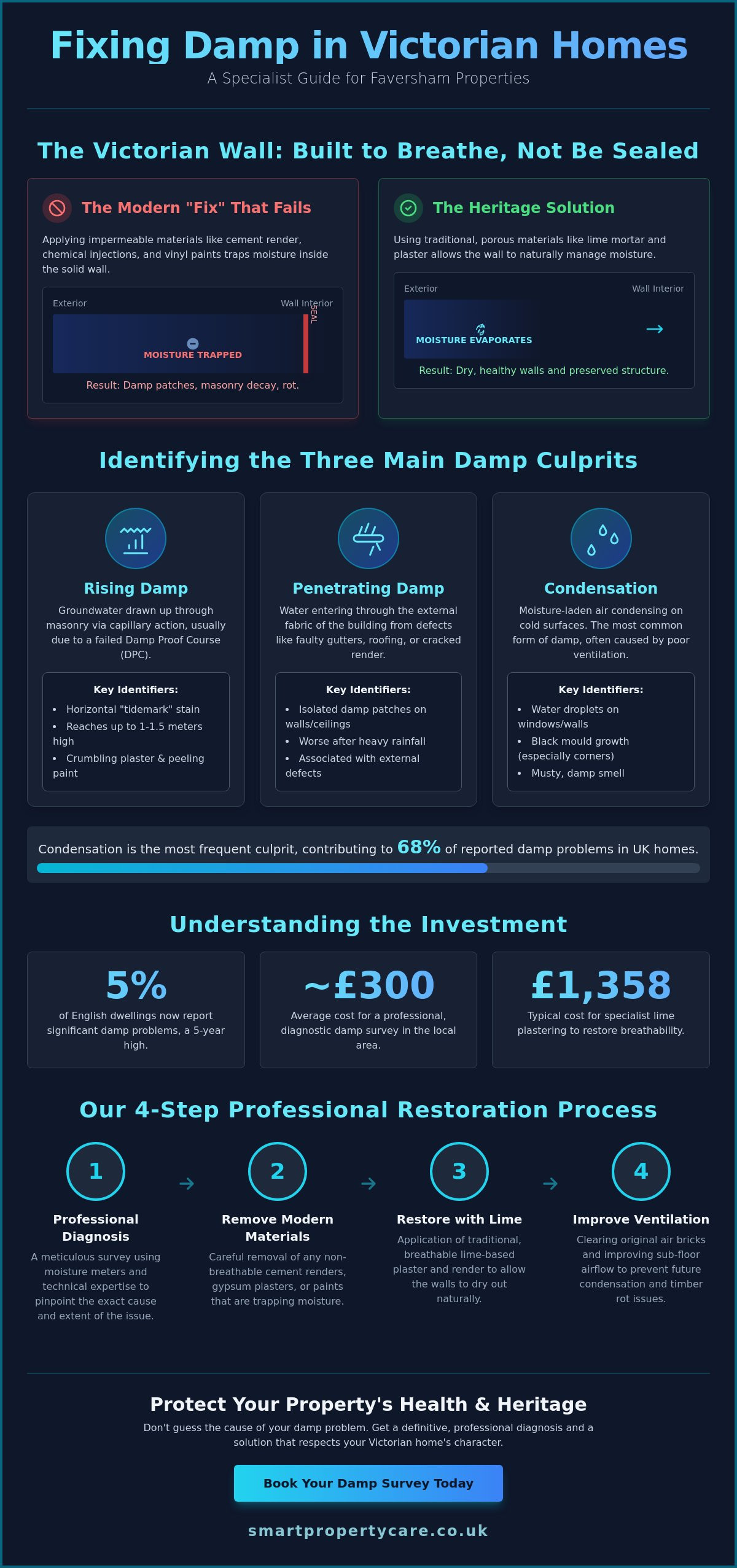
Victorian bricks and lime mortar are porous by design. They allow moisture to travel through the wall and evaporate away naturally. We call this “breathability.” According to BS 7913:2013, breathability is defined as the ability of a material to allow moisture to move through it in a liquid or vapor state without causing damage to the structure. Problems occur when modern improvements like cement-based renders or non-breathable vinyl paints are applied. These materials create an impermeable seal. Moisture becomes trapped behind the surface, leading to internal damp patches and masonry decay. Learning how to fix damp in a victorian house Faversham often starts with removing these restrictive modern layers to restore the building’s natural equilibrium.
Faversham Specifics: Geography and Architecture
Faversham’s unique geography presents specific challenges. Properties near Faversham Creek or the town centre often sit on ground with a high water table. This proximity to water increases the risk of rising damp, as moisture is drawn up into the solid brickwork through capillary action. The coastal humidity of East Kent adds another layer of complexity. Salt-laden air can penetrate external brickwork, attracting further moisture from the atmosphere. In 2023, data indicated that 30% of Victorian-era properties suffered from deteriorating brickwork or roofing, a figure that remains high in exposed Kentish towns.
Suspended timber floors are also common in Faversham period homes. These require constant airflow through air bricks to prevent the build-up of humidity. If these vents are blocked or ground levels have been raised over the decades, the sub-floor environment becomes a breeding ground for woodworm and dry rot. It’s vital to maintain these systems for the health of the property. Our meticulous restoration approach focuses on these bespoke local factors to ensure a dry, healthy home for every client.
Identifying the Three Main Damp Culprits
Accurately diagnosing the source of moisture is the first step in protecting your property’s structural integrity. Misidentifying the cause leads to wasted investment and continued decay. Whether it’s groundwater rising through masonry or condensation forming on cold surfaces, each issue requires a bespoke approach. In 2023, 5% of dwellings in England reported damp problems, and without a clear diagnosis, your home could remain part of that statistic. Knowing how to fix damp in a victorian house Faversham begins with recognizing these three distinct threats.
Rising damp typically manifests as a horizontal “tidemark” on ground floor walls, often reaching up to one metre in height. This occurs when the original damp proof course fails; a common issue considering over 60% of Victorian homes still rely on their original, deteriorating barriers. Penetrating damp is different, caused by external defects like leaking gutters, faulty chimneys, or porous brickwork. In Faversham, the salt-laden coastal air can accelerate the degradation of external mortars, making walls more susceptible to water ingress. Finally, condensation is the most frequent culprit, contributing to 68% of reported damp problems and acting as the primary driver for black mould growth. Because these symptoms often overlap, booking a damp survey is the only way to be certain of the cause before beginning repairs.
Rising Damp vs. Penetrating Damp: How to Tell
Distinguishing between these two requires a meticulous eye. Rising damp is usually continuous along a wall’s base, while penetrating damp appears as isolated patches that darken after heavy Kentish rainfall. You can use a “touch test” to feel for localized cold spots, but a professional moisture meter provides the only definitive proof. Look closely at your external ground levels. In many Faversham terraces, modern landscaping or high flower beds have inadvertently buried original air bricks, choking the sub-floor ventilation and forcing moisture into the internal walls.
The Role of Hygroscopic Salts
When groundwater rises, it carries hygroscopic salts into the brickwork and plaster. These salts are chemically attracted to moisture and will continue to pull water from the atmosphere even after a leak is stopped. Standard gypsum plaster acts like a thirsty sponge for these salts, drawing moisture from the air and remaining damp even when the primary source of ingress is resolved. To permanently fix the issue, specialist plastering is required to replace the contaminated materials with salt-retardant alternatives. If you’re unsure which culprit is affecting your home, we offer a free, no-obligation quote to help you find the most effective solution for your property.
Fixing Damp: Modern Chemical DPC vs. Traditional Lime Methods
Choosing the right remediation strategy is a critical decision for any period property owner. In Faversham, the debate often centres on whether to use modern chemical injections or return to traditional building techniques. While some contractors suggest that a chemical damp proof course is the only solution, the reality is more nuanced. Understanding how to fix damp in a victorian house Faversham requires a balanced view that respects the original architecture while utilising 2026 technology where appropriate. Approximately 60% of Victorian homes still rely on their original, failing barriers, making a modern intervention sometimes necessary to prevent structural decay.
Our approach at Smart Property Care involves a hybrid strategy. We combine high-end craftsmanship with certified technical solutions. For many homeowners, this means a blend of restoring the building’s natural breathability and installing targeted waterproofing systems in high-risk areas like cellars near the Creek. This meticulous method ensures the property remains dry without compromising the historic character of the Kentish brickwork.
The Case for Chemical Injection
Modern silane-based cream injections are highly effective when applied correctly to compatible masonry. We inject these specialised creams into the mortar joints to create a new, water-repellent barrier. This process typically costs between £70 and £120 per linear metre. However, the injection alone is rarely enough. It must be paired with specialist salt-neutralising plastering to manage the hygroscopic salts discussed in the previous section. This treatment is particularly suitable for later Victorian terraces where the bricks are dense enough to handle the process without crumbling, providing a seamless and long-lasting solution.
Why Traditional Methods Often Win
Traditional methods focus on moisture management rather than total exclusion. Repointing external walls with lime mortar allows trapped water to evaporate freely, preventing the internal damp patches common in Faversham homes. This is often the most effective way to protect soft, handmade Victorian bricks. In the local area, the average cost for specialist lime plastering is £1,358, reflecting the high level of skill required for this bespoke finish.
Sometimes, the most effective “fix” isn’t a product at all, but a structural adjustment. Lowering external ground levels that have crept above the original damp proof course can resolve moisture issues instantly. In one recent restoration of a Faversham Victorian terrace, we discovered that clearing blocked air bricks and replacing cement render with breathable lime mortar reduced internal humidity levels by 25% within weeks. This outcome demonstrates why we prioritise a “building-first” philosophy. If you are ready to restore your home’s health, we provide a free, no-obligation quote to help you determine the best path forward.
Basement Waterproofing and Tanking
For properties with cellars, especially those in low-lying areas of East Kent, standard damp proofing may be insufficient. Structural waterproofing, or tanking, involves applying a waterproof membrane or coating to the internal walls. This is essential for converting damp basements into dry, usable spaces. Given the high water tables in parts of Faversham, a professional installation is vital to ensure the system can withstand hydrostatic pressure without failing. Our certified team ensures every tanking project meets the highest standards of the Expert Craftsman.
Step-by-Step Guide to Drying Out Your Victorian Property
Theory must now translate into meticulous action. Restoring a period home requires a systematic approach that addresses the external causes before tackling internal symptoms. If you skip a step, you risk trapping moisture behind new finishes, leading to a costly repeat of the entire process. Approximately 30% of property sales involving Victorian homes collapse due to damp issues discovered late in the process; following this roadmap ensures your home remains a valuable, healthy asset. Here is the definitive sequence for how to fix damp in a victorian house Faversham.
- Step 1: External Audit. Inspect gutters, downpipes, and hopper heads during a heavy Kentish downpour. Even a minor leak can saturate a solid brick wall in hours.
- Step 2: Ventilation Recovery. Clear every air brick around the perimeter. Sub-floor air movement is the only way to prevent the humidity that leads to structural rot in suspended timber floors.
- Step 3: Eliminate Cold Spots. Install targeted condensation control measures. Victorian homes often have “cold bridges” where internal walls meet external masonry; these must be managed to prevent black mould.
- Step 4: Plaster Remediation. Strip back salt-contaminated plaster to the masonry. This is essential because hygroscopic salts will continue to pull moisture from the air even if the wall is technically “dry.”
- Step 5: Breathable Decoration. Finish with clay-based or silicate paints. These allow the wall to continue its natural breathing cycle rather than sealing it with modern vinyl.
External Maintenance: The First Line of Defence
Many Faversham homeowners inadvertently “bridge” their damp proof course by raising patio levels or building high flower beds. If the ground level is less than 150mm below your DPC, moisture will bypass your defences entirely. The salt-laden air near Faversham Creek also plays a role, as it can degrade external mortar joints faster than in inland areas. Meticulous repointing with lime mortar is often required to restore the weather-shield. Don’t overlook the chimneys; failed flashing or porous chimney stacks are common entry points for penetrating damp that manifests as mysterious patches on upper-floor ceilings.
Specialist Internal Plastering
Standard gypsum plaster is the enemy of a successful Victorian damp fix. It acts as a sponge for moisture and salts, eventually bubbling and blowing off the wall. To achieve a permanent solution, we use salt-retardant renders or specialist breathable backing coats. This process ensures that any residual moisture can evaporate without damaging the decorative finish. Our expert craftsmen take immense pride in achieving a seamless, high-end finish that perfectly matches your property’s original Victorian aesthetics. To ensure your home is treated with this level of technical precision, you can book a professional damp remediation survey today.
Why Professional Preservation is Essential in Faversham
DIY attempts often focus on surface symptoms rather than root causes. Homeowners frequently apply “damp-proof” paints or modern plasters that eventually fail because they don’t address the underlying moisture source. This approach is risky. It can hide structural issues like wet rot or woodworm until the damage becomes extensive and expensive to repair. Professional preservation is about meticulous root-cause analysis. Given that 67% of UK properties are affected by some form of damp, an expert eye is the only way to ensure your investment is protected. Learning how to fix damp in a victorian house Faversham involves a deep understanding of how these buildings were originally intended to function.
A specialist report acts as a safeguard for your property’s market value. We know that more than 30% of property sales involving Victorian-era homes collapse due to damp issues discovered late in the process. Having a professional survey and a clear remediation plan ready can prevent these delays. It provides potential buyers and mortgage lenders with the confidence that the building is structurally sound and professionally maintained. Our role as an Expert Craftsman is to provide that assurance through high-end, certified work.
Expert Surveys and Technical Reports
Our process begins with a comprehensive damp survey. These surveys typically cost between £150 and £400, with an average of around £300. This is a small price for the clarity it provides. We don’t just wave a moisture meter at the wall; we conduct a meticulous audit of the entire building envelope. You’ll receive a costed specification for remedial works that prioritises long-term health over quick fixes. This document is essential for mortgage lenders who require evidence of professional diagnosis before approving loans on period properties in East Kent.
The Smart Property Care Guarantee
With over 20 years of expertise across Kent, including Faversham, Canterbury, and Herne Bay, Smart Property Care delivers a standard of craftsmanship that is second to none. We provide insurance-backed guarantees on our work, offering you complete peace of mind. Our team understands the local challenges, from the high water tables near the Creek to the specific needs of Kentish brickwork. We are a comprehensive one-stop shop for everything from specialist plastering to mould remediation. If you’re ready to secure your home’s future, request your no-obligation damp survey in Faversham today to begin your property’s transformation.
Secure Your Property’s Historic Future
Protecting your Victorian home from moisture requires more than a standard repair; it demands a restoration philosophy that respects original masonry. We’ve explored how restoring breathability through lime mortar and maintaining meticulous sub-floor ventilation are the primary defences against decay. Understanding how to fix damp in a victorian house Faversham means moving beyond surface-level patches to address the root causes of rising and penetrating moisture. By following a systematic audit of your property’s exterior and interior, you ensure a dry, healthy environment that preserves your investment for decades to come.
Smart Property Care brings over 20 years of Kent property preservation experience to every project. As a family-run business with deep local knowledge of Faversham architecture, we specialise in the bespoke plastering and rendering techniques these unique buildings require. We provide the technical expertise and insurance-backed guarantees you need for total peace of mind. Your home is a significant asset, and it deserves the care of an expert craftsman. Book your specialist Victorian property damp survey in Faversham today. Let’s work together to restore your property’s character and comfort.
Frequently Asked Questions
Do Victorian houses always have damp problems?
No, Victorian houses are not inherently damp; they are designed to be moisture-permeable. These properties manage water through a natural breathing cycle using porous bricks and lime mortar. Problems typically begin when modern, impermeable materials like cement render or vinyl paint trap moisture within the walls. Maintaining the building’s original breathability is the most effective way to ensure a dry, healthy environment.
Can I use a dehumidifier to fix damp in my Victorian home?
A dehumidifier is a useful tool for managing condensation, but it cannot fix structural damp issues. It works by removing moisture from the air, which helps prevent black mould on cold surfaces. However, it won’t address the root cause of rising damp or penetrating moisture coming through the masonry. To permanently resolve the issue, you must identify and repair the specific structural defect rather than just treating the symptoms.
How much does it cost to fix damp in a Victorian house in Faversham?
The investment required depends on the specific diagnosis and the size of your property. A professional damp survey in Faversham typically costs between £150 and £400. For remedial works, a chemical DPC injection generally ranges from £70 to £120 per linear metre. If your home requires specialist lime plastering, the average cost in the local area is £1,358, while heritage lime plastering in Kent is often priced between £45 and £75 per square metre.
Is rising damp a myth in period properties?
Rising damp is a documented scientific reality caused by capillary action in porous building materials. While it’s sometimes misdiagnosed by inexperienced contractors, the presence of hygroscopic salts and distinct tidemarks confirms its existence in many solid-wall buildings. Understanding how to fix damp in a victorian house Faversham requires an accurate diagnosis to distinguish rising moisture from simple condensation or localized leaks.
Will new windows cause more damp in my Victorian house?
New windows can increase damp problems if they are installed without adequate ventilation measures. Victorian homes originally relied on the natural air exchange provided by draughty sash windows. If you replace these with airtight uPVC units that lack trickle vents, internal humidity levels will rise significantly. This trapped moisture often results in heavy condensation and mould growth on cold internal wall surfaces.
What is the best plaster to use on a damp Victorian wall?
Traditional lime plaster is the superior choice for Victorian walls because it allows the masonry to breathe. If the wall has been contaminated by ground salts, a specialist salt-retardant render is necessary to provide a stable base for decoration. You should avoid standard gypsum plaster; it acts like a sponge for moisture and will eventually bubble or peel if any residual dampness remains in the brickwork.
How long does it take for a Victorian wall to dry out after treatment?
The standard rule for drying out solid masonry is one month for every 25mm of wall thickness. For a typical 9-inch Victorian solid wall, you should allow at least nine months for the structure to reach equilibrium. While you can use controlled heating and ventilation to assist the process, rushing to redecorate before the wall is fully dry often leads to spoiled finishes and salt migration.
Do I need planning permission for damp proofing in a Faversham conservation area?
Internal damp proofing works generally don’t require planning permission from Swale Borough Council. However, if your property is Grade II listed, you must obtain Listed Building Consent before any work begins. External changes, such as replacing original lime pointing with cement or altering the render, may also require specific approval to ensure the historic character of the Faversham conservation area is meticulously preserved.