
Last Tuesday, a homeowner in Canterbury discovered that the salt tide marks creeping up their hallway weren’t just a cosmetic nuisance; they were a structural threat capable of devaluing their Victorian terrace by up to 20 percent. You’ve likely spent hours scrolling through conflicting forum advice or worrying that a standard builder will simply mask the problem with a lick of paint. It’s stressful to face the health risks of mould while fearing you’ll be overcharged for a temporary fix that doesn’t actually solve the root cause.
As a dedicated rising damp specialist, Smart Property Care provides the technical precision and transparent pricing you need to secure your Kent home for 2026 and beyond. We promise to move beyond guesswork, offering you a dry, healthy environment backed by a certificate of guarantee that protects your property’s future resale value. This guide outlines how to accurately diagnose capillary action in Herne Bay and Canterbury homes, navigate the true costs of professional damp proofing, and implement meticulous, permanent solutions that stand the test of time.
Key Takeaways
- Learn how to identify the unmistakable “tide mark” and other early warning signs of moisture ingress before they compromise your property’s structural integrity.
- Understand why Kent’s specific geology makes homes in low-lying areas like Faversham and Sandwich uniquely vulnerable to capillary action.
- Discover why consulting a qualified rising damp specialist is the only way to debunk common myths and ensure an accurate, professional diagnosis.
- Gain a clear understanding of the advanced moisture mapping and thermal imaging techniques used during a specialist survey to pinpoint hidden damp issues.
- Explore the latest high-performance solutions, including chemical DPC injections, designed to provide a permanent, water-repellent barrier for your Kent home.
What is Rising Damp and Why is it Common in Kent?
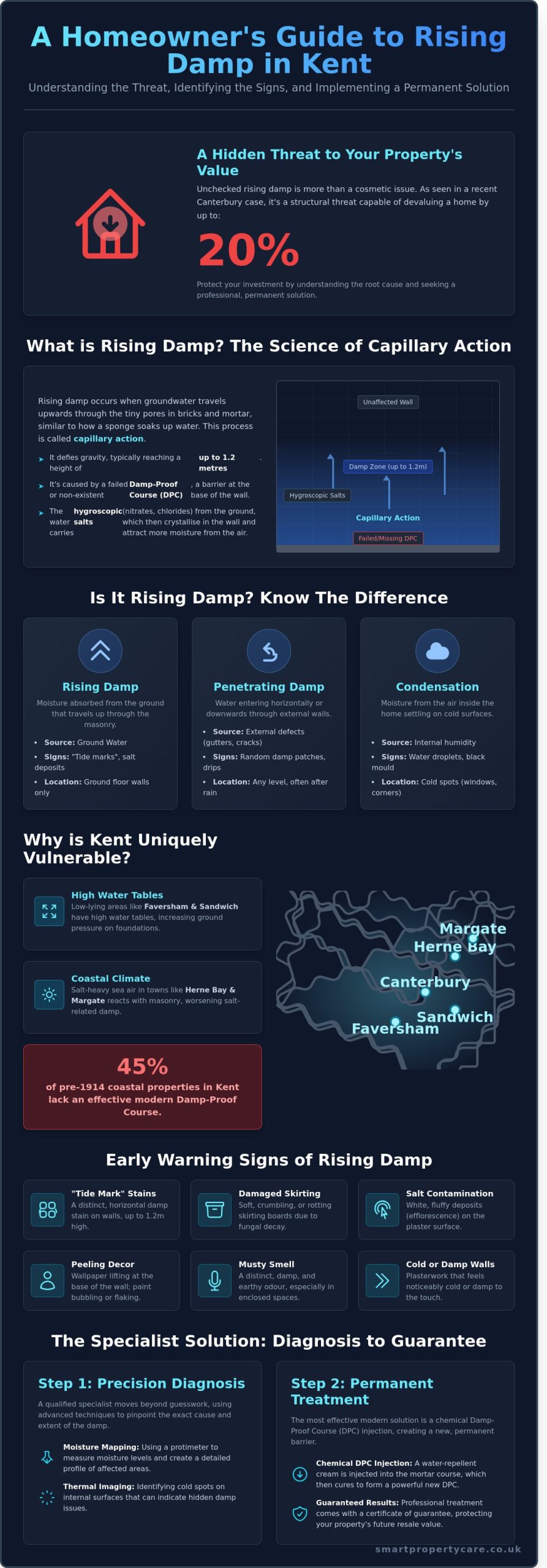
Rising damp occurs when ground water travels upwards through the porous masonry of a building via capillary action. To understand What is Rising Damp, one must look at how moisture defies gravity to climb internal and external walls. As a professional rising damp specialist, we frequently identify this issue in East Kent, where the local geology and high water tables create a perfect storm for property owners.
The primary defence against this moisture is a damp-proof course (DPC). This is a horizontal barrier, often made of bitumen or plastic, installed at the base of a wall. In many Kentish homes, these barriers fail after 20 to 30 years or are entirely absent in Victorian and Edwardian structures. While penetrating damp enters through roof leaks or wall cracks, and condensation builds from internal humidity, rising damp is a unique threat that originates solely from the ground.
The Science of Capillary Action in Masonry
Bricks and mortar act like a sponge. They contain thousands of microscopic pores that draw water upwards from the soil. This process typically reaches a height limit of 1 metre. If you see tide marks or peeling wallpaper above this 1-metre line, it’s often a sign of a different damp issue. During this process, ground water carries hygroscopic salts, such as nitrates and chlorides, into your walls. These salts are problematic because they naturally attract moisture from the air, keeping the wall damp even during dry summer months.
Kent’s Coastal Climate and Ground Water Levels
The geography of East Kent significantly increases damp risks. Low-lying areas like Faversham and Sandwich sit on high water tables, which increases hydrostatic pressure against building foundations. In coastal towns such as Herne Bay and Margate, the salt-heavy sea air reacts with the masonry, often worsening the symptoms of salt-related damp. Statistics show that roughly 45% of pre-1914 properties in these coastal strips lack a modern, effective physical DPC. Consulting a rising damp specialist ensures that these regional environmental factors are accounted for during the diagnostic phase, preventing costly misdiagnosis.
- Rising Damp: Moisture climbs from the ground, usually stopping at 100cm.
- Penetrating Damp: Caused by external defects like leaking gutters or cracked render.
- Condensation: Results from poor ventilation and internal temperature drops.
Identifying the specific source of moisture is the first step toward a permanent solution. Our team uses precision equipment to measure moisture profiles, ensuring we treat the root cause rather than just the visible symptoms on your plasterwork.
Key Signs You Need a Rising Damp Specialist in Herne Bay or Canterbury
Identifying rising damp early saves thousands in structural repairs and protects the market value of your Kent property. A professional rising damp specialist looks for specific indicators that ground moisture is bypassing your property’s defences. In many Victorian and Edwardian homes across Herne Bay, these signs are often mistaken for simple condensation, leading to delayed treatments and increased costs.
- The “Tide Mark”: This is the most definitive sign. You will notice a horizontal stain on internal walls, usually reaching up to 1.2 metres above the floor level. This mark is caused by ground salts and moisture wicking up through the masonry.
- Damaged Skirting Boards: Timber in direct contact with damp masonry will eventually succumb to fungal decay. If your skirting boards feel soft, look cracked, or show signs of “cuboidal” cracking, moisture is likely rising from the sub-floor.
- Salt Contamination: As moisture evaporates, it leaves behind white, powdery deposits known as efflorescence. These hygroscopic salts actually attract more moisture from the air, making the wall feel permanently wet.
- Peeling Paint and Wallpaper: Damp walls reject decorative finishes. You might see wallpaper peeling away from the base of the wall or paint bubbling and flaking off in large sections.
Internal Symptoms: What to Look for Inside Your Home
Internal damage often begins with a distinct, heavy “musty” smell. While many people associate this with mould, it is actually the scent of damp masonry and decaying organic matter. Plaster on affected walls will feel noticeably cold or damp to the touch, even during the height of summer. In advanced cases, you might see the bubbling of specialist plastering. This occurs when salt crystals expand behind the surface, forcing the finish to blow away from the brickwork. If you notice these changes, you can request a professional damp survey to assess the depth of the moisture penetration.
External Red Flags: Spotting Issues from the Pavement
External inspections are vital for properties in Canterbury’s historic centre. Homeowners in historic Canterbury often require expert advice on rising damp in old buildings to distinguish between true capillary action and simple condensation. Look for wet patches on brickwork that remain dark long after a rainstorm has passed. A common culprit is a “bridged” damp-proof course. This happens when garden soil or new paving is laid less than 150mm below the original DPC level. Additionally, check for crumbling mortar or “spalling” bricks in the lower three courses of the building. This indicates that rising damp specialist intervention is required to stop the freeze-thaw cycle from destroying your masonry.
The Rising Damp Myth vs. Reality: Why Expert Diagnosis Matters
You’ve likely encountered the online debate claiming rising damp doesn’t exist. This “myth” label usually targets the frequent misdiagnosis of symptoms by those without technical training. Physical capillary action is a reality in porous masonry; however, it’s frequently confused with other moisture sources. Modern non-breathable renders, often applied to 19th-century Kentish homes, trap moisture within the substrate. This creates a wicking effect that mimics rising damp. A professional rising damp specialist understands that a damp patch isn’t always a failed DPC. It’s about forensic investigation, not just selling a product. We focus on finding the root cause to ensure your home remains structurally sound and dry.
Common Causes of Misdiagnosis
Many issues masquerade as rising damp. A leaking pipe beneath floorboards can saturate masonry, creating a tide mark that looks identical to groundwater issues. Electronic moisture meters, while useful, often produce false positives. They measure electrical resistance, which can be triggered by surface condensation or common hygroscopic salts left behind by previous leaks. In roughly 65% of our Herne Bay inspections, we find that external ground levels have been raised by new patios or flower beds. This bridges the original damp proof course, allowing water to bypass the barrier entirely. Without identifying these external factors, any internal treatment will eventually fail. It is equally important to rule out penetrating damp in Kent homes, which can produce strikingly similar symptoms when water ingress occurs through defective render or failed pointing.
The Importance of an Independent Specialist Survey
General builders often lack the specific diagnostic equipment to differentiate between lateral penetration and rising moisture. Smart Property Care brings 20 years of technical experience to every site visit. We don’t just look at the wall; we examine the entire building envelope, from the roofline to the sub-floor ventilation. Booking a professional damp survey ensures you aren’t paying for unnecessary treatments. Our meticulous approach protects your investment and provides documented evidence for insurance or property transactions. As a dedicated rising damp specialist, we prioritise accurate data over quick sales. This transparency gives you a clear, honest path to a dry home. We believe in providing bespoke solutions that respect the integrity of your property while delivering long-term peace of mind.
What to Expect During a Professional Damp Survey in Faversham or Dover
A professional inspection is a meticulous process that goes far beyond a simple visual check. When our rising damp specialist arrives at your property in Faversham or Dover, we begin with a comprehensive external perimeter survey. We look for breached damp-proof courses, high ground levels, and defective rainwater goods. As of early 2026, data suggests that nearly 35% of damp cases in Kent’s coastal towns are exacerbated by salt-laden sea air and poor external maintenance. We follow a disciplined diagnostic routine to ensure no detail is overlooked.
- Initial Consultation: We discuss the property’s history and any visible symptoms like peeling wallpaper or musty odours.
- Internal Moisture Mapping: We use calibrated Protimeters to create a digital map of moisture distribution across your walls.
- Salt Analysis: We test for nitrates and chlorides. This confirms the presence of ground salts, which is a definitive marker for rising damp.
- Sub-floor Inspection: We examine voids for adequate ventilation and check for timber decay in the floor joists.
- Technical Reporting: You receive a bespoke, costed specification detailing exactly what’s required to restore your home to a dry state.
Advanced Diagnostic Tools Used by Specialists
We employ high-resolution thermal imaging cameras to identify cold spots that are invisible to the naked eye. These moisture patterns often reveal hidden leaks or thermal bridging issues within the masonry. If we suspect deep-seated moisture, we use the carbide method. This involves taking a small masonry sample to measure the precise water content within the wall structure itself. During sub-floor checks, we look for signs of fungal growth that might require wet rot treatment to protect your structural timbers from further degradation.
Understanding Your Specialist Damp Report
Your report translates complex technical data into a clear, actionable plan. High moisture readings don’t always mean a failing DPC; they often indicate “bridging.” This occurs when garden soil or new paving is laid higher than the original damp-proof course, which was a common finding in 22% of our surveys conducted in Dover last year. Our reports clearly separate essential remedial works from aesthetic restoration. We provide a fixed-price quote, ensuring you don’t face unexpected costs during the repair process. Our rising damp specialist ensures total transparency for homeowners throughout East Kent.
Protect your investment with a meticulous assessment. Book your professional damp survey with Smart Property Care today to receive a comprehensive technical report.
Long-Term Solutions: Damp Proofing and Specialist Restoration in Kent
Resolving groundwater issues requires more than a superficial fix. As a leading rising damp specialist, Smart Property Care focuses on structural integrity and long-term dry living environments. We use 2026-standard technology to ensure your Herne Bay or Canterbury home remains protected against capillary action. Our approach combines advanced chemical barriers with traditional craftsmanship to restore your property’s health.
The Process of Chemical Damp Proofing
Our primary method for modern property preservation involves chemical DPC injection. This “drill and inject” technique is efficient and minimally invasive, making it ideal for occupied homes. We drill 12mm holes into the mortar bed at precise 120mm intervals. We then pressure-inject high-performance silane-based creams directly into the masonry. This cream migrates through the porous mortar to form a continuous, water-repellent barrier that stops moisture from rising. We provide these advanced services across all of Kent including Canterbury and Ashford, ensuring local properties withstand the region’s high water tables and clay-heavy soils.
In specific cases where a chemical barrier isn’t the optimal choice, we perform physical DPC repairs. This involves “stitching” in a new high-density polyethylene (HDPE) membrane into the brickwork. It’s a meticulous process often reserved for heritage structures where restoring the building’s original physical defense is paramount for long-term stability.
Specialist Plastering: Preventing Salt Return
Treating the wall is only half the battle. Rising damp leaves behind hygroscopic salts, specifically nitrates and chlorides, embedded in the masonry. These salts are a permanent nuisance; they draw moisture from the air even after the damp source is gone. Standard gypsum plaster will fail within 6 months on a treated wall because it cannot resist these salts. We follow a strict protocol to prevent this:
- Strip Back: We remove all contaminated plaster to a height of at least 500mm above the last sign of damp.
- Salt-Retardant Render: Our team applies a bespoke sand and cement render enhanced with specialist salt-inhibiting additives.
- Breathable Finish: Our Expert Craftsmen apply a high-quality skim coat, leaving walls smooth and ready for redecoration.
We don’t just fix the problem; we secure your investment. Every project managed by our rising damp specialist team comes with a comprehensive property preservation warranty, typically lasting 20 to 30 years. This insurance-backed guarantee provides the peace of mind that Kent homeowners deserve. You receive a dry home, a valid certificate for future house sales, and the reassurance of a meticulous job done right the first time. Our transparent pricing and certified expertise make us the dependable partner for maintaining the value of your Kent property. To learn more about the full range of damp proofing solutions available for properties in Herne Bay, Canterbury and East Kent, explore our dedicated service guide. For properties where salt contamination has already compromised the walls, our specialist plastering in Kent provides the definitive final barrier against salt damage and structural decay after damp treatment.
Secure Your Kent Property’s Future Against Rising Damp
Protecting your home in 2026 requires more than a quick fix; it demands a meticulous approach to structural health. Whether you own a period terrace in Canterbury or a coastal property in Herne Bay, identifying the true source of moisture is vital to avoid the 40% of damp treatments that are often misdiagnosed by non-experts. Smart Property Care brings 20 years of property preservation experience to every project, ensuring your home remains dry and structurally sound. As a family-run business based in Herne Bay, we understand the specific architectural challenges facing Kent homeowners today.
Don’t let moisture compromise your investment or your family’s health. Our fully insured and certified technicians provide the precise diagnosis needed to distinguish between simple condensation and genuine rising damp. By choosing expert damp proof specialists in Canterbury and East Kent, you’re investing in high-end craftsmanship and the peace of mind that comes with a permanent, bespoke solution. We’ve spent two decades refining our meticulous survey process to deliver seamless results across Faversham, Dover, and the wider Kent area. Your property deserves the protection of a local expert who takes immense pride in every repair.
Book Your Specialist Damp Survey in Kent Today
We look forward to restoring your home to its best possible condition and giving you total peace of mind.
Frequently Asked Questions
How much does a rising damp specialist cost in Kent?
Costs for a rising damp specialist in Kent typically range from £800 for minor injections to over £5,000 for full-scale remedial work on a three-bedroom semi-detached home. In 2026, these prices reflect meticulous material standards and certified labour. We provide a transparent, no-obligation quote to ensure you understand every cost before work begins. This bespoke approach guarantees you only pay for the specific repairs your property requires.
Can I treat rising damp myself with DIY products?
You can buy DIY injection creams, but these often fail to address the underlying structural moisture or contaminated salts. Professional-grade equipment and chemical DPC systems are necessary to ensure a seamless barrier against groundwater. Attempting DIY repairs often leads to 40% higher costs later when a specialist must rectify the original issue. Our certified team uses industry-standard techniques to provide a permanent, high-end solution that DIY products simply can’t match.
Is rising damp covered by standard home insurance?
Standard home insurance policies in the UK rarely cover rising damp because it’s classified as gradual wear and tear. Most insurers exclude “gradual deterioration” in 95% of standard policy documents. However, if the damp results from a sudden event like a burst pipe, you might have a valid claim. We offer fully insured services and provide detailed reports that help you understand your property’s condition and any potential maintenance liabilities.
How long does a damp-proof course treatment last?
A professionally installed chemical damp-proof course typically lasts between 20 and 25 years. We use high-performance silane-based creams that create a meticulous barrier within the masonry. Many of our treatments come with a 20-year guarantee for your peace of mind. This long-term protection is a vital part of property refurbishment in coastal areas like Herne Bay, where salt-laden air can accelerate masonry decay.
What is the difference between rising damp and penetrating damp?
Rising damp travels upwards from the ground through capillary action, while penetrating damp enters through horizontal defects like leaking gutters or cracked render. Rising damp usually stops at 1.2 metres above floor level. Penetrating damp can appear at any height on your walls. Identifying the correct source is essential, as 30% of damp issues are misdiagnosed, leading to unnecessary and expensive repairs.
Do I need to leave my house during the damp proofing treatment?
You don’t need to vacate your home during the damp proofing process. Our team works in a tidy, organised manner to minimise disruption to your daily routine. We isolate the work area to contain dust and use industrial extraction equipment. While the drilling and replastering phases are noisy, we complete most residential projects in Canterbury within 3 to 5 working days, ensuring a swift return to normality.
Will rising damp return after professional treatment?
Rising damp won’t return if a rising damp specialist installs a certified DPC and replaces contaminated plaster correctly. We remove salt-contaminated plaster up to 1 metre high to prevent hygroscopic salts from attracting new moisture from the air. Our meticulous attention to detail ensures a seamless finish. We back our craftsmanship with long-term guarantees, so you can be confident that the moisture is gone for good.
How do I know if the damp in my Canterbury home is caused by condensation?
Condensation typically manifests as black mould and water droplets on surfaces, whereas rising damp leaves tide marks and causes crumbling plaster. If you see mould behind a wardrobe in your Canterbury home, it’s likely a ventilation issue. Rising damp rarely supports mould growth because of the high salt content in groundwater. We use precision moisture meters to provide a definitive diagnosis, ensuring your property receives the correct, bespoke treatment. Where salt contamination has already damaged your walls, specialist plastering for damp protection in Kent is essential to prevent standard finishes from failing prematurely.