
Is that hairline crack in your Canterbury terrace a minor settling issue or a £15,000 threat to your home’s foundation? For many homeowners across Kent, spotting a new fissure above a door frame triggers immediate anxiety about escalating costs and property devaluation. It’s a common concern, especially when 1 in 5 older properties in the South East requires some form of professional intervention to maintain its integrity. You deserve the peace of mind that comes from knowing your biggest investment is secure. We’ll help you address the complexities of structural repairs with the expertise of Smart Property Care Ltd, your local, family-run specialist.
You probably believe that your home should be your sanctuary, not a source of constant worry about subsidence or shifting walls. We agree that clarity is the best remedy for property stress. In this article, you’ll discover how to accurately identify, assess, and resolve structural issues to safeguard your Kent home’s value and safety. We’ll provide a clear overview of common Kentish soil problems, the latest reinforcement technologies, and the essential certification process that ensures a smooth sale when you eventually decide to move on.
Key Takeaways
- Learn how to distinguish between minor cosmetic cracks and deep-seated movement to safeguard your property’s long-term load-bearing capacity.
- Understand how Kent-specific environmental factors, such as London Clay and coastal erosion, necessitate specialist structural repairs to maintain market value.
- Discover the critical link between damp and timber decay, and why ignoring moisture ingress can lead to masonry spalling and structural failure.
- Explore non-disruptive, modern reinforcement techniques like crack stitching that provide a meticulous, ‘invisible’ alternative to traditional underpinning.
- Find out what to expect during a professional inspection and how a costed specification helps secure approval from mortgage lenders and insurers.
Understanding Structural Repairs: Why Integrity Matters for Kent Homes
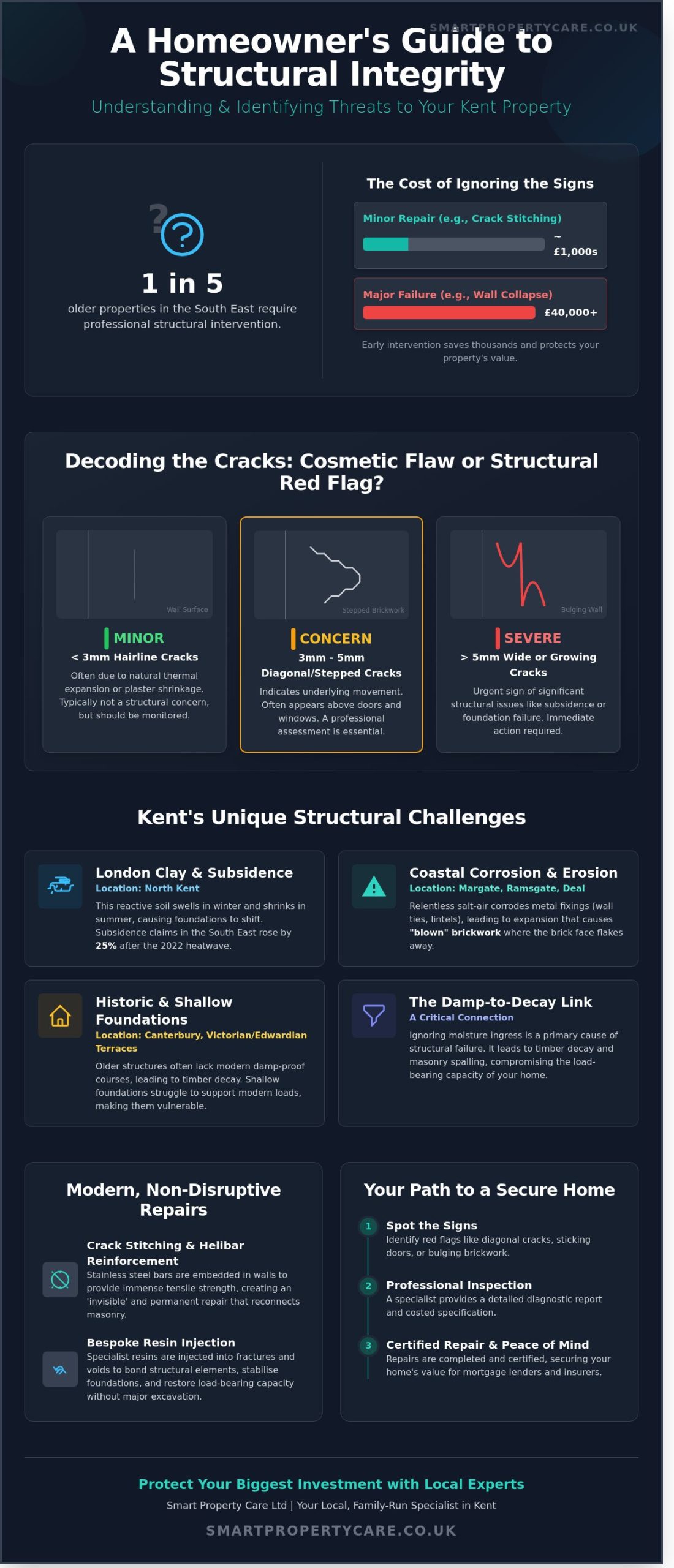
Structural repairs represent the critical interventions required to restore or reinforce the load-bearing capacity of a building. It’s vital to distinguish between minor cosmetic hairline cracks and deep-seated structural movement that threatens the building’s core. While 1mm cracks often result from natural thermal expansion, fissures exceeding 3mm or those following a stepped pattern through brickwork usually indicate a more serious underlying issue. Ignoring these signs leads to catastrophic results, including total wall failure or roof collapse, which can escalate repair bills from a few thousand pounds to over £40,000.
In the UK property market, structural integrity is a primary focus for RICS surveyors and mortgage lenders. A property showing signs of Understanding Structural Settlement will often be flagged as a high-risk asset. This can lead to mortgage retentions where lenders withhold 10% to 20% of the loan until the structural repairs are certified as complete. Ensuring your home is stable isn’t just about safety; it’s a financial necessity that protects your property’s market value and ensures you remain fully insured.
The Role of the Expert Craftsman in Property Preservation
Smart Property Care leverages 20 years of hands-on experience to protect Kent’s diverse architectural landscape. We believe that property preservation requires a sophisticated blend of modern technology and traditional building skills. We use bespoke resin injection and helibar masonry reinforcement alongside meticulous brick matching to ensure every repair is invisible. As a family-run business, we offer a personal touch that ensures peace of mind. Our team is fully insured and provides a transparent, professional service that prioritises the long-term health of your home over quick, temporary fixes.
When to Call a Structural Specialist in Herne Bay or Canterbury
Homeowners in coastal areas like Herne Bay or historic centres like Canterbury must remain vigilant for specific red flags. If you notice diagonal cracks above window frames, bulging external brickwork, or doors that suddenly stick, it’s time to act. A general builder might suggest a cosmetic patch, but a property preservation specialist identifies the root cause of the movement. We recommend a professional structural survey as the essential first step. This provides a detailed diagnostic report, allowing us to implement structural repairs that are both effective and permanent. Our seamless process takes you from initial concern to a fully certified, stable home.
Identifying Common Structural Issues in East Kent Properties
Properties across East Kent face a unique set of geological and historical challenges that dictate the health of their foundations. In North Kent, the presence of London Clay is a primary concern for homeowners. This specific soil type is highly reactive to moisture; it swells during wet winters and shrinks during dry summers. Following the record-breaking temperatures of 2022, subsidence claims in the South East rose by 25 percent as the clay subsoil dehydrated and shifted.
Coastal towns such as Margate, Ramsgate, and Deal encounter a different set of obstacles. The relentless salt-air environment accelerates the corrosion of metal fixings within masonry. This often leads to “blown” brickwork where internal expansion forces the face of the brick to flake away. In Canterbury, the architectural legacy of timber-framed buildings and medieval foundations creates distinct vulnerabilities. These older structures often lack the damp-proof courses found in modern builds, leading to timber decay that compromises load-bearing capacity. Victorian and Edwardian terraces, which dominate much of East Kent’s urban landscape, were frequently built with shallow foundations that struggle to support modern internal modifications.
Subsidence and Heave: The Kent Geological Factor
Fluctuating water tables across the county directly impact foundation stability. In Ashford and Sittingbourne, mature tree roots in close proximity to residential streets often exacerbate these issues. A single mature oak can transpire hundreds of litres of water daily, causing the soil to collapse and foundations to drop. Homeowners should look for diagonal cracks that are wider than 3mm, especially those that are visible on both internal and external walls. If you spot these signs, it’s vital to seek a professional structural assessment to determine the rate of movement.
Cavity Wall Tie Failure: A Hidden Danger
Wall ties are the essential metal connectors that bind the internal and external leaves of a cavity wall. In maritime climates like Whitstable, the high salt content in the air penetrates porous mortar and causes these ties to rust. As the metal oxidises, it expands to several times its original size. Properties built between 1930 and 1970 are at the highest risk because the galvanisation standards of that era were often insufficient for coastal exposure. The most common symptom is a series of horizontal cracks appearing in the mortar joints at regular intervals.
Lintel Failure and Masonry Cracking
Lintels serve as the horizontal beams that support the weight of the wall above windows and doors. In the historic quarters of Faversham, many older properties rely on timber or early concrete lintels that have reached the end of their functional life. When these components fail, you’ll often see “stepped” cracking in the masonry or a visible sag in the window frame. Any structural repairs involving these elements must strictly adhere to Building Regulations for repairs to ensure the property remains legally compliant and structurally sound. Cracks usually follow the path of least resistance, meaning they’ll appear first around openings where the building envelope is naturally at its weakest.
The Critical Link Between Damp, Timber Decay, and Structural Failure
Many Kent homeowners dismiss a damp patch as a cosmetic annoyance. This is a costly mistake. Moisture is the primary catalyst for structural failure in traditional brick properties. When water ingress is left unaddressed, it triggers a chemical and physical degradation of the building fabric. Water weakens mortar joints through a process of leaching, eventually leading to masonry spalling where the brick face flakes away. In a 2024 study of period properties in Tunbridge Wells, masonry strength was found to decrease by up to 15% when saturation levels remained above 20% for more than two years. Structural repairs often become inevitable when these early warning signs are ignored.
A holistic approach to property preservation is the only way to ensure long term stability. Isolated masonry repair is often a temporary fix if the moisture source remains active. We treat the building as a single, breathing organism. This means addressing the roof leaks, gutter failures, or ground-level issues before reinforcing the walls. Our meticulous process ensures that once the structural integrity is restored, it stays that way. We provide the following solutions to stop the cycle of decay:
- Comprehensive moisture mapping to locate hidden leaks.
- Wall tie replacement where corrosion has occurred due to damp.
- Re-pointing with breathable lime mortars to allow moisture escape.
- Installation of lateral restraints to stabilise bowing walls.
Timber Decay: When Rot Becomes a Structural Threat
Dry rot is a silent destroyer of Kentish homes. This fungus, Serpula lacrymans, can reduce the weight and strength of a floor joist by 50% within just six months. Effective dry rot treatment is essential to prevent a total floor collapse. In many Kentish roof voids, woodworm infestations also go unnoticed until the rafters become brittle. We assess whether timber needs a full replacement or if chemical reinforcement is sufficient. For historic beams, we often use resin injection techniques to restore strength without losing the original character of the property.
Rising Damp and Masonry Integrity
Rising damp introduces ground salts like nitrates and chlorides into your walls. These salts are hygroscopic, meaning they pull moisture from the air, keeping the brickwork permanently wet. This corrosive environment eats away at the mortar bed, leading to a loss of structural cohesion. Professional damp proofing Kent is your first line of defence against this slow-motion collapse. Following the installation of a damp proof course, we use specialist salt-retardant plastering. This isn’t just for aesthetics; it restores the structural skin of the wall and prevents further salt migration from compromising the structural repairs performed on the masonry.
Modern Structural Repair Techniques: From Crack Stitching to Timber Resin
Modern engineering has transformed how we approach property stabilisation. Historically, fixing a subsiding wall meant massive excavations and disruptive underpinning. Today, we utilise “invisible” reinforcement methods that target the root cause without stripping a building to its foundations. These structural repairs rely on high-performance stainless steel and advanced chemical anchors to restore integrity. By using CE-marked materials, we ensure every intervention meets BS EN 845-1 standards, providing homeowners with a 50-year design life and the peace of mind that comes with insurance-backed guarantees.
The shift towards non-disruptive technology means we can often complete works in a fraction of the time required by traditional methods. We focus on precision. Whether it is reinforcing a bowed wall or securing a failing lintel, the goal is a seamless finish that preserves the building’s original character while exceeding modern safety requirements.
Crack Stitching: The Helifix Method
We solve masonry cracking by installing stainless steel helical bars into the existing bed joints. This process, often referred to as the Helifix method, involves cutting precise slots and bonding the bars with high-strength thixotropic resin. It effectively “stitches” the brickwork back together, redistributing structural loads across the wall. This technique is particularly vital for preserving Kentish brickwork, as it requires no unsightly external plates and allows the building to remain aesthetically untouched after repointing.
Cavity Wall Tie Replacement
Coastal properties in Dover and Deal are frequently susceptible to wall tie corrosion due to salt-laden air. We use 10mm borescope cameras to inspect the cavity health with minimal intrusion. If the original mild steel ties have expanded or failed, we isolate them to prevent further masonry damage and install new 316-grade stainless steel ties. This meticulous approach ensures the inner and outer leaves of your home remain securely bonded for decades, even in harsh maritime environments.
Timber Resin Repairs and Joist Strengthening
Historical Kentish homes often suffer from decayed beam ends where timber meets damp masonry. Rather than replacing entire structural beams, we use high-strength epoxy resins to bond new timber sections to the healthy original wood. This bespoke refurbishment technique maintains the structural capacity of the floor or roof while saving significant costs on materials. These specialist structural repairs integrate perfectly with our mould remediation strategies, ensuring that the underlying damp issues are resolved before the timber is reinforced.
Reliability is the cornerstone of our service. If you have noticed stepped cracking or sagging floorboards, acting quickly prevents minor faults from becoming major liabilities. Secure your property’s future by requesting a comprehensive structural assessment from our expert Kent team today.
Professional Structural Surveys and Remediation in Herne Bay and Margate
Homeowners in Herne Bay and Margate face unique challenges due to the coastal geology and historical building methods prevalent in East Kent. Addressing structural repairs requires more than just technical skill; it demands a deep understanding of local planning requirements and the 2010 Building Regulations. At Smart Property Care, we provide a costed specification that serves as a vital document for mortgage lenders and insurers. Most major UK lenders, including Lloyds and Nationwide, require this level of detail before approving equity release or property transfers on homes with known defects. Our meticulous site management ensures that every project stays on track, maintaining 100% compliance with health and safety standards while protecting your investment.
The Smart Property Care Survey Process
Our process is designed for clarity and speed, moving from your initial enquiry to a comprehensive technical report within 48 hours of the site visit. We don’t rely on guesswork. Our team utilises advanced diagnostic tools, such as Protimeter moisture meters and FLIR thermal imaging cameras, to identify hidden triggers like subterranean leaks or cold bridging. These issues often go unnoticed until they cause significant masonry cracking or timber decay. As a family-run business with a 20-year reputation in Kent, we prioritise transparent pricing. You’ll receive a fixed-price breakdown that eliminates the “hidden extras” often associated with traditional building firms. This disciplined approach provides the peace of mind you need when your home’s stability is at stake.
Restoring Your Property’s Value and Aesthetic
A structural fix is only half the job. To truly protect your property’s market value, the final finish must be flawless. We specialise in high-end plastering and rendering services that ensure your structural repairs are completely invisible to the naked eye. Whether we’re working on a Victorian terrace in Margate or a modern detached home in Herne Bay, our craftsmen match existing textures and finishes with precision. We treat your home with the respect it deserves, maintaining a clean and organised site throughout the remediation programme. Our goal is to leave your space transformed and structurally sound, removing the stress of property maintenance.
Don’t let structural concerns devalue your home or stall a potential sale. Contact the Smart Property Care team today to book your no-obligation survey in Kent. Our expert craftsmen are ready to provide the bespoke solutions and technical excellence your property requires.
Secure the Future of Your Kent Property Today
Protecting your home’s long-term value requires proactive maintenance and expert intervention. We’ve detailed how identifying early warning signs like masonry cracks or timber decay prevents minor issues from becoming costly disasters. By utilising modern techniques such as crack stitching and timber resin remediation, you ensure your building remains safe and stable for decades. Smart Property Care brings 20+ years of Kent property preservation experience to every project. As a family-run business, we pride ourselves on meticulous craftsmanship and deep local expertise across East Kent. We’re fully insured and dedicated to providing seamless, professional solutions for homeowners in Canterbury, Herne Bay, and Margate. Don’t let structural concerns compromise your peace of mind or your investment. Our team delivers authoritative surveys and robust structural repairs that stand the test of time. Take the first step toward a secure, worry-free property by contacting our specialists for a comprehensive assessment.
Book Your Professional Structural Survey in Kent Today
We’re ready to help you restore your property’s integrity with the care and precision it deserves.
Frequently Asked Questions
How much do structural repairs typically cost in Kent?
Minor structural repairs in Kent typically range from £500 to £2,500 for localized masonry reinforcement and crack stitching. If your property requires extensive underpinning due to subsidence, costs can escalate to between £12,000 and £25,000 depending on the building size. We provide transparent pricing and a free, no-obligation quote to ensure you understand the exact investment required for your specific property.
Will structural repairs be covered by my home insurance?
Most comprehensive home insurance policies cover structural work caused by subsidence, heave, or landslip. You’ll typically be responsible for a standard insurance excess of £1,000 for these specific claims. However, insurers won’t pay for repairs resulting from general wear and tear or poor maintenance. We recommend reviewing your policy documents or contacting your provider to confirm your coverage level before starting work.
How can I tell if a crack in my wall is serious?
A crack is generally considered serious if it’s wider than 3mm or follows a stepped diagonal pattern through the brickwork. You should also look for cracks that are wider at the top than the bottom, as this indicates active foundation movement. If you can see daylight through the gap or if doors and windows have started sticking, it’s time to call a certified professional for a meticulous inspection.
How long do structural repairs like crack stitching take?
Standard crack stitching for a single elevation typically takes between 1 and 3 days to complete. Our team works efficiently to install stainless steel helical bars and high-strength grout with minimal disruption to your daily routine. For more complex structural repairs involving multiple walls or internal bracing, the timeline may extend to 10 working days. We always provide a clear schedule of works before we begin.
Do I need to move out of my house during structural repairs?
You won’t usually need to move out of your home during the repair process. We’ve designed our methods to be non-intrusive, allowing 95% of our clients to remain in residence while we work. If the project involves significant internal floor removal or major underpinning, we’ll discuss any necessary access requirements well in advance. Our goal is to provide a seamless service that restores your peace of mind without uprooting your life.
What causes structural movement in coastal towns like Herne Bay?
Structural movement in Herne Bay is frequently caused by the high concentration of London Clay, which shrinks and swells with seasonal moisture changes. This clay shrinkage accounts for roughly 75% of subsidence cases across the South East. Coastal properties also face unique challenges from salt-air corrosion of wall ties and the gradual impact of coastal erosion on local water tables, which can destabilise older foundations.
Can I sell my house after it has had structural repairs?
You can absolutely sell your house after structural repairs, provided the work is backed by professional certification and a long-term guarantee. We provide a 10-year insurance-backed guarantee on our structural work, which gives prospective buyers and mortgage lenders the confidence they need. In many cases, a fully repaired and certified property is easier to sell than one with visible, unaddressed defects that frighten off surveyors.
What is the difference between underpinning and crack stitching?
Underpinning involves strengthening the foundations of a building by extending them deeper into the ground, often 1 or 2 metres below the surface. Crack stitching is a less invasive masonry reinforcement technique that uses stainless steel bars to knit fractured walls back together. While underpinning addresses the root cause of ground movement, crack stitching restores the physical integrity and aesthetic appearance of the brickwork itself.